
The Real 1 Carat Diamond Ring Cost A Buyer's Guide
- Luke Zucco
- Jan 15
- 13 min read

Ever wondered about the real 1 carat diamond ring cost? It’s not one simple number. The price tag can swing from around $2,500 to over $20,000, and that massive gap comes down to a few critical details. Getting a handle on what drives these prices is your first step to finding a stunning ring that feels right for your budget.
What Drives the Price of a 1 Carat Diamond Ring
Let's start with a core idea: not all one-carat diamonds are created equal. Think of it like buying a car. Two cars might share the same engine size, but the sticker price will be worlds apart based on the model, features, and performance. A diamond’s quality characteristics are its "features," and they're what ultimately determine its value.
The diamond's quality grades are the biggest drivers, but the shape you choose also plays a surprisingly big role. Each element stacks up to create thousands of possible price points for what seems like the "same" one-carat stone.
Key Factors Influencing Cost
The 4Cs: Cut, Color, Clarity, and Carat weight are the universal standards used to grade a diamond. Even a tiny shift in one of these grades can move the price by hundreds or even thousands of dollars.
Diamond Shape: The classic round brilliant is the most popular and, you guessed it, often the most expensive shape. On the other hand, fancy shapes like oval, cushion, or princess cuts can give you more bang for your buck and even look larger for the same carat weight.
Market Dynamics: Just like any valuable commodity, diamond prices aren't static. They move with supply, demand, and broader economic trends.
A quick look at current market data shows just how wide this price diversity is. An analysis from StoneAlgo's Diamond Price Index, which tracks over 161,000 live diamond listings, puts the average price for a 1-carat diamond ring around $4,336. But that average hides a huge range, from as low as $1,114 to a peak of $10,780, all depending on its specific qualities.
A 1-carat round diamond—the most sought-after shape—currently averages $5,045 per carat, while an elegant oval cut is more budget-friendly at an average of $4,195.
This shows how your choice of shape directly impacts the final cost, giving you a powerful way to manage your budget right from the start.
Average Cost of a 1 Carat Diamond by Shape
Speaking of shape, it's one of the first and most impactful decisions you'll make. A diamond's shape not only defines its style but also influences how much raw diamond is lost during the cutting process, which directly affects its price.
The table below breaks down the average market prices for different 1-carat diamond shapes. It’s a great starting point for seeing how your favorite style lines up with your budget.
Diamond Shape | Average Cost (USD) | Recent Price Trend |
|---|---|---|
Round Brilliant | $5,045 | Stable |
Oval | $4,195 | Increasing |
Cushion | $3,580 | Stable |
Princess | $3,150 | Decreasing |
Emerald | $3,650 | Stable |
Pear | $3,880 | Increasing |
Marquise | $3,620 | Stable |
As you can see, opting for a shape other than the classic round can unlock significant savings. A princess or cushion cut, for example, can save you over 30% compared to a round diamond of the same carat weight and similar quality. It’s a savvy move that lets you either save money or put those funds toward a better color or clarity grade.
How the 4Cs Control Your Diamond's Price
If you want to get smart about the 1 carat diamond ring cost, the 4Cs are where you start. Don't think of them as dry, technical terms. Instead, see them as four levers you can pull to find that perfect sweet spot between a diamond’s beauty and your budget. Each "C"—Cut, Color, Clarity, and Carat—plays a huge role in what you ultimately pay.
Let’s kick things off with what most experts agree is the most important C of all: Cut. This isn’t about the diamond's shape (like round or oval), but how well its facets are angled and arranged to handle light.
Think of a diamond's cut like a perfectly crafted prism. A poorly cut diamond lets light leak out the sides and bottom, leaving it looking dull and lifeless. But a masterfully cut stone? It grabs every bit of light and shoots it back out in a dazzling explosion of sparkle and fire. That's why a diamond with an "Excellent" or "Ideal" cut grade costs more—it’s the single biggest factor behind that jaw-dropping brilliance.
Breaking Down Color and Clarity
Next up is Color. The Gemological Institute of America (GIA) grades diamond color from D (totally colorless) to Z (a noticeable yellow or brown tint).
Picture a glass of water. A D-color diamond is like pure, icy spring water—absolutely clear. As you move down the scale, you get a faint, warm hint of color. While a perfectly colorless diamond is the rarest and most expensive, you can find incredible value in the G-I range. To the naked eye, these diamonds look fantastic, but they come with a much friendlier price tag.
Then there’s Clarity, which is all about the tiny imperfections inside (inclusions) or on the surface (blemishes) of the diamond. Think of it like looking through a window. A flawless diamond is a perfectly clean, smudge-free pane of glass. Lower clarity grades have microscopic "specks" that are often impossible to see without a jeweler's loupe.
This is a huge opportunity to save money. Diamonds with grades like VS1 (Very Slightly Included) or even SI1 (Slightly Included) can be "eye-clean," meaning their flaws are invisible to the naked eye. You get a stone that looks perfect without paying the premium for actual perfection.
This concept map shows you how all these factors work together to set the price.
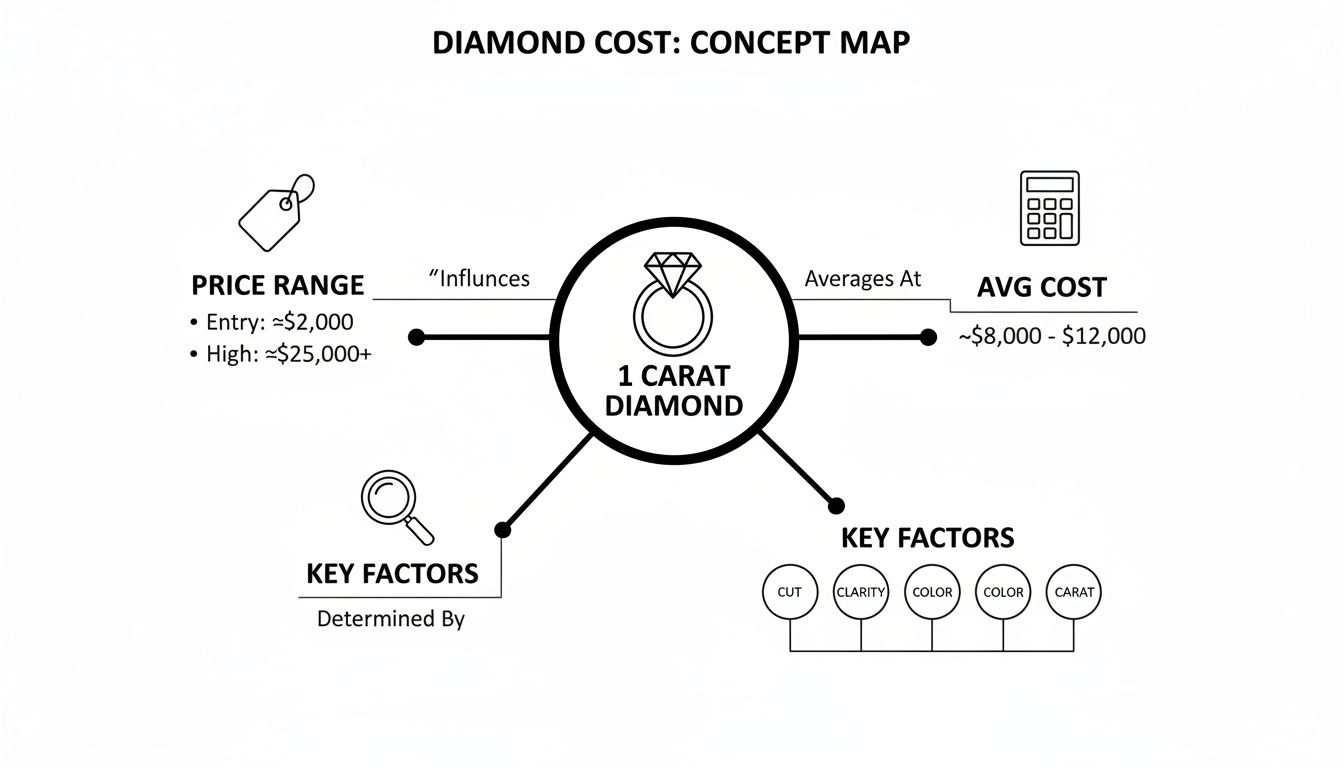
As you can see, the final cost is all about the trade-offs you make between these different quality grades.
The Carat Weight Magic Number
Finally, we have Carat. This is simply a measure of the diamond's weight, where one carat equals 200 milligrams. While it's true that heavier diamonds cost more, the price doesn't climb steadily. It jumps.
There are big price hikes at popular "magic numbers," especially the famous 1.0-carat mark. Here’s a pro tip: a diamond that weighs 0.95 carats can look almost identical to a 1.0-carat stone but cost 15-20% less. This is one of the smartest ways to stretch your budget without sacrificing visual size.
The dance between these four factors creates a massive price spectrum for a 1-carat diamond, anywhere from $2,500 to over $20,000 for just the stone. A top-of-the-line D color, Internally Flawless (IF) diamond will sit at that peak, but a beautiful SI2 clarity, K color diamond can be had for around $3,000.
This is where you, the shopper, have all the power. By learning to balance the 4Cs, you can find a diamond that fits your vision and your wallet perfectly. To really get a handle on these trade-offs, check out our smart shopper's guide to the 4 Cs of diamonds.
Uncovering the Hidden Costs in Your Ring Setting
While the diamond rightfully steals the spotlight, the ring setting is so much more than a supporting act. It’s a game-changer, shaping both the final look of your ring and the total 1 carat diamond ring cost. It's easy to overlook, but the setting's price can swing from a few hundred to several thousand dollars, so ignoring it can lead to a surprise at checkout.
Your first major decision here is the metal. Each option brings its own unique vibe, durability, and price tag to the table, forming the very foundation of your ring.
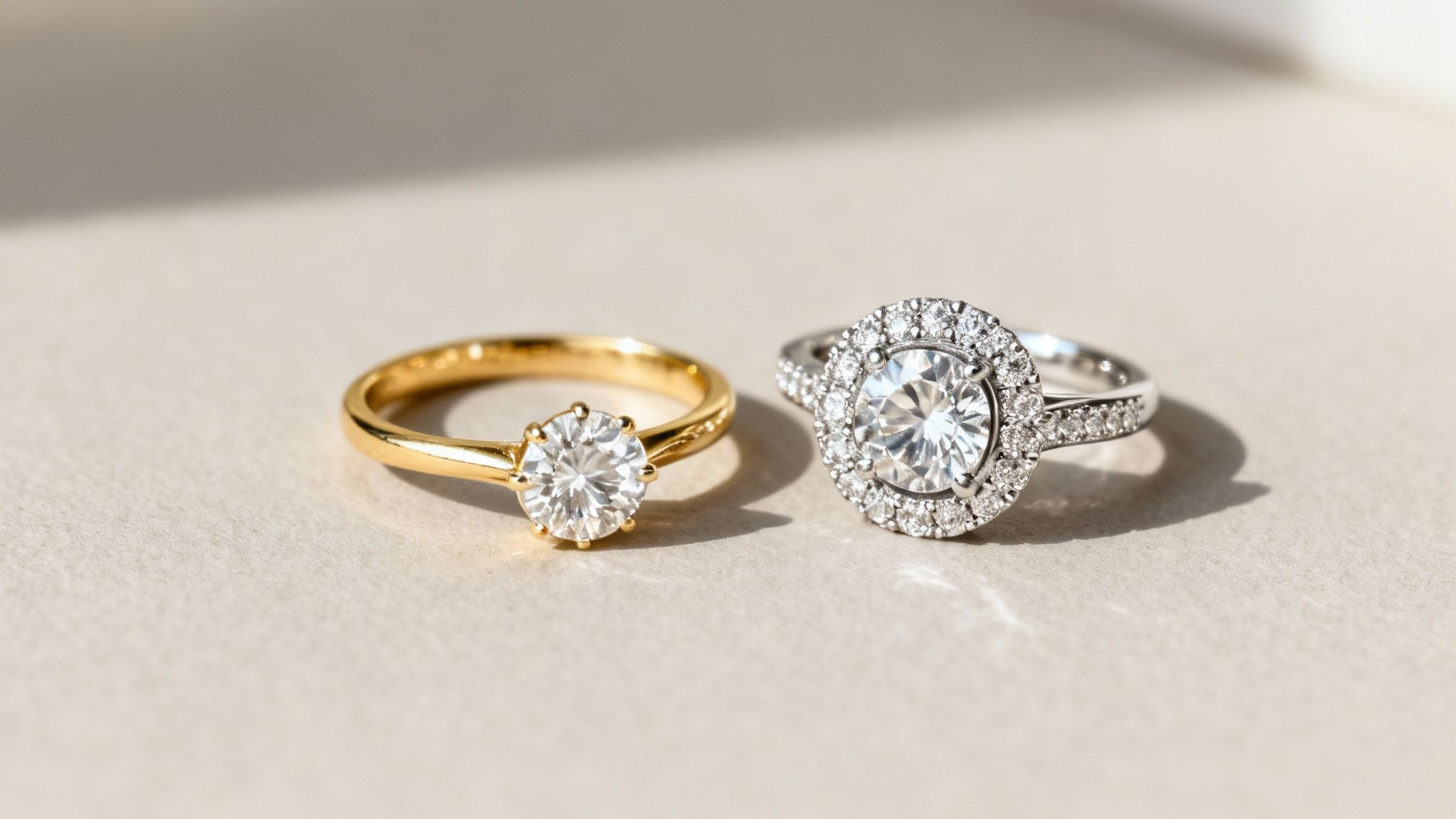
Comparing Popular Ring Metals
The two main contenders you’ll be looking at are platinum and gold, and each one has a totally different impact on your wallet. Knowing the difference is key to matching the ring to your budget and lifestyle.
Platinum: Famous for its bright, silvery-white shine and incredible toughness, platinum is the premium choice. It's naturally hypoallergenic and denser than gold, which gives it a satisfying, substantial feel on your finger. But that luxury comes at a cost—a platinum setting can easily run $500 to $1,000 more than a similar one in gold.
Gold (14k or 18k): Gold is where you find amazing versatility and value. 14k gold is a crowd favorite, striking a perfect balance between durability and price. If you want something a bit richer in color, 18k gold has a higher gold content, though it's also a touch softer. Both are fantastic, budget-friendly alternatives to platinum.
Think of your metal choice like a car's chassis. Gold is a reliable and stylish sedan that gets the job done beautifully. Platinum is the high-performance luxury model—pricier upfront but built for ultimate longevity.
The metal sets the stage, but it’s the complexity of the setting that can really make the cost climb.
How Setting Style Affects the Price
Beyond the metal, the intricacy of the design plays a huge role in the final price tag. A simple, elegant band just requires less labor and fewer materials than a design dripping with dozens of extra diamonds.
Here’s a practical breakdown of how style influences cost:
Simple Solitaire Setting: This is the timeless classic—a plain metal band that lets the center stone do all the talking. It's the most affordable route, usually adding $400 to $900 to the ring's total cost.
Pavé Setting: This style lines the band with tiny diamonds set closely together, creating a continuous, shimmering surface of sparkle. All those extra diamonds and the meticulous labor involved push the price up, often adding $1,200 to $2,000.
Halo Setting: A halo encircles the main diamond with a ring of smaller stones, a clever trick that makes the center stone look bigger while adding a ton of extra brilliance. This intricate style is one of the pricier options, easily adding $1,500 to over $2,500 to your budget.
Making an informed choice on the setting is crucial for keeping your overall spending in check. If you want to explore these styles in more detail, you can dive into a practical guide to engagement ring settings to find the perfect match for your stone and budget.
How Diamond Shape Influences Price and Appearance
When you’re thinking about a 1-carat diamond ring, the shape is so much more than a style choice. It’s actually one of the most powerful tools you have for controlling the final cost and the stone's visual impact. While everyone talks about carat weight, the diamond's shape plays a massive role in its price tag and, believe it or not, how big it actually looks on your finger.
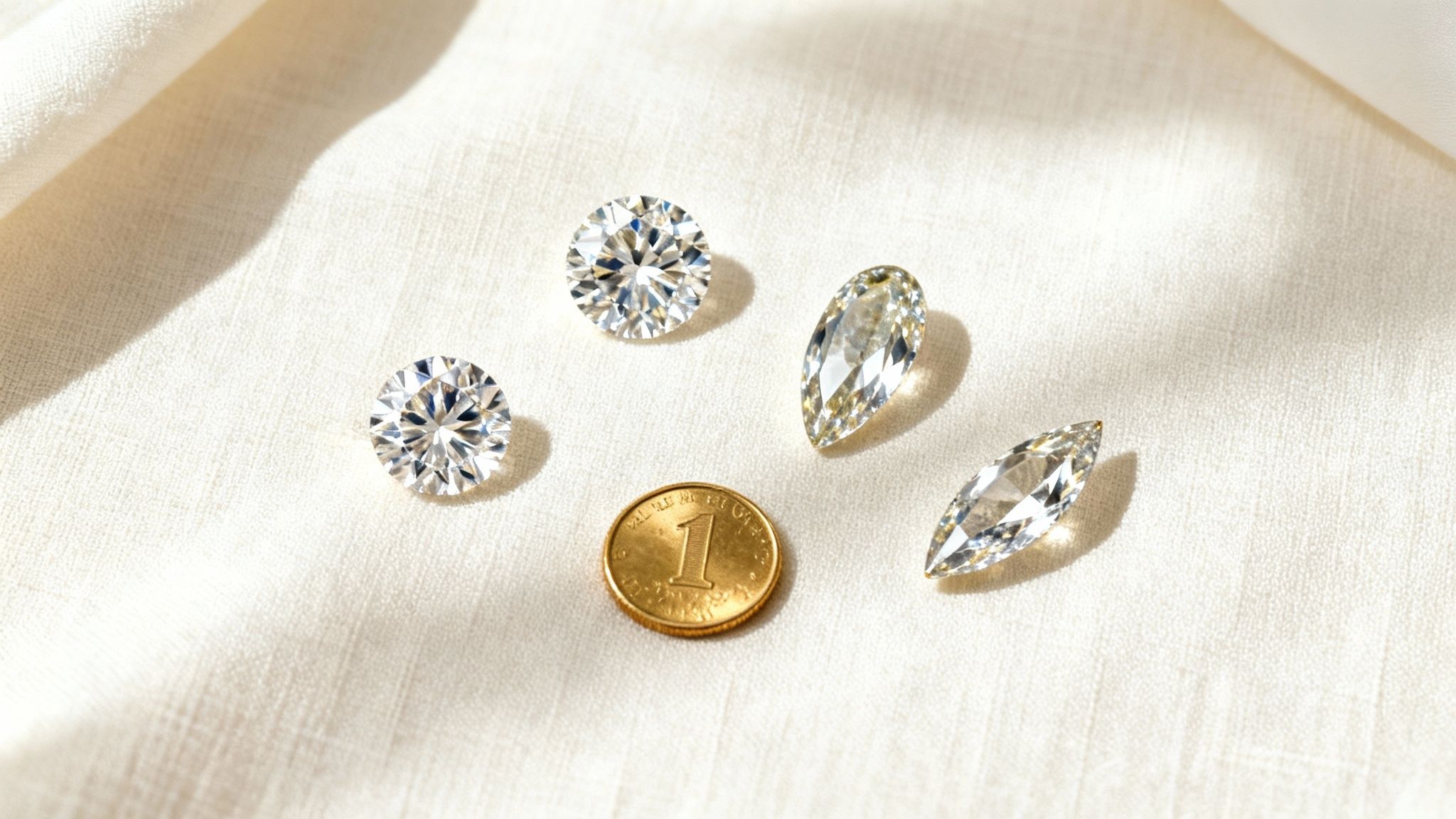
The undisputed king of the diamond world is the classic round brilliant. Its timeless appeal and incredible sparkle make it the go-to for a reason, but that popularity comes at a premium. To get that perfect, fiery circle, cutters often have to sacrifice over 50% of the original rough diamond. That waste makes it the most expensive shape per carat, hands down.
Why Fancy Shapes Offer Better Value
This is where "fancy shapes"—basically any cut that isn't a round brilliant—become your secret weapon for getting the most out of your budget. Shapes like oval, princess, and cushion aren't just unique; they're cut far more efficiently from the rough diamond. And that efficiency means a lower price for you.
For example, a 1 carat oval diamond can easily cost 15-25% less than a 1 carat round diamond of the exact same quality. That price difference is huge. It means you can either pocket the savings or reinvest it into a better color or clarity grade, essentially getting a more beautiful diamond for your money.
The bottom line is simple: choosing a fancy shape over a round brilliant is one of the easiest ways to get a visually stunning ring without inflating your budget. It's about making a smart trade-off between tradition and value.
Creating the Illusion of a Larger Diamond
Beyond the cost savings, certain diamond shapes work a little magic with an incredible optical illusion. Elongated shapes, in particular, can make a 1 carat diamond look much larger than its actual weight suggests.
Oval Diamonds: Their stretched-out shape covers more surface area on the finger, making them appear noticeably bigger than a round stone of the same carat weight.
Marquise Diamonds: With their dramatic, pointed ends, marquise cuts have one of the largest face-up surface areas of any shape, creating a major size impression.
Pear-Shaped Diamonds: The unique teardrop silhouette of a pear shape also lengthens the finger and gives the illusion of a bigger stone.
This "spread" effect means you can get that big, bold look without paying for extra carat weight. A 1 carat oval can look as large as a 1.15 carat round, giving you that coveted "wow factor" on a more accessible budget.
To see how these shapes really stack up against each other, take a look at the table below. It breaks down how price and visual size play out across the most popular cuts.
1 Carat Diamond Shape Cost and Size Illusion Comparison
Shape | Average Cost (USD) | Perceived Size | Best For |
|---|---|---|---|
Round Brilliant | $4,500 - $6,000 | True to Size | Classic sparkle, timeless appeal |
Oval | $3,500 - $5,000 | Larger | A modern, finger-slimming look |
Princess | $3,000 - $4,500 | Slightly Smaller | A sharp, contemporary style |
Cushion | $3,200 - $4,800 | Slightly Smaller | A vintage, romantic feel |
Marquise | $3,800 - $5,200 | Largest | A dramatic, statement look |
Pear | $3,600 - $5,100 | Larger | A unique, elegant silhouette |
Ultimately, choosing a shape is a personal decision, but understanding its impact on your wallet and its visual presence is empowering. If you want to dive deeper into all the options, you can explore this complete guide to diamond ring shapes. Knowing the facts will help you find a ring that doesn't just sparkle, but shines in all the ways that matter most to you.
Putting Today's Diamond Prices in Perspective
When you’re looking at the 1 carat diamond ring cost, it's easy to get tunnel vision. But is now a good time to buy? To answer that, you have to zoom out and look at the bigger picture. The diamond market, like any market for a valuable commodity, has its own rhythm—a history of peaks, valleys, and steady growth.
Thinking about a diamond's price today is like judging a stock by a single day's performance. It tells you almost nothing. When you look at its value over a longer timeline, you see the real story. Diamonds have a long history of holding their value, making them a tangible asset that isn’t prone to the wild swings you see elsewhere.
But "holding value" doesn't mean the price is static. Not at all. The market moves with global economic health, shifts in what people want, and changes in mining output. Understanding this context is what separates a nervous buyer from a confident one.
Market Fluctuations and Buying Opportunities
A dip in the market isn’t a sign of weakness. For a smart buyer, it’s an open door. When prices cool off after a period of intense demand, it creates a window where you can get a stunning 1 carat diamond for a much more reasonable cost. That’s why when you buy can be just as important as the 4Cs you choose.
Let's look at the numbers. A top-tier 1-carat colorless diamond that sold for around $8,000 per carat back in January 2006 eventually climbed past $13,000. More recently, it settled under $11,000—that's still a 35% overall appreciation, even with the dips. Today, with the average for similar stones reported at $5,465, it's clear the market has cooled from its previous highs. This signals that now could be an excellent time for buyers. You can discover more insights about these historical price trends to see for yourself.
Viewing your purchase through this long-term lens transforms it from a simple expense into an investment. You're not just buying a piece of jewelry; you're acquiring an asset with a proven track record of enduring worth.
This perspective should give you some peace of mind. While you should always buy a ring you absolutely love, it’s nice to know you’re also investing in something that has historically been a reliable store of value. It makes the decision feel less like a splurge and more like a smart, meaningful acquisition for your future together.
Your Top Questions on Diamond Ring Costs Answered
So, we've walked through the 4Cs, settings, and certifications that drive the 1 carat diamond ring cost. But you probably still have a few questions rolling around in your head. Let's tackle them head-on.
Think of this as your final checklist—straightforward answers to the most common questions, designed to give you that last bit of confidence before you find the one.
Can I Get a Beautiful 1 Carat Diamond Ring for Under $3000?
Yes, you absolutely can, and it doesn't mean settling for something that doesn't sparkle. The secret is making smart trade-offs on the technical specs—the things you can't even see with the naked eye. It’s all about putting your budget where it matters most: the visual wow factor.
Here’s how you can make it happen:
Color Grade: Go for a diamond in the G-I color range. To most people, these diamonds look perfectly white, especially once set in a ring. They offer a huge saving compared to the premium D-F grades.
Clarity Grade: Look for an SI1 or SI2 clarity grade. As long as the diamond is "eye-clean," meaning you can't see any inclusions without magnification, you’ve found the sweet spot for value.
Shape and Setting: Non-round shapes like oval or princess cuts can save you a surprising amount of money. Pair it with a simple, elegant 14k gold setting, and you’ll keep the total cost down without sacrificing style.
Is a Lab-Grown 1 Carat Diamond a Good Alternative?
Lab-grown diamonds aren't just a good alternative; they're a fantastic one. Physically, chemically, and visually, they are identical to natural diamonds. The only difference is their origin story—one grew in the earth, the other in a lab.
Because they can be created in a controlled environment, a lab-grown diamond often costs 30-50% less than a mined diamond of the exact same quality. This means you can either get a much higher-quality 1 carat diamond for your budget or even jump up to a larger stone than you thought you could afford. While their resale value is lower, they are an incredible choice if your main goal is getting the biggest, most brilliant diamond for your money.
Why Is There a Price Jump at the 1.0 Carat Mark?
That big price hike you see right at the 1.0 carat mark? It's almost entirely psychological. Hitting that "magic number" carries a certain prestige, and the diamond industry prices its inventory to match that demand. For a savvy shopper, this creates a huge opportunity.
One of the best ways to get more for your money is to look for diamonds just shy of the full carat—think 0.90-0.95 carats. The size difference is impossible to spot with the naked eye, but the cost savings can be massive, often 15-20% less than a full 1.0 carat stone of the same quality.
Does Diamond Certification Really Affect the Price?
Immensely. A diamond certificate from a top-tier, independent lab like the GIA (Gemological Institute of America) is your non-negotiable quality guarantee. It’s an unbiased, expert verification of the diamond's 4Cs, ensuring the stone you’re buying is exactly what the seller claims it is.
A GIA-certified diamond costs more because you're paying for confidence and security. This third-party validation protects your investment and takes all the guesswork out of the equation. An uncertified diamond might seem like a bargain, but you're running the risk of its quality being inflated. Always, always insist on a reputable certificate—it's the single most important document in your purchase.
At Panther De Luxe, we believe finding the perfect ring should be an exciting and transparent journey. Explore our curated collection of both natural and lab-grown diamond rings to find a piece that truly reflects your style and budget.
Comments