
A Smart Shopper's Guide to the 4 Cs of Diamonds
- Luke Zucco
- Dec 16, 2025
- 16 min read

Shopping for a diamond can feel overwhelming, but it doesn't have to be. The key to buying with confidence lies in understanding four simple factors: the 4 Cs of diamonds. Think of them as the universal language for a diamond's quality, covering its Cut, Color, Clarity, and Carat Weight.
Get these down, and you'll know exactly what you’re looking at—and paying for.
Your Quick Guide to the 4 Cs
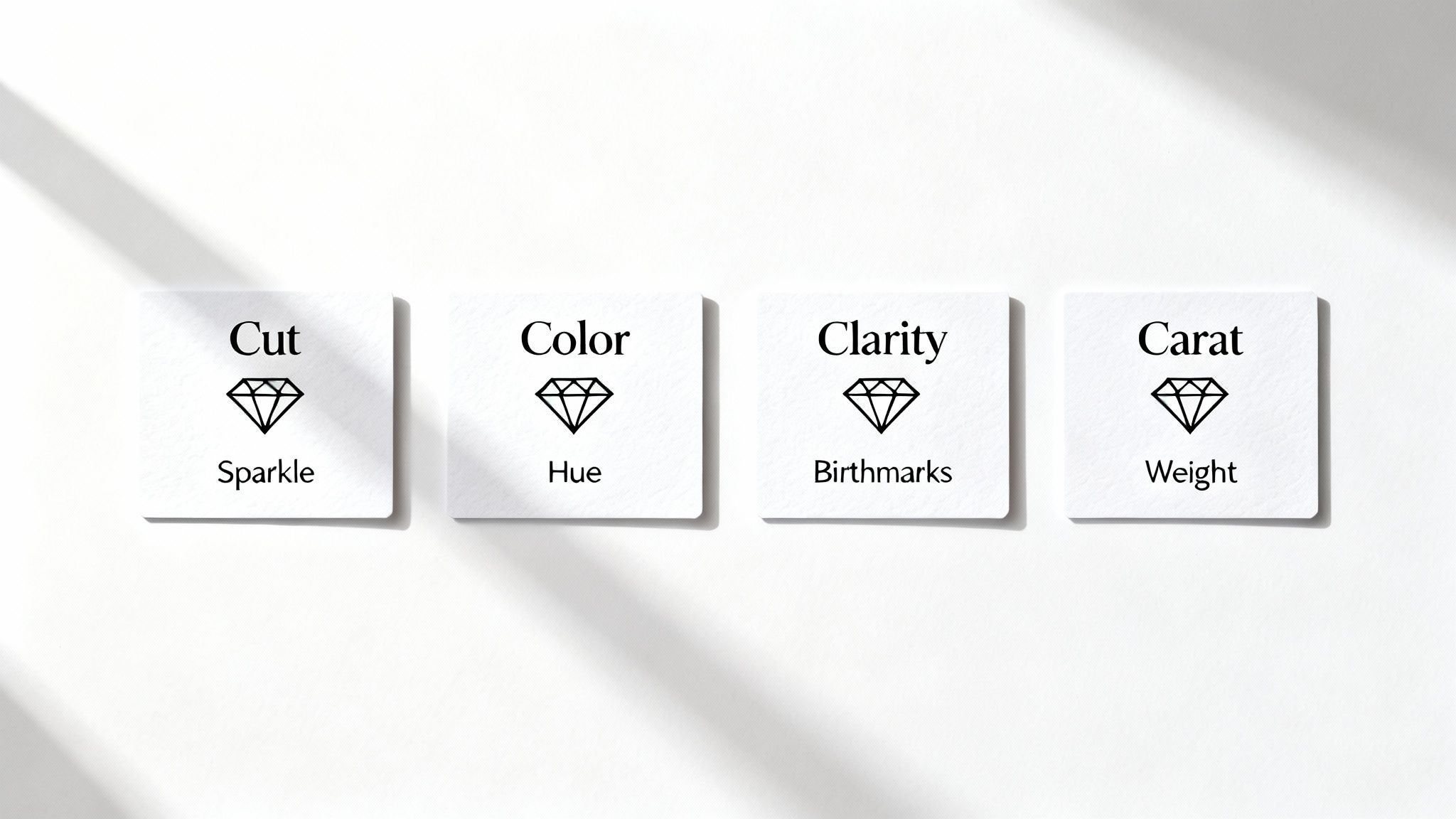
Before you even start browsing, getting a handle on this framework is the single most important step. It’s the difference between guessing and knowing. The 4 Cs give you a clear blueprint for evaluating any stone, empowering you to make smart trade-offs that fit your budget and what you value most.
This system isn't new; it was created back in the mid-20th century to bring consistency to a once-subjective market. Before standardized grading, a diamond's quality was often just a matter of opinion. Now, these four characteristics give everyone—from jewelers to buyers—a shared vocabulary to define what makes a diamond unique.
A Foundation for Smart Shopping
The real secret isn't just knowing what each C means, but understanding how they work together. They're an interconnected system where each factor influences the others, affecting both the diamond’s look and its price tag.
For instance, a diamond with a flawless color grade won't look its best if the cut is poor and lacks sparkle. On the flip side, an exceptional cut can make a diamond with slight color or clarity imperfections look absolutely brilliant.
Balancing these elements is how you find the best possible diamond for your money. It’s all about deciding what’s most important to you—be it maximum sparkle, sheer size, or icy-white purity.
To make this easy, we've put together a quick cheat sheet. This table breaks down what each of the 4 Cs of diamonds measures, the impact it has on the stone’s appearance, and how it affects the final price. Use it as a quick reference to build your knowledge from the ground up.
The 4 Cs of Diamonds at a Glance
The 'C' | What It Measures | Impact on Appearance | Price Influence |
|---|---|---|---|
Cut | The quality of a diamond's angles, proportions, and facets, which control its interaction with light. | Determines the diamond's sparkle, fire, and brilliance. This is the most crucial factor for a diamond's beauty. | High. An Excellent or Ideal cut significantly increases value, often more than any other factor. |
Color | The absence of color in a white diamond, graded on a scale from D (colorless) to Z (light yellow or brown). | Affects the diamond's whiteness and brightness. Higher grades appear icier and more transparent. | High. Colorless (D-F) diamonds are the rarest and most expensive, with prices decreasing down the scale. |
Clarity | The presence of internal characteristics (inclusions) and surface blemishes, graded from Flawless to Included. | Impacts the diamond's purity. "Eye-clean" diamonds have no visible flaws, appearing perfect to the naked eye. | Moderate to High. Flawless diamonds are exceptionally rare and costly. Value drops as inclusions become more visible. |
Carat Weight | The diamond's physical weight, with one carat equaling 200 milligrams. | Directly relates to the diamond's perceived size. A higher carat weight generally means a larger-looking stone. | Very High. Price increases exponentially with carat weight due to the rarity of larger rough diamonds. |
This table is your starting point. As you dive deeper into each "C," you'll start to see how you can prioritize certain qualities over others to find a diamond that is perfect for you.
Why Diamond Cut Is Your Most Important Choice
While all of the 4 Cs of diamonds have a role to play, the Cut is the one that truly breathes life into the stone. It’s the single most important factor for a diamond's beauty, and it’s entirely controlled by human hands.
Think of a raw diamond as a room full of mirrors. The master cutter’s job is to arrange those mirrors—the facets—at the perfect angles to capture light, bounce it around inside, and shoot it straight back to your eye.
That dazzling light show is what we call sparkle, brilliance, and fire.
Don't confuse a diamond's Cut with its shape (like round, pear, or oval). The cut is a technical grade that measures how well a diamond’s facets handle light. A superior cut can make a stone look bigger, brighter, and more alive than a poorly cut diamond of the exact same weight, color, and clarity.
The Science of Sparkle Explained
A diamond’s performance comes down to three key elements, all decided by the quality of its cut. Once you understand these, you'll see why this "C" is where you should focus your budget.
Brilliance: This is the bright, crisp white light that reflects from a diamond. It’s what makes the stone pop. A well-cut diamond is like a perfect prism, returning the maximum amount of light right through the top.
Fire: These are the flashes of rainbow colors you see when the diamond moves. It happens when the stone splits white light into its spectral colors, creating that vibrant, fiery effect.
Scintillation: This is the play of light and dark patterns across the diamond’s surface as you move it. It’s that intense, blinking sparkle that catches your eye from across the room.
These three work together to create that jaw-dropping beauty. A diamond with a poor cut will just leak light out of its bottom or sides, leaving it looking dull and glassy, no matter how great its other grades are.
A poorly cut diamond is like a high-performance engine that's out of tune—it has incredible potential but can't deliver the power. An excellent cut unlocks a diamond's full beauty.
Why Proportions and Symmetry Matter
Grading labs like the GIA get technical, but two things they look at are easy to understand: proportions and symmetry.
Proportions are all about the angles and measurements of the facets. If the angles are too deep or too shallow, light escapes out the bottom instead of bouncing back to you, which kills the sparkle.
Symmetry is about how precisely the facets are aligned. Perfect alignment ensures light is gathered and reflected evenly. Even tiny misalignments can create dead spots or dial down the brilliance.
Labs grade these factors on a simple scale:
Excellent
Very Good
Good
Fair
Poor
For maximum sparkle, you should always, always aim for an Excellent or Very Good cut grade. This is the real secret to getting the most visual impact for your money.
Cut: The Ultimate Value Driver
Putting your money into a higher cut grade is the smartest move you can make when buying a diamond. It affects the stone’s beauty more than any other C. In fact, a diamond with an "Excellent" cut can even make lower color grades (like G or H) and clarity grades (like SI1) look brighter and cleaner.
The market knows this, too. Cut is the strongest driver of a diamond's price among the 4 Cs. Data shows that top-cut grades command a massive premium. An Ideal or Excellent cut round brilliant can raise the retail price by 50% to 120% compared to a Good or Fair cut stone of the same carat, color, and clarity.
This means you can often get a more beautiful diamond by prioritizing cut and compromising a little on the other Cs. A 0.90-carat, G-color, SI1-clarity diamond with an Excellent cut will almost always look more stunning than a 1.00-carat, D-color, Flawless diamond with only a Good cut.
While the cut grade is your starting point, remember that different diamond shapes have their own unique personalities. To see how these shapes differ, check out our guide on the different diamond cuts explained. This will help you make a choice that perfectly matches your style.
Understanding Carat Weight and Price Jumps
Of all the 4 Cs of diamonds, Carat is the one everyone knows—or thinks they know. It's the first thing most people ask about, but it’s often mistaken for size. Carat is actually a measure of weight. One carat is precisely 200 milligrams, a universal standard that keeps the diamond world consistent.
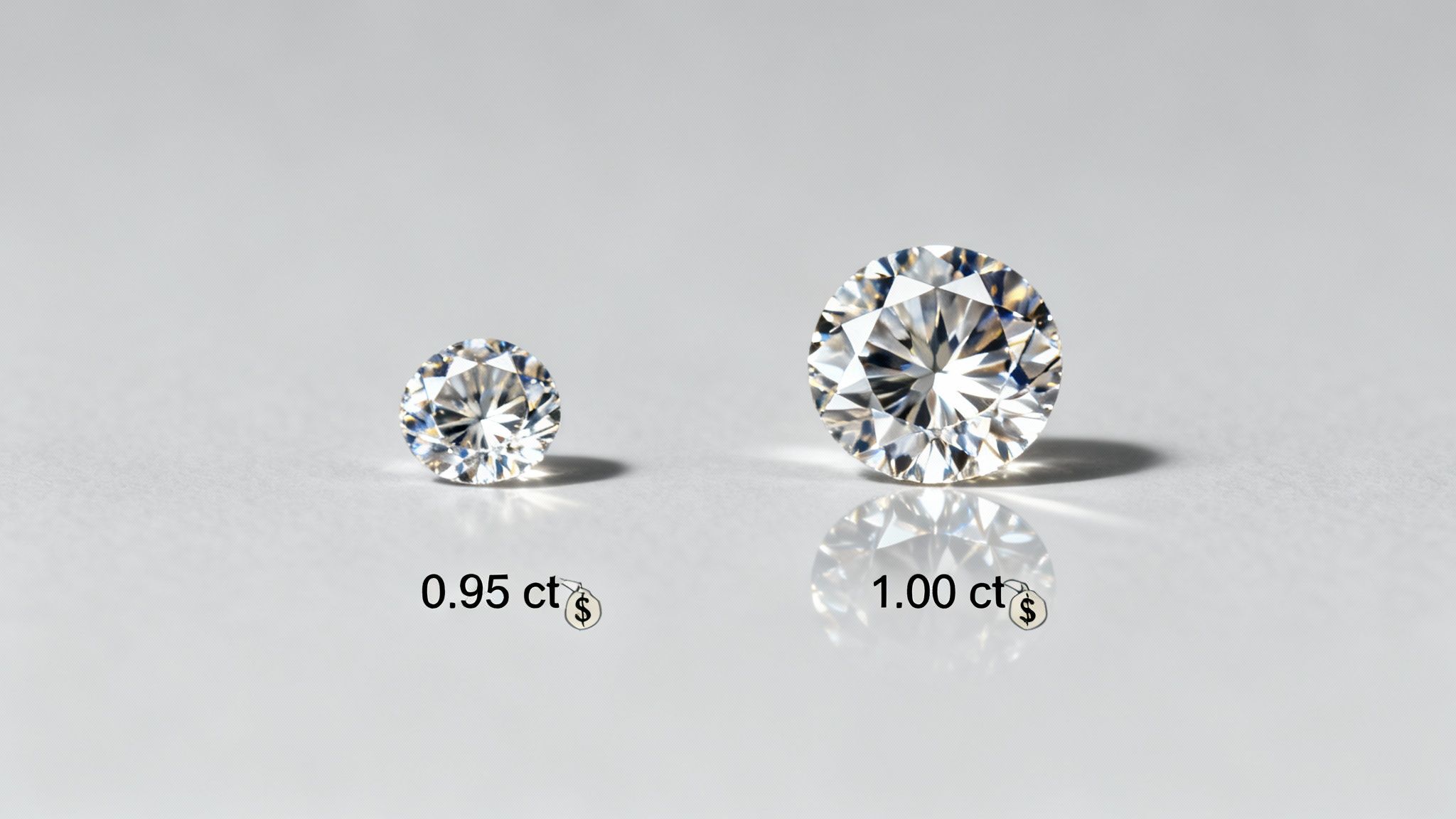
Now, while a heavier diamond is usually a bigger diamond, the two don’t always line up perfectly. A clumsy, deep cut can hide a lot of weight in the belly of the stone, making a 1.00-carat diamond look smaller than a beautifully cut 0.95-carat that spreads its weight across its diameter.
This is where the other Cs come into play. A high carat weight is just a number without a great cut to unleash its brilliance and presence. To see just how impressive carat weight can be, take a look at massive gems like this natural yellow diamond crystal weighing over 21 carats—it puts rarity and scale on full display.
The Truth About Carat and Cost
When it comes to price, carat weight has a massive impact, but it’s not a simple one-to-one relationship. You might assume a two-carat diamond costs twice as much as a one-carat. It's actually more like four or five times the price.
This exponential jump happens because larger, gem-quality rough diamonds are incredibly rare. Miners have to sift through tons of earth just to find a single one-carat rough diamond. Finding one big enough to yield a two-carat finished stone is an entirely different level of luck.
As the carat weight climbs, the price-per-carat skyrockets right along with it. It’s the single most dramatic price influencer among the 4 Cs.
Navigating the Magic Numbers
In the diamond world, certain carat weights act like pricing cliffs. We call them "magic numbers"—the popular, round-number weights that everyone asks for. The biggest ones are:
0.50 Carat (a half carat)
0.75 Carat (three-quarters of a carat)
1.00 Carat (the iconic one carat)
1.50 Carat
2.00 Carat
The moment a diamond hits one of these magic numbers, its price jumps—a lot. A 1.00-carat diamond can cost 20-30% more than a 0.95-carat diamond, even if they have the exact same cut, color, and clarity. To the naked eye, the size difference is impossible to spot.
This premium is almost entirely driven by psychology. There's a powerful allure to owning a "full carat" stone, and the market prices that milestone accordingly.
The Savvy Shopper's Secret
This is where you can find some of the best deals. The strategy is simple: buy "shy" of the magic numbers. Instead of a 1.00-carat, look for a diamond between 0.90 and 0.98 carats.
This one small adjustment can save you thousands for a size difference no one will ever see. The same logic holds true across the board. A 0.48-carat looks identical to a 0.50-carat, and a 1.90-carat is indistinguishable from a 2.00-carat once it's in a ring. It’s a smart trade-off that frees up your budget for a better cut or a higher color grade.
Having some context on what others are buying can also be helpful. If you’re curious, you can explore our analysis of how many carats the average engagement ring is. By strategically navigating these weight categories, you can land a diamond that looks impressive without paying the premium.
Decoding Diamond Color and Clarity
Once you’ve nailed the Cut and have a handle on Carat, it’s time to talk about the two Cs that give a diamond its purity and personality: Color and Clarity. They might sound technical, but the concepts are pretty simple. Color grades the absence of color, while clarity measures the tiny, natural characteristics inside the stone.
Think of these two as the supporting actors in your diamond's story. Cut is the star that delivers the brilliant performance, but Color and Clarity add all the nuance and depth. More importantly, they’re where you can make smart compromises to free up your budget for a better Cut or a bigger diamond—without giving up any of the beauty you can actually see.
Understanding Diamond Color: The Spectrum of Purity
When we talk about diamond color, we’re usually talking about white diamonds and grading how little color they have. The industry uses a D-to-Z scale, where D is absolutely colorless and Z has a noticeable light yellow or brown tint.
It’s less of a strict set of boxes and more of a subtle spectrum. The difference between a D and an E, or a G and an H, is almost impossible for an untrained eye to spot, especially once the diamond is set in a ring.
Here’s a practical way to think about the color grades:
Colorless (D-F): These are the rarest and most valuable grades, showing no trace of color. They represent the absolute top tier of purity.
Near Colorless (G-J): This is the sweet spot for value. Diamonds in this range look icy white to the naked eye but come at a much friendlier price than the colorless grades. A G or H color diamond is a fantastic choice for almost everyone.
Faint (K-M): At this level, a slight, warm tint becomes visible. These diamonds can look gorgeous set in yellow or rose gold, which beautifully complements their warmth.
The secret to choosing color is realizing you don't need a D-grade diamond to get a stunning, white-looking stone. A G, H, or even an I color diamond can look just as beautiful in a real-world setting.
The Myth of Flawless Clarity
Next up is Clarity, which is all about a diamond’s natural “birthmarks.” These characteristics are known as inclusions (internal flaws) and blemishes (external marks), and they form deep within the earth as the diamond crystallizes. You can think of them as a diamond’s unique fingerprint—no two are ever identical.
A Flawless (FL) diamond, with zero visible inclusions under 10x magnification, is exceptionally rare and carries an astronomical price tag. But here’s the most important thing to know: you do not need a flawless diamond to get a beautiful one.
The real goal for most shoppers is to find an "eye-clean" diamond. This simply means the stone has no inclusions that are visible to your naked eye. The tiny characteristics are only visible under a jeweler’s loupe, not in your everyday life.
Finding the Eye-Clean Sweet Spot
The clarity scale runs from Flawless (FL) all the way down to Included (I), but the best value is hiding right in the middle. These are the grades that offer incredible beauty without the premium price:
VS1 / VS2 (Very Slightly Included): Inclusions here are minor and take effort to see even under 10x magnification. These diamonds are almost always eye-clean.
SI1 (Slightly Included): This is often the best-value grade of all. Many SI1 diamonds are completely eye-clean, especially in brilliant-cut shapes like rounds, which are masters at hiding imperfections.
Choosing a G-color, SI1-clarity diamond is one of the smartest trade-offs you can make. It frees up a huge chunk of your budget to invest in an Excellent Cut or a larger carat weight—the two factors that really drive a diamond’s visual impact.
The interplay between these two Cs also has a major effect on market value. Historically, Color and Clarity combine to create rarity bands that the trade prices with significant percentage differences. Beyond the near-colorless range (D-F), each one-grade step up can increase prices by 5–30%, with larger stones seeing even steeper jumps. For example, moving from an H color to a D color in a one-carat round diamond can raise the retail price by 20–60%, even if all other Cs are identical. You can learn more about how these factors drive diamond pricing in the industry. This knowledge empowers you to understand precisely where your money is going when you select a stone with higher purity grades.
Making Smart Trade-Offs to Fit Your Budget
Knowing what the 4 Cs of diamonds are is one thing. Learning how to balance them is where the real art comes in. Think of it like adjusting sliders on a soundboard to get the perfect mix—boosting one C often means you’ll need to dial back another to stay within your budget. This is where you move from theory to real-world diamond buying.
The key is to decide what matters most to you. Is it that undeniable, fiery sparkle that catches light from across the room? Or are you dreaming of a larger stone that makes a bold statement? Maybe it's that pure, icy-white look you can’t get out of your head. There’s no single right answer—only the right answer for your style and your wallet.
Once you’ve identified your top priority, you can strategically compromise on the other Cs in ways that are almost impossible to see with the naked eye. This is the secret to finding a diamond that looks far more expensive than it actually is.
Scenario 1: You're Chasing Maximum Sparkle
If your dream is a diamond that just explodes with light, then Cut is your non-negotiable. A diamond with an Excellent or Ideal cut grade is the engine driving its brilliance and fire. You should plan to allocate the biggest slice of your budget right here, because nothing else can make up for a dull cut.
So, where do you save? You can comfortably compromise on Color and Clarity without anyone noticing. Look for a diamond in the G to H color range. These are considered "near colorless," and they look perfectly white once set in a ring—especially in yellow or rose gold—but cost quite a bit less than stones in the D-F grades.
For clarity, an SI1 (Slightly Included) grade is the sweet spot for value. Most SI1 diamonds are completely "eye-clean," which means their tiny inclusions are only visible under a jeweler’s loupe. Plus, the brilliant faceting of a well-cut diamond is fantastic at hiding these minor imperfections. You could even go for a slightly smaller carat weight, knowing a superior cut will make the diamond appear larger and more vibrant anyway.
The Sparkle Seeker's Recipe:* Priority: Excellent Cut Grade* Compromise: G-H Color, SI1 Clarity, and maybe a slightly smaller Carat weight.
This is all about making strategic choices. If you start with a primary goal, like getting the most sparkle, you can make informed decisions on where to be flexible.
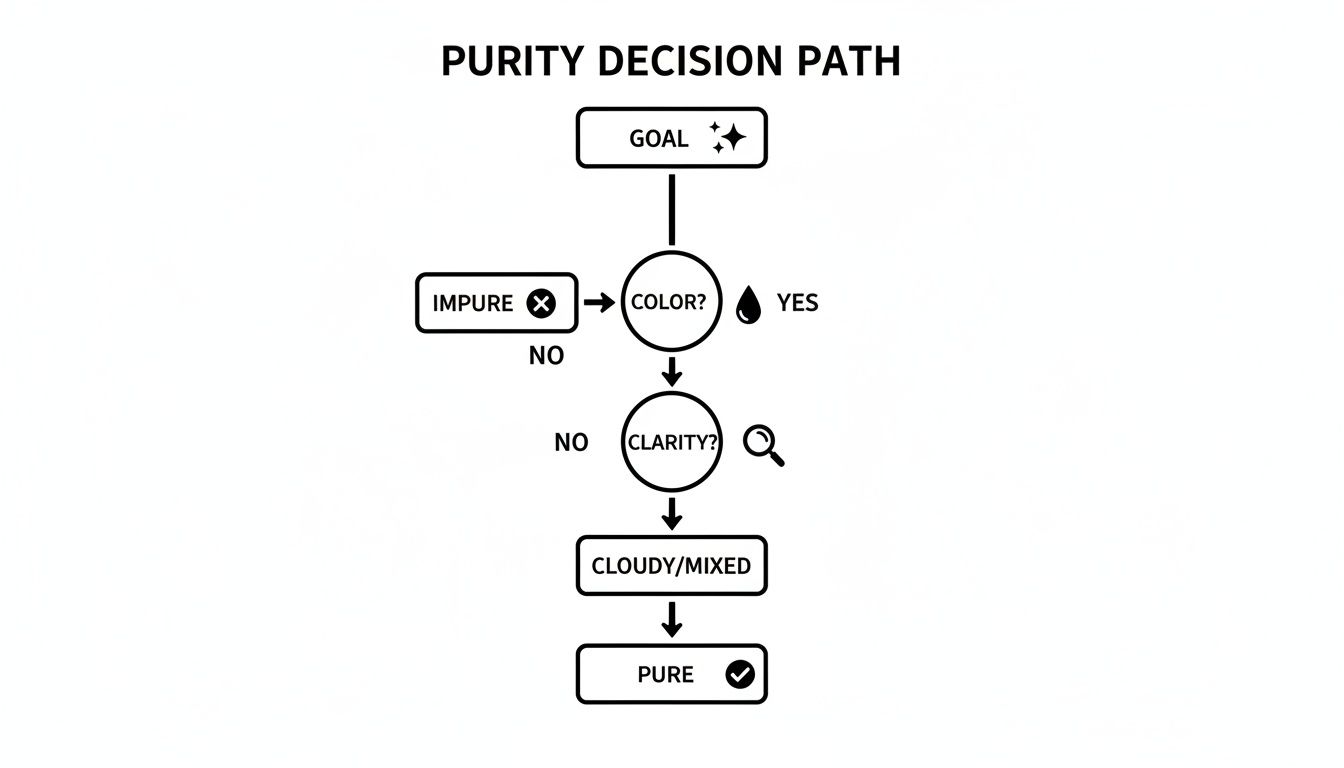
This path shows how you can balance factors like Color and Clarity to make your budget work harder for you.
Scenario 2: You Want an Impressive Size
If a larger-looking diamond is what you're after, then Carat Weight becomes your focus. But you can’t just ignore everything else. The trick is to find a balance that gives you the size you want without sacrificing too much beauty.
A great place to start is by looking for diamonds just shy of the "magic numbers"—think 1.00 or 2.00 carats. A 0.95-carat diamond, for example, looks virtually identical to a 1.00-carat stone but can cost 20-30% less. This is probably the single best hack for getting more size for your money.
From there, you can be more flexible with Color and Clarity. An I or J color diamond can still look stunning, especially if you set it in yellow or rose gold, which will complement its natural warmth. For clarity, a well-chosen SI1 or even some SI2 diamonds can be eye-clean, especially in brilliant-cut shapes that are great at hiding flaws. Just make sure the cut grade is at least "Very Good" to avoid ending up with a big but lifeless stone.
Scenario 3: You Love That Icy-White Look
For those who adore that crisp, absolutely colorless look, Color is king. You’ll want to focus your search on the D-F range to guarantee there are no detectable hints of yellow. This is especially important if you're setting your diamond in platinum or white gold, as these cool-toned metals will highlight any warmth in a lower-grade stone.
To afford a premium color grade, you’ll need to make smart trade-offs elsewhere. You can opt for a more modest Carat Weight, since a slightly smaller but perfectly colorless diamond has a striking presence all its own.
Clarity is another area where you can be flexible. A VS2 or SI1 diamond will still appear flawless to the naked eye, freeing up your budget to invest in that top-tier D color. And as long as the cut is "Very Good" or better, the stone will have plenty of life and sparkle.
Understanding how these elements play off each other is everything. It allows you to confidently build a diamond that not only fits your budget but also perfectly reflects your personal style.
Smart Trade-Offs Based on Your Priority
Choosing a diamond is all about finding the right balance for you. This table breaks down how to juggle the 4 Cs based on what you value most, whether it's blinding sparkle, impressive size, or pure, icy color. Think of it as your cheat sheet for getting the most beautiful diamond for your budget.
If Your Priority Is... | Prioritize This 'C' | Where You Can Compromise | Example Diamond Profile |
|---|---|---|---|
Maximum Sparkle & Brilliance | Cut (Excellent/Ideal) | Color (G-H) & Clarity (SI1, eye-clean) | A 0.90ct, G color, SI1 clarity, Excellent cut round brilliant. |
Impressive Size | Carat (Aim just below "magic" sizes like 1ct) | Color (I-J) & Clarity (SI1/SI2, eye-clean) | A 0.95ct, I color, SI1 clarity, Very Good cut diamond set in yellow gold. |
Icy, Colorless Appearance | Color (D-F range) | Carat (Slightly smaller) & Clarity (VS2/SI1) | A 0.80ct, D color, SI1 clarity, Very Good cut diamond set in platinum. |
Ultimately, there’s no "best" diamond—only the best diamond for the person wearing it. By leading with your priority, you can make intelligent compromises and find a stone you'll love forever.
Why Diamond Certification Is Your Best Friend
Once you've wrapped your head around Cut, Color, Clarity, and Carat, there’s one last piece of the puzzle. Some call it the unofficial "fifth C"—Certification. And honestly? It might be the most important factor in protecting your investment and making sure you actually get what you’re paying for.
Think of a diamond grading report as the stone’s official title and a detailed inspection rolled into one. It’s an unbiased, third-party verification that the diamond's 4 Cs are exactly what the seller claims. Without it, you're just taking someone's word for it, and that’s a gamble you don’t want to take.
Not All Certificates Are Created Equal
The lab that issues the certificate is everything. Reputable labs like the Gemological Institute of America (GIA) are the gold standard for a reason—their grading is famously strict, consistent, and completely impartial.
Here’s where it gets tricky. Other labs often have looser standards. A diamond graded as a "G" color by a less-known lab might only earn an "I" or "J" grade from the GIA. This gap means you could easily overpay for a lower-quality stone, thinking you've stumbled upon an amazing deal. Always, always insist on a report from a top-tier lab.
A diamond certificate from a trusted lab doesn't just describe the diamond; it validates its quality and value. It's the ultimate tool for consumer confidence, transforming a complex purchase into a transparent and secure transaction.
This objective proof gives you total peace of mind. It ensures you’re paying a fair price based on internationally recognized standards, not just an inflated in-house appraisal.
From Purchase to Protection
A solid certificate is also your key to protecting the diamond for years to come. Once you've found your stone, getting a professional jewelry appraisal for insurance is a crucial next step, and the grading report is the foundational document for that appraisal.
If you’re curious about the process, understanding the factors that influence GIA certification cost can offer a deeper appreciation for why this paperwork is such a worthwhile investment. By arming you with verified facts, a certificate helps you sidestep costly mistakes and shop with the confidence of an expert.
Your Top Questions, Answered
Once you’ve got a handle on the 4 Cs, the real-world questions start popping up. It’s one thing to know the theory, but another to feel confident when you're about to make a choice. Here are the practical answers to what shoppers ask us most.
Which C Can I Compromise On?
If you have to pick one, let it be Clarity. This is where you can get the most for your money without sacrificing what you can actually see.
You can save a huge amount by choosing an "eye-clean" diamond—think SI1 or even a well-chosen SI2—where the tiny imperfections are impossible to spot without a jeweler's loupe. Funneling that part of your budget into a better Cut will give you so much more sparkle and life, which is what you'll notice every single day.
The goal isn't a flawless diamond on paper; it's a beautiful diamond in person. Prioritizing an eye-clean stone over a high clarity grade is one of the best ways to maximize value.
Does the Diamond's Shape Change Which C Matters Most?
Absolutely. Each shape has its own personality, and that changes which of the 4 Cs takes center stage.
A round brilliant cut is engineered for maximum fire and sparkle, so Cut is everything. For shapes with long, open facets like an emerald or asscher cut, those facets act like clean windows right into the heart of the stone. For these, Color and Clarity become much more obvious.
Step Cuts (Emerald, Asscher): Aim a little higher here. You'll want to look at G+ color and VS1+ clarity, as any tint or inclusion is much more visible.
Fancy Shapes (Oval, Pear): A great Cut is non-negotiable to avoid the "bow-tie" effect—that distracting shadow that can stretch across the diamond's center.
Is a One Carat Diamond Double the Price of a Half Carat?
Not even close. Diamond prices don't scale up gently; they jump exponentially.
This is all about rarity. Large, high-quality rough diamonds are far harder to find than smaller ones. Because of this, a 1.0-carat diamond can easily cost three to four times more than a 0.50-carat diamond of the exact same quality. You'll see the biggest price leaps right at those popular "magic number" weights, like the full-carat mark.
At Panther De Luxe Shop, we believe an informed choice is a confident one. Explore our curated collection of certified diamonds where you can see the 4 Cs in action and find a stone that perfectly balances beauty and value. Discover your ideal diamond at https://www.pantherdeluxe.com.
Comments