
The Definitive A-Z List of Gemstones for Jewelry
- Luke Zucco
- Dec 30, 2025
- 22 min read

Welcome. You've just found your go-to resource for all things gemstones, designed for both curious enthusiasts and savvy jewelry shoppers. This is your complete A–Z list of gemstones, built to help you make choices you feel great about.
Think of this as your personal guide, exploring all the key details for each gem—from color and hardness to its deeper meaning. It's all about empowering you with the right knowledge.
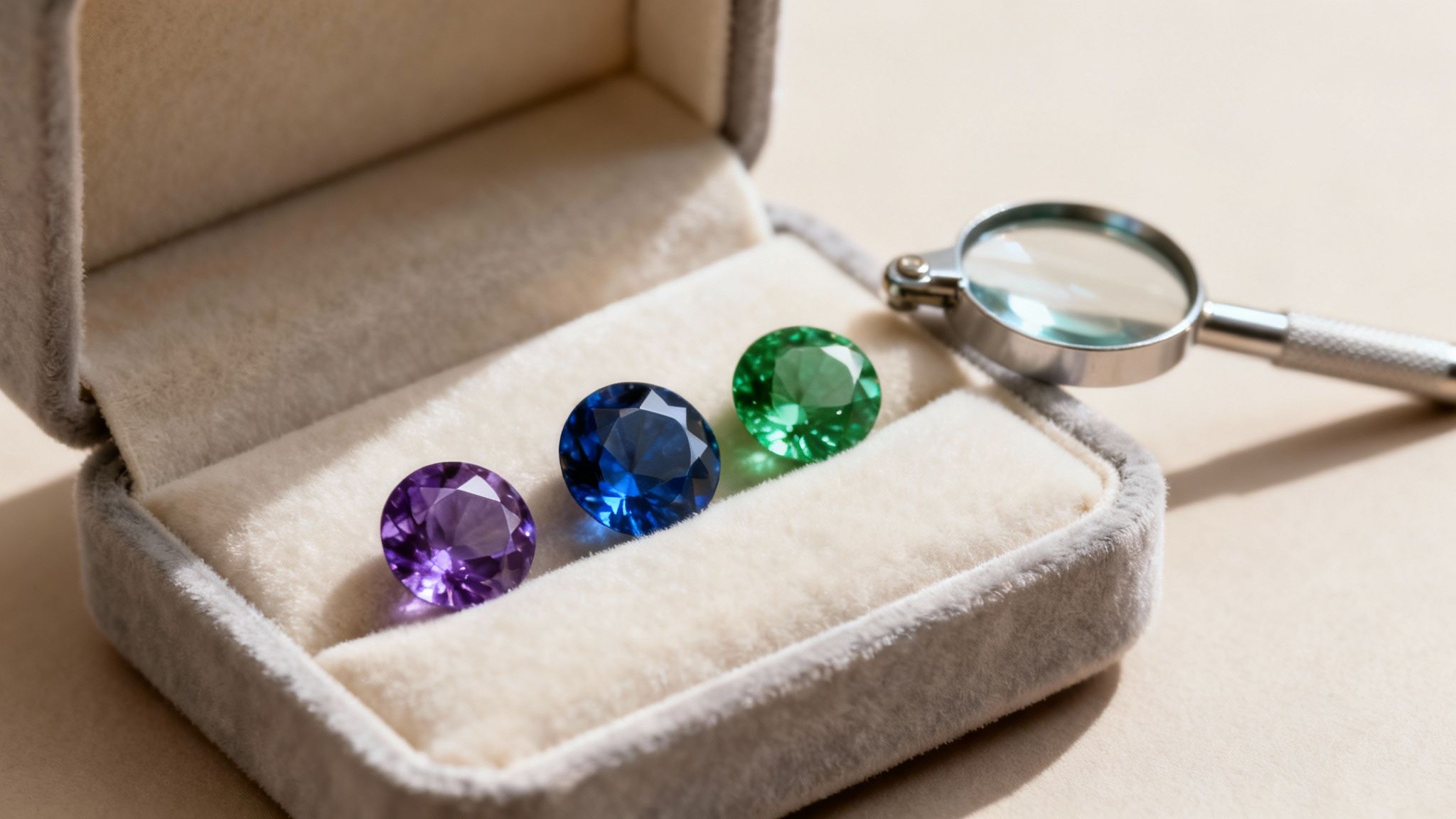
Your Essential Guide to Choosing Gemstones
Picking out a gemstone is a personal experience. Maybe you're looking for a birthstone, searching for the perfect engagement ring, or just found a piece that speaks to you. Understanding what makes each stone unique ensures your jewelry doesn't just look incredible, but actually fits your life.
Our fascination with these natural wonders is only growing. The global gemstones market was valued at around US$37.48 billion in 2025 and is expected to hit US$52.67 billion by 2032. That surge tells us one thing: people are craving luxury and personalized jewelry more than ever. If you're curious, you can read more about gemstone market trends on persistencemarketresearch.com.
What You Will Discover
This reference guide is designed to help you explore the distinct qualities that make each gemstone so special. Once you learn what sets different stones apart, you'll be able to choose pieces that are not only beautiful but also durable and meaningful.
Here’s a peek at what’s inside:
Detailed Profiles: Every entry gives you a complete overview, covering everything from common colors and hardness ratings to typical treatments and proper care.
Practical Guidance: We connect the dots for you. For instance, we explain why a diamond’s legendary hardness is perfect for a ring you’ll wear daily, while a pearl’s delicate luster is better suited for a necklace.
Informed Decisions: You’ll also find birthstone associations and tips on how to spot fakes, turning you into a much more confident and knowledgeable shopper.
To get started with the basics, check out our guide on the difference between precious and semi-precious stones. It’s a great foundation.
So, you’re ready to dive into the world of gemstones? Fantastic. We’ve put together this A-Z guide to make finding what you need as simple as possible. Think of it as your field guide, whether you're buying your first piece of jewelry or you’re a seasoned collector looking for specific details.
The guide is organized alphabetically, so you can skip right to the stone you’re curious about. No need to read it cover-to-cover (unless you want to, of course).
How to Read Each Entry
Every gemstone has its own story and a unique set of characteristics. To help you make a smart choice, we’ve broken down each entry into a consistent format. Knowing what these details mean will help you pick a stone that not only looks great but also suits your lifestyle.
Here’s a quick rundown of what you'll find for each gem:
Common Colors: This covers the spectrum of colors a stone is known for, from its most iconic shades to the rarer, more collectible hues.
Mohs Hardness: A simple 1 to 10 scale that tells you how well a gem resists scratches. This is a game-changer for durability, especially in rings.
Typical Treatments: We'll let you know about common enhancements like heat treatment or oiling. This is standard practice in the industry to improve a gem's color or clarity.
Birthstone Associations: Find out if a stone is linked to a specific month or zodiac sign—perfect for personalized gifts.
Care Instructions: Real-world advice on how to clean and protect your jewelry so it stays beautiful for years to come.
A stone’s Mohs hardness is one of the most practical details to pay attention to. For instance, any gem rated 7 or higher is generally tough enough for an everyday ring. Softer stones, on the other hand, are better suited for earrings or pendants where they won't get knocked around as much. This one little number can save you a lot of heartache (and money) down the road.
Quick Reference Gemstone Properties
Sometimes you just need a quick comparison without digging through a full A-to-Z list. This section is for you. Think of it as a cheat sheet for the most popular gemstones, designed to help you weigh your options at a glance.
The visual guide below breaks down the essentials—color, hardness, and care—for some of the stones you'll encounter most often.
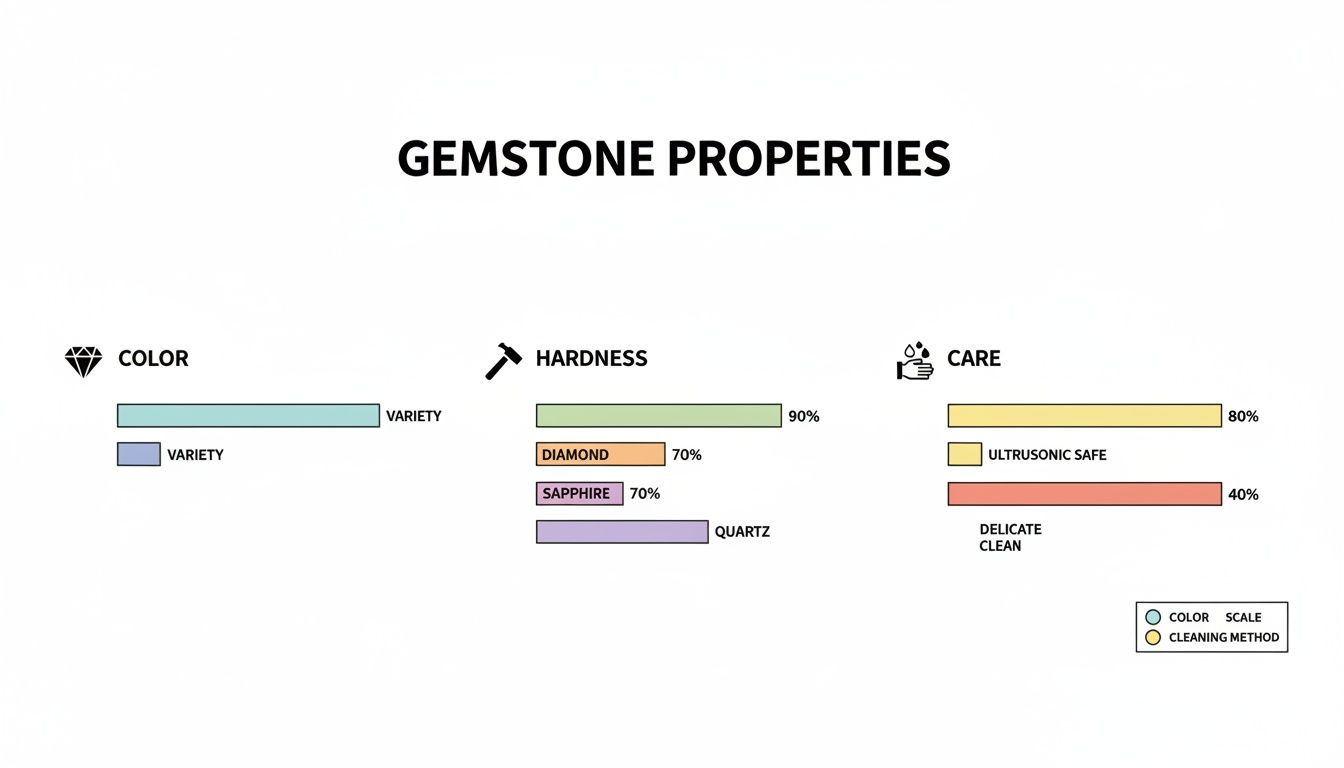
As you can see, there's a direct link between a gem's toughness (its Mohs hardness rating) and how you should care for it. For an even closer look, we've got a whole guide on how to identify gemstones at home with some simple tricks of the trade.
Popular Gemstones At a Glance
The table below summarizes the key attributes of the most sought-after gems in the jewelry world. Use it to quickly compare their durability, common colors, and birthstone connections to find the perfect fit. It's an invaluable tool whether you're choosing your first piece or adding to a growing collection.
Gemstone | Mohs Hardness | Primary Colors | Birthstone Month(s) |
|---|---|---|---|
Diamond | 10 | Colorless, Yellow, Brown | April |
Ruby | 9 | Red, Pinkish-Red | July |
Sapphire | 9 | Blue, Pink, Yellow, Green | September |
Emerald | 7.5–8 | Green | May |
Amethyst | 7 | Purple, Violet | February |
Garnet | 6.5–7.5 | Red, Green, Orange | January |
Opal | 5.5–6.5 | White, Black, Orange | October |
This at-a-glance view helps simplify the decision-making process, giving you a solid starting point before you dive deeper into the unique story and characteristics of each individual stone.
The Complete A–Z List of Gemstones
Welcome to the heart of our guide. This is where you’ll find everything you need to know about your favorite gemstones, all organized alphabetically for a quick and easy reference. Each entry is designed to give you the full picture—from durability to care tips—so you can feel totally confident in your next jewelry choice.
Agate
A member of the chalcedony family, Agate is all about its incredible, fine banding and rich, earthy tones. Ancient civilizations were drawn to it, carving it into intricate objects and wearing it for courage and protection. Those mesmerizing layers tell a story of volcanic activity and slow crystallization over millions of years, making each piece truly one-of-a-kind.
You’ll often see it in statement jewelry, like bold pendants and chunky cuff bracelets, where its unique patterns can really shine.
Common Colors: A whole spectrum, including white, gray, blue, red, brown, and black, almost always in concentric bands.
Mohs Hardness: 6.5–7, making it durable enough for most jewelry if you treat it with a little care.
Typical Treatments: Dyeing is very common to create vibrant blues, greens, and pinks you wouldn't find in nature.
Birthstone Month: Not a primary birthstone, but it's often linked to the zodiac sign Gemini.
Care Instructions: A simple clean with warm, soapy water and a soft brush is all it needs. Steer clear of harsh chemicals and ultrasonic cleaners, especially if the stone is dyed.
Alexandrite
Alexandrite is one of those rare, almost magical gemstones, famous for its dramatic color-changing abilities. It appears greenish in daylight or fluorescent light, then shifts to a reddish-purple under the warm glow of an incandescent bulb. This chameleon-like quality makes it one of the most sought-after collector’s gems in the world.
First discovered in Russia's Ural Mountains in the 1830s, it was named after the future Czar Alexander II. Its rarity is part of its charm. For those captivated by its unique qualities, you can explore the full story of this remarkable color-changing gem in our detailed guide on Alexandrite stone.
Common Colors: Greenish-blue in daylight, shifting to a reddish-purple in incandescent light.
Mohs Hardness: An excellent 8.5. This makes it incredibly durable and perfect for everyday wear, including engagement rings.
Typical Treatments: High-quality Alexandrite is usually left untreated. You'll find plenty of lab-created versions, which offer the look at a more accessible price point.
Birthstone Month: One of the modern birthstones for June.
Care Instructions: Its toughness makes it pretty low-maintenance. It's safe to clean with warm soapy water, ultrasonic cleaners, and steam cleaners.
Amethyst
The purple variety of quartz, Amethyst is loved for its stunning violet hues that range from a deep, royal "Siberian" purple to a soft, dreamy lavender. For centuries, it was held in the same regard as rubies and emeralds. The ancient Greeks even believed it could protect its owner from getting drunk—its name literally means "not intoxicated" in Greek.
Today, it's a staple in the jewelry world, adored for its beauty and affordability. It's versatile enough for everything from delicate earrings to big, bold cocktail rings.
Common Colors: Light lilac to a deep, rich purple.
Mohs Hardness: A solid 7, which is great for jewelry but means you should protect it from scratches from harder gems.
Typical Treatments: It's often heat-treated to lighten the color or remove brownish tones, resulting in that perfect, uniform purple.
Birthstone Month: The official birthstone for February.
Care Instructions: Just use warm, soapy water. Keep it away from prolonged sun exposure or intense heat, as this can cause the color to fade over time.
Aquamarine
Named from the Latin for "water of the sea," Aquamarine’s serene blue and greenish-blue color instantly brings to mind the calm of the ocean. It’s a member of the beryl family, which makes it a cousin to Emerald. Legends claimed it was the treasure of mermaids and kept sailors safe on their voyages.
Its beautiful, watery clarity makes it a favorite for elegant designs. Unlike emeralds, it's easier to find larger, eye-clean aquamarine stones, allowing for some seriously impressive cuts.
Common Colors: Light blue, greenish-blue, to a deep blue. The most prized color is a saturated, vibrant blue.
Mohs Hardness: 7.5–8, offering excellent durability for all types of jewelry.
Typical Treatments: Almost all Aquamarine is heat-treated to remove yellow tones and bring out that pure blue. This treatment is stable and permanent.
Birthstone Month: The birthstone for March.
Care Instructions: Warm, soapy water is the safest cleaning method. It can be a bit brittle despite its hardness, so protect it from any sharp knocks.
Citrine
Citrine is the sunny, yellow-to-orange variety of quartz, getting its name from the French word for lemon, citron. This cheerful gem is all about positivity and prosperity—it's often called the "merchant's stone" because it was thought to attract wealth. Fun fact: most citrine on the market is actually heat-treated amethyst.
Its warm glow is a fantastic and affordable alternative to yellow sapphire or topaz. It’s a popular choice for big, fashionable pieces that make a bright, happy statement.
Common Colors: Pale yellow, golden honey, to a brownish-orange.
Mohs Hardness: A good 7, making it suitable for everyday wear as long as you protect it from hard bumps.
Typical Treatments: Heat treating amethyst or smoky quartz is standard practice to achieve those lovely yellow and orange hues.
Birthstone Month: One of two birthstones for November.
Care Instructions: Clean it with warm water and mild soap. Avoid high heat and direct sun, as sudden temperature changes can cause it to crack and sunlight can make the color fade.
Diamond
Diamond is the undisputed king of gemstones, known for its unmatched sparkle, fire, and hardness. Made of pure carbon, it’s the hardest natural substance on Earth. Its name comes from the Greek word adamas, meaning "invincible"—a fitting title for the ultimate symbol of eternal love and strength.
While classic colorless diamonds are the most popular, they also come in a whole rainbow of "fancy" colors. Diamonds reign supreme in the gemstone world, capturing a massive 65% market share worth about $15.9 billion in 2024, far outpacing colored gemstones at 25% ($6.1 billion) and pearls at 10% ($2.4 billion). This dominance traces back centuries, but 2025 marks a pivotal shift as colored gems surge ahead with 7.2% growth, driven by demand for rarity and novelty. Discover more insights about these gemstone market trends on folkmarketgems.com.
Common Colors: Colorless is most common, but they are found in shades of yellow, brown, blue, green, pink, and red.
Mohs Hardness: A perfect 10, the highest possible score. This makes it the most durable gemstone for any type of jewelry, especially engagement rings.
Typical Treatments: Treatments like laser drilling and fracture filling can improve the clarity of lower-quality stones. High-Pressure/High-Temperature (HPHT) treatment can enhance color.
Birthstone Month: The birthstone for April.
Care Instructions: It’s very durable but can be chipped by a hard blow. Clean it with a soft brush and a mix of warm water and mild detergent, or pop it in an ultrasonic cleaner.
Emerald
With its vivid green hue, Emerald is the most famous member of the beryl family. Prized for millennia, its color is a symbol of rebirth and love. The first known emerald mines were in Egypt, dating from at least 330 BC, and Cleopatra herself was known for her passionate love of the stone.
Most emeralds have inclusions—often called jardin (French for garden)—which are seen as part of the stone's unique character. Finding a natural emerald with high clarity is incredibly rare, making them even more valuable than diamonds of the same carat weight.
Common Colors: Light to deep green. The most desirable color is a slightly bluish-green with strong saturation.
Mohs Hardness: 7.5–8, which is very good, but its natural inclusions can make it prone to chipping.
Typical Treatments: The vast majority of emeralds are fracture-filled with oil or resin to improve their clarity. This is a standard treatment but requires special care.
Birthstone Month: The birthstone for May.
Care Instructions: Never use ultrasonic or steam cleaners. Clean it gently with a soft brush and warm, soapy water. Avoid harsh chemicals and sudden temperature changes.
Garnet
Garnet isn't just one stone, but a diverse group of minerals. While most people think of a deep red color, garnets come in nearly every color imaginable, including vibrant green (tsavorite) and fiery orange (spessartite). This gem has been used since the Bronze Age for everything from abrasives to adornment.
The name "garnet" comes from the Latin word granatus, meaning "pomegranate," a nod to its rich red seeds. Its variety and affordability make it a wonderfully versatile choice.
Common Colors: Red, green, orange, pink, purple, and yellow. Blue is extremely rare.
Mohs Hardness: 6.5–7.5, depending on the specific type. The harder varieties are excellent for everyday wear.
Typical Treatments: Garnets are almost always untreated, celebrated for their natural, untouched beauty.
Birthstone Month: The birthstone for January.
Care Instructions: Most garnets are durable enough for regular cleaning with warm water and a soft brush. Ultrasonic cleaners are generally safe for most, but avoid them for fractured stones.
Jade
Jade is a name that applies to two different minerals: Nephrite and Jadeite. Jadeite is the rarer and more valuable of the two, especially prized for its intense green color, known as "Imperial Jade." Nephrite is more common and comes in a wider range of colors, including creamy white and various shades of green.
For thousands of years, jade has been revered in Chinese culture as a symbol of purity, wisdom, and good health. It's often carved into intricate pendants, bangles, and figurines.
Common Colors: Various shades of green, lavender, white, red, black, and yellow.
Mohs Hardness: 6.5–7 for Jadeite and 6–6.5 for Nephrite. Both are exceptionally tough and resistant to chips and breaks.
Typical Treatments: Dyeing and polymer impregnation are common to enhance color and durability. Look for "Type A" jade, which is completely natural.
Birthstone Month: Associated with the 12th wedding anniversary.
Care Instructions: Clean with a soft, damp cloth and mild soap. Avoid harsh chemicals and ultrasonic cleaners, which can damage treated stones.
Lapis Lazuli
Lapis Lazuli is a deep blue metamorphic rock prized for its intense color for over 6,000 years. Its name is a mix of the Latin word lapis ("stone") and the Persian word lazhuward ("blue"). It's often speckled with golden pyrite inclusions that look like a starry night sky.
In ancient times, Lapis Lazuli was ground into a powder to create ultramarine, the finest and most expensive of all blue pigments, used by Renaissance painters like Vermeer and Titian.
Common Colors: Deep blue to royal blue, often with flecks of golden pyrite and white calcite.
Mohs Hardness: 5–6, making it a relatively soft stone. It’s best for earrings, pendants, or rings that are worn carefully.
Typical Treatments: Often treated with wax or resin to improve its color and shine. Dyeing can also be used to create a more uniform blue.
Birthstone Month: An alternative birthstone for September.
Care Instructions: A soft, dry cloth is best for cleaning. Avoid water and chemicals, as they can damage its porous surface. Protect it from scratches and hard knocks.
Moonstone
Moonstone is cherished for its captivating adularescence—that billowy, moonlight-like sheen that seems to glide across the gem's surface. It’s a member of the feldspar group and comes in a range of colors, from colorless to gray, yellow, or pink. The most prized moonstones are colorless with a strong blue sheen.
This gem has long been associated with magic, love, and protection. In India, it's considered a sacred stone and is often given as a traditional wedding gift.
Common Colors: Colorless, white, gray, peach, with a white to blue sheen.
Mohs Hardness: 6–6.5, which means it's susceptible to scratching and chipping. It's best suited for earrings, pendants, and brooches.
Typical Treatments: Moonstone is typically not treated.
Birthstone Month: One of the modern birthstones for June.
Care Instructions: Clean gently with warm, soapy water and a soft cloth. Never use ultrasonic or steam cleaners, and store it separately to avoid scratches.
Opal
Opal is famous for its unique play-of-color, a dazzling display of flashing rainbow hues that shift as you move the stone. This incredible effect is caused by light diffracting off microscopic silica spheres. Major sources include Australia, which produces about 95% of the world's precious opal.
The sheer variety of opal is astonishing. From the fiery Mexican Fire Opal to the dark and dramatic Australian Black Opal, each stone possesses a personality as unique as a fingerprint. This diversity makes it a favorite among collectors and designers who crave individuality.
Common Colors: White, black, gray, orange, red, with a rainbow play-of-color.
Mohs Hardness: 5.5–6.5, making it a very delicate gemstone that requires special care.
Typical Treatments: Some opals are treated with sugar or smoke to darken their body color. Doublets and triplets (thin slices of opal glued to a backing) are also common.
Birthstone Month: The birthstone for October.
Care Instructions: Clean with a soft, damp cloth. Avoid sudden temperature changes, dry conditions, and harsh chemicals. And definitely never use an ultrasonic cleaner.
Pearl
Pearls are the only gemstones created by a living creature. Formed inside the shells of mollusks, these organic gems have been treasured for their lustrous beauty for centuries. Natural pearls are incredibly rare; most pearls today are cultured, meaning a human initiated the formation process.
Their soft glow and classic elegance have made them a timeless symbol of sophistication. Pearls come in a variety of shapes, sizes, and colors, from classic white Akoya to dark Tahitian and golden South Sea pearls.
Common Colors: White, cream, pink, silver, gold, gray, and black.
Mohs Hardness: 2.5–4.5, making them very soft and easily scratched or damaged.
Typical Treatments: Bleaching is common to achieve a uniform white color. Dyeing is used to create a wide range of fashion colors.
Birthstone Month: One of the birthstones for June.
Care Instructions: Pearls are very delicate. Avoid contact with chemicals like perfume and hairspray. Wipe them with a soft cloth after wearing and always store them separately.
Peridot
Peridot is one of the few gemstones that occurs in only one color: a vibrant olive green with a slight golden undertone. It’s the gem variety of the mineral olivine, which is found in volcanic lava and even in meteorites. The ancient Egyptians called it the "gem of the sun," believing it protected its wearer from terrors of the night.
Its cheerful green color is perfect for summer jewelry. Unlike many gems whose color comes from trace elements, peridot's color is an essential part of its chemical makeup.
Common Colors: Lime green to olive green.
Mohs Hardness: 6.5–7, offering fair durability, but it can be susceptible to scratches.
Typical Treatments: Peridot is almost never treated.
Birthstone Month: The birthstone for August.
Care Instructions: Clean with warm, soapy water. Avoid ultrasonic cleaners and sudden temperature changes, which can cause it to fracture.
Ruby
Ruby is the red variety of the mineral corundum—the same mineral that forms sapphire. Its color, caused by chromium, ranges from pinkish-red to a deep "pigeon's blood" red, the most valuable hue. For centuries, ruby has been a symbol of power, passion, and protection.
As one of the four traditional precious gems, a fine-quality ruby can command higher prices per carat than even a diamond. Its hardness is second only to diamond, making it an excellent choice for any kind of jewelry.
Common Colors: Pinkish-red to deep, vibrant red.
Mohs Hardness: 9, making it exceptionally durable and perfect for everyday wear, including engagement rings.
Typical Treatments: Heat treatment is a very common and accepted practice to improve both color and clarity.
Birthstone Month: The birthstone for July.
Care Instructions: It's safe to clean with warm soapy water, ultrasonic cleaners, and steam cleaners. However, fracture-filled stones should only be cleaned with a damp cloth.
Sapphire
Sapphire, like ruby, is a variety of corundum. While it's most famous for its brilliant blue color, sapphire comes in every color of the rainbow except red (which is ruby). These "fancy" sapphires can be pink, yellow, green, or purple. A special orange-pink variety is known as Padparadscha.
This versatile gem symbolizes wisdom, virtue, and good fortune. Its exceptional hardness and stunning range of colors make it a popular and practical choice for engagement rings and other fine jewelry.
Common Colors: Blue, pink, yellow, green, purple, orange, and colorless.
Mohs Hardness: 9, providing outstanding durability for any jewelry application.
Typical Treatments: Heat treatment is routinely used to develop or intensify color and improve clarity. This enhancement is stable and permanent.
Birthstone Month: The birthstone for September.
Care Instructions: Very easy to care for. Clean with warm water and soap, or use ultrasonic and steam cleaners (except for fracture-filled or dyed stones).
Spinel
For centuries, Spinel was mistaken for ruby and sapphire due to its brilliant color and hardness. Some of history's most famous "rubies," like the Black Prince's Ruby in the British Crown Jewels, are actually spinels. Today, this once-overlooked gem is prized in its own right for its excellent durability and vibrant range of colors.
Spinel offers the beauty of more famous gems, often at a more accessible price. It's rarely treated, making it a favorite among gem connoisseurs who value natural beauty.
Common Colors: Red, pink, blue, purple, orange, and black.
Mohs Hardness: 8, making it a durable stone suitable for all types of jewelry.
Typical Treatments: Spinel is almost always untreated, which is one of its key selling points.
Birthstone Month: A modern birthstone for August.
Care Instructions: Clean with warm, soapy water. Ultrasonic and steam cleaners are generally safe.
Tanzanite
A relatively recent discovery, Tanzanite is found in only one small area of Tanzania, near Mount Kilimanjaro. It’s a blue-to-violet variety of the mineral zoisite, celebrated for its remarkable pleochroism—it can show different colors (blue, violet, and burgundy) when viewed from different angles.
Discovered in 1967 and popularized by Tiffany & Co., its rarity and unique color have quickly made it one of the most popular colored gemstones on the market.
Common Colors: Blue, violet, and purplish-blue.
Mohs Hardness: 6.5–7, which means it's best for earrings and pendants. If you're setting it in a ring, it needs a protective setting and careful wear.
Typical Treatments: Virtually all tanzanite is heat-treated to produce its striking blue-violet color, removing natural brownish tones.
Birthstone Month: One of the birthstones for December.
Care Instructions: Never use ultrasonic or steam cleaners. Clean with warm, soapy water and a soft brush, and protect it from hard blows and sudden temperature changes.
Topaz
Topaz is a versatile gem that comes in a wide array of colors, from the fiery reds of Imperial Topaz to the popular and affordable blues. In ancient times, almost any yellow gem was called topaz. Today, Imperial Topaz is the rarest and most valuable, while blue topaz, created by treating colorless topaz, is a jewelry staple.
This gemstone has been associated with strength and healing for centuries. Its good hardness makes it a durable choice for a variety of jewelry styles.
Common Colors: Colorless, yellow, orange, brown, pink, red, and blue.
Mohs Hardness: 8, making it a very hard and durable gemstone suitable for everyday wear.
Typical Treatments: Irradiation and heat treatment are commonly used to turn colorless topaz into various shades of blue. Some pink topaz is created by heating yellow topaz.
Birthstone Month: Precious topaz (yellow to orange) is the birthstone for November, while blue topaz is an alternative for December.
Care Instructions: Clean with warm, soapy water, but avoid steam and ultrasonic cleaners. Its perfect cleavage means it can split with a single hard blow, so protect it from knocks.
Tourmaline
Tourmaline boasts the widest color range of any gemstone, with some crystals even displaying multiple colors at once. From the rich red of Rubellite to the neon blue-green of Paraíba and the bicolored Watermelon Tourmaline, there is a variety for every taste.
Its name comes from the Sinhalese word toramalli, which means "stone with mixed colors." It also has unique electrical properties that cause it to attract dust—a quality once used by Dutch traders to clean their pipes.
Common Colors: Virtually every color, including black, pink, green, blue, and multicolored.
Mohs Hardness: 7–7.5, making it a good, durable choice for all jewelry.
Typical Treatments: Heat treatment and irradiation are sometimes used to lighten dark stones or enhance their color.
Birthstone Month: An alternative birthstone for October.
Care Instructions: Clean with warm, soapy water and a soft brush. Ultrasonic and steam cleaners are not recommended.
Turquoise
Turquoise is an opaque, blue-to-green mineral that has been cherished as a gemstone for thousands of years by cultures all over the world. Its unique hue, from sky blue to green-blue, has made its name synonymous with the color itself. Native American, Egyptian, and Persian cultures all held it in high regard as a holy stone and a bringer of good fortune.
A porous stone, it's often found in arid regions. The finest quality turquoise is a pure, robin's egg blue with no veining, though the spiderweb matrix patterns are also highly valued.
Common Colors: Sky blue, greenish-blue, and green.
Mohs Hardness: 5–6, making it relatively soft and requiring gentle care.
Typical Treatments: It's often stabilized with plastic resin to improve durability and enhance color. It can also be waxed or dyed.
Birthstone Month: One of the three birthstones for December.
Care Instructions: A soft cloth is all you need for cleaning. Avoid chemicals, cosmetics, and ultrasonic cleaners. Protect it from scratches and sharp blows.
Zircon
Zircon is a brilliant gemstone with a fire and sparkle that can often rival a diamond's. It's important not to confuse it with cubic zirconia, which is a synthetic diamond simulant. Zircon is a natural mineral that comes in a wide range of colors, including blue, red, yellow, and green.
Colorless zircon was once a popular diamond substitute in the early 20th century. Today, blue zircon is the most popular variety, created by heating brown zircon.
Common Colors: Blue, red, brown, yellow, green, and colorless.
Mohs Hardness: 6.5–7.5, making it suitable for most jewelry, but it can be brittle.
Typical Treatments: Heat treatment is commonly used to create blue, golden brown, and colorless varieties from brownish zircon.
Birthstone Month: One of the birthstones for December.
Care Instructions: Clean with warm, soapy water, but avoid ultrasonic and steam cleaners. Its brittle nature means it can chip easily, so be sure to avoid hard knocks.
How to Select the Right Gemstone for Your Jewelry
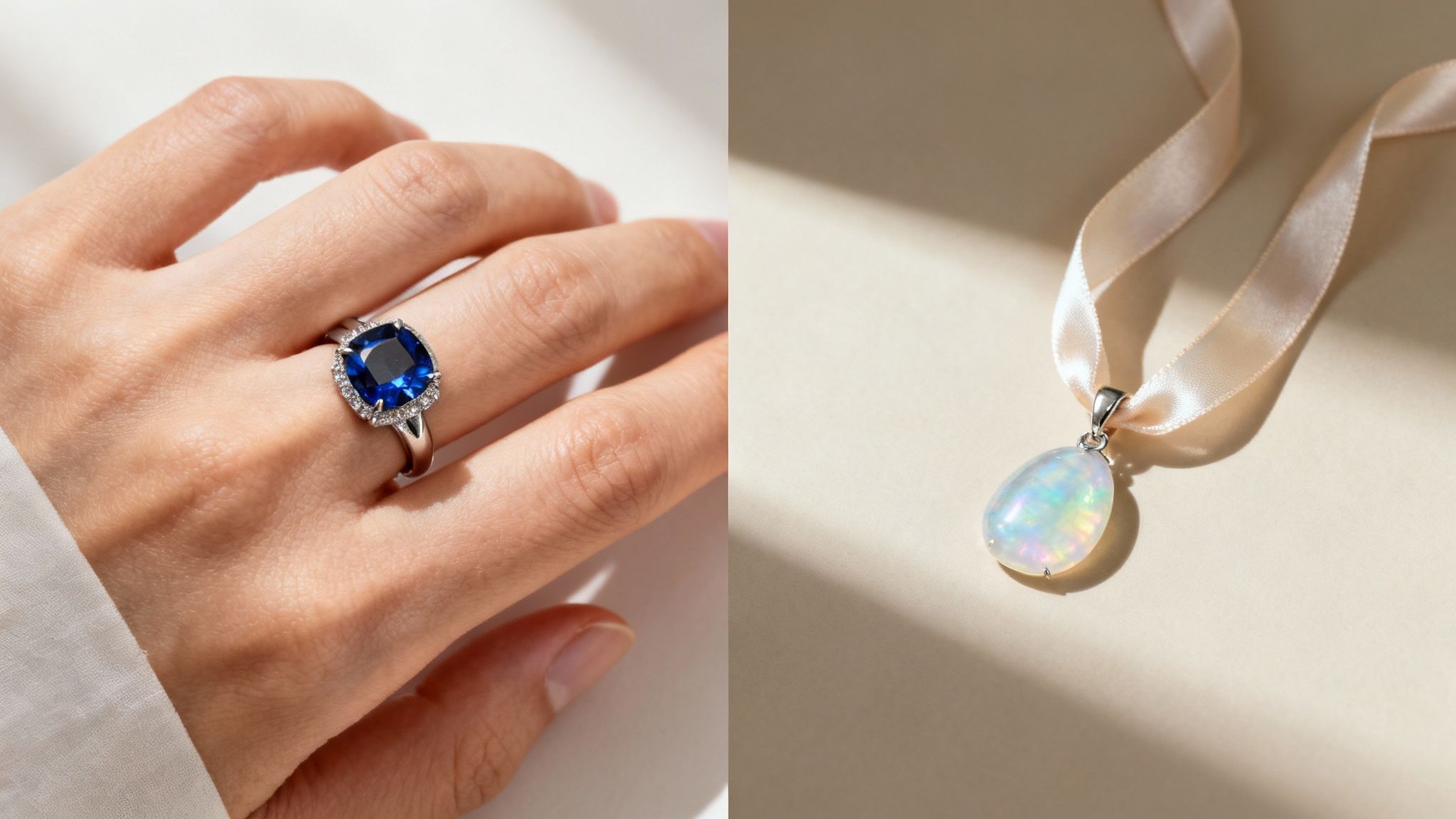
Knowing the stats of a gemstone from our A–Z list is one thing, but putting that knowledge into practice is where the real magic happens. The perfect gemstone isn’t just about finding a pretty color or a brilliant sparkle. It’s about matching the stone to both the jewelry type and your lifestyle.
A gem that might look stunning in a pendant could get completely wrecked after a week on an engagement ring. This guide will help you connect the dots, making sure you choose a piece of jewelry you can love and wear for years to come.
Best Gemstones for Rings and Everyday Wear
Let's be honest: rings take a beating. Engagement rings, wedding bands, and right-hand rings are constantly exposed to bumps, scrapes, and knocks. For any ring you plan on wearing daily, durability is the most important factor. Period.
This is where the Mohs scale of hardness becomes your best friend. A higher number means the gem is more resistant to scratching, which is what keeps it looking polished and brilliant over time.
Mohs Hardness of 8 or Higher: Stones in this range are your safest bet. We’re talking about Diamond (10), Sapphire and Ruby (9), and Alexandrite (8.5). Their incredible toughness means they can handle the grind of daily life without you having to worry.
Think About Lifestyle: Is the ring for someone with a very active lifestyle or a hands-on job? If so, you should lean heavily toward the hardest stones available. A protective setting, like a bezel that wraps around the stone's edge, can also add a huge layer of security.
Top Choices for Necklaces and Pendants
Necklaces and pendants live a much more sheltered life, hanging safely against the chest with very little risk of impact. This opens up a whole world of possibilities, letting you choose softer, more delicate gemstones that would be too fragile for a ring. Here, you can focus on color, uniqueness, and personal meaning instead of just raw durability.
A pendant is the perfect place to show off a gemstone with a really unique optical effect. Think of the mesmerizing play-of-color in an Opal or the gentle, glowing sheen of a Moonstone. These stones can finally get the attention they deserve without the constant fear of damage.
Softer stones that really shine in pendants include:
Opal (5.5–6.5): Its incredible flashes of color are best seen in a piece that moves with the body.
Pearl (2.5–4.5): A timeless, elegant choice whose delicate luster is kept safe from scratches.
Turquoise (5–6): The bold, opaque color makes a gorgeous statement hanging from a chain.
Ideal Gems for Earrings
Earrings are by far the safest pieces of jewelry you can own. Tucked away on the ear, they are almost completely protected from bumps and scratches. This makes them the perfect place to experiment with any gemstone you love, no matter its hardness.
For earrings, the main things to think about are color, cut, and weight. You can confidently choose softer stones like Lapis Lazuli or Tanzanite without a second thought. Because they're worn as a pair, the cut and symmetry become really important for a balanced, polished look. The color can also be chosen to complement the wearer's eyes or skin tone, making them an incredibly personal accessory.
A Guide to Gemstone Treatments and Enhancements
When you start exploring the world of gemstones, you’ll quickly notice that many have been “treated” or “enhanced.” This isn't some industry secret; it's a standard and widely accepted practice that helps improve a gem’s color or clarity. Think of it as the finishing touch.
These enhancements unlock the hidden potential within a stone, making truly beautiful gems more accessible and affordable. Transparency is everything, though. A reputable seller will always tell you what treatments a stone has undergone, which helps you understand its value and how to care for it properly.
Common Gemstone Enhancements
Treatments can be as simple as gentle heating or as complex as modern irradiation. Each method has a specific purpose, designed to turn a beautiful stone into an unforgettable one.
Here are a few of the most common treatments you’ll come across:
Heat Treatment: This is by far the most prevalent enhancement. It’s used on stones like sapphires and rubies to permanently deepen their color and melt away tiny inclusions, improving their clarity. In essence, it completes a process that nature started but didn’t quite finish.
Oiling: Used almost exclusively for emeralds, this treatment involves filling tiny, surface-reaching fissures with a colorless oil or resin. It’s a delicate process that makes the emerald’s natural inclusions far less visible, dramatically improving its transparency and overall appearance.
Irradiation: This is how we get those stunning, vibrant blue hues in most topaz. A colorless topaz is exposed to radiation to alter its atomic structure and change its color, which is then followed by a gentle heating to stabilize the gorgeous new shade.
It's important to remember that treatments don't make a gemstone "fake." They are simply part of the journey for many gems, a way of enhancing the natural beauty that was already there.
Gemstone Questions Answered
Even after scrolling through dozens of gemstones, a few questions always pop up. It’s totally normal. Here are some quick, clear answers to the things jewelry shoppers wonder about most, so you can feel completely confident in your choice.
What’s the Real Difference Between Precious and Semi-Precious Gemstones?
Historically, only four stones got the “precious” title: diamond, ruby, sapphire, and emerald. Everything else was lumped into the "semi-precious" category. Truthfully, that distinction is pretty outdated now.
Today, a gemstone’s value is all about its quality—the famous 4Cs of color, clarity, cut, and carat weight. For instance, a top-grade tsavorite garnet can easily be worth more than a lower-quality emerald. It’s much smarter to judge each stone on its own merit instead of relying on an old-fashioned label.
The modern market cares about rarity and beauty, not old classifications. A flawless, vibrant "semi-precious" stone will always outshine a mediocre "precious" one.
How Does the Mohs Scale of Hardness Actually Work?
The Mohs scale is a simple way to measure how resistant a mineral is to scratching, ranking gems from 1 (Talc) to 10 (Diamond). It’s a straightforward comparison of what can scratch what.
But here’s the crucial part: the scale isn’t linear. A Diamond at 10 isn't just a little harder than Corundum (ruby and sapphire) at 9—it's many times harder. This is exactly why a gem’s Mohs rating is so important for figuring out if it can handle the bumps and scrapes of everyday wear.
Are Lab-Grown Gemstones Considered Real?
Yes, one hundred percent. Lab-grown gemstones have the exact same chemical, physical, and optical properties as their mined counterparts. The only thing that separates them is their origin story—one grew in a controlled lab environment, the other deep within the earth.
They offer the same stunning beauty and durability, often as a more ethical and budget-friendly choice. It’s a common point of confusion, but you can rest assured they are the real deal.
At Panther De Luxe Shop, we believe every gemstone has its own magic, whether it’s a timeless classic or a modern favorite. Explore our collections and find the piece that’s waiting to tell your story. Discover your next treasure at Panther De Luxe Shop.
Comments