
Difference Between Precious and Semi Precious Stones Guide
- Luke Zucco
- 1 day ago
- 16 min read
The whole idea of "precious" vs. "semi-precious" stones is really just a throwback—a tradition, not a scientific rule. Historically, only four gems got the top-tier "precious" label: diamond, ruby, sapphire, and emerald. Everything else was lumped into the semi-precious category. But in today's market, that old system can be pretty misleading.
Unpacking Historical Gemstone Labels
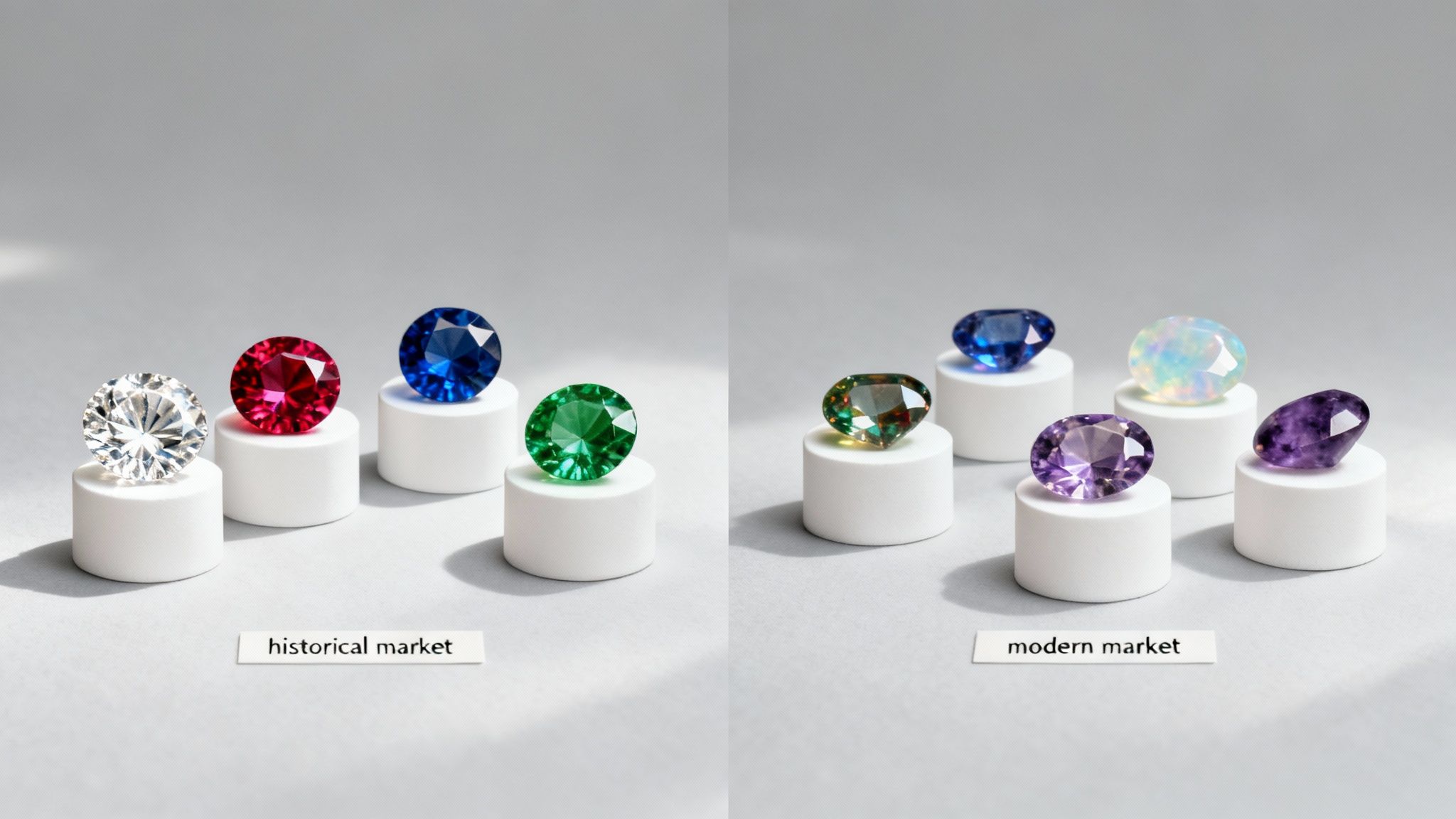
That line separating precious from semi-precious is a relic of the past, something more rooted in old-school marketing than a stone's actual quality or value. For centuries, this created a clear hierarchy, but if you look at the modern gem market, you'll see a totally different story.
The old labels can trip you up because they suggest "precious" always means more valuable. In reality, a stone's true worth comes down to its individual quality, how rare it is, and what people are willing to pay for it—not its historical classification.
The Origins of a Misleading System
The distinction between precious and semi-precious was largely drawn up centuries ago by European traders. Back then, it was all about rarity and demand, which crowned diamonds, rubies, sapphires, and emeralds as the world's most elite gems. In contrast, stones that were more widely available, like amethyst or garnet, got the "semi-precious" tag and were often priced under $300 for the mass market. If you're curious about how these values were set, there's some great background on how gemstone values were established.
This history has led to some common myths that just don't hold up anymore:
Myth: Precious stones are always more expensive than semi-precious ones.
Reality: Not even close. A top-quality semi-precious gem, like a rare Paraíba tourmaline, can easily fetch a higher price than a low-quality ruby or sapphire.
Myth: "Semi-precious" means the stone is less beautiful or lower quality.
Reality: Many semi-precious stones are absolute showstoppers. Think of the incredible color and sparkle of tanzanite or a tsavorite garnet—they can easily rival anything from the "big four."
The key takeaway is that 'precious' and 'semi-precious' are just outdated marketing labels. A gem's real value is determined by its individual characteristics—the famous 4Cs (color, clarity, cut, and carat weight)—not which category it was put in centuries ago.
A Modern View of Gemstone Categories
Today, gemologists and savvy jewelers tend to skip these rigid classifications. Instead, they look at each stone for what it is. The table below really shows the gap between the traditional view and what's actually happening in the market now.
Precious vs Semi Precious Stones: A Modern Snapshot
This table offers a quick look at how the old-school labels stack up against today's reality.
Attribute | Precious Stones | Semi-Precious Stones |
|---|---|---|
Historical Examples | Diamond, Ruby, Sapphire, Emerald | All other gemstones (e.g., Amethyst, Garnet, Topaz, Tourmaline, Jade) |
Perceived Rarity | Considered extremely rare and exclusive | Generally seen as more common and abundant |
Modern Value Reality | Value varies wildly; a low-quality diamond can be quite inexpensive | High-quality specimens of certain stones can be exceptionally rare and incredibly valuable |
Market Perception | Still seen as the peak of luxury jewelry and investment gems | Increasingly popular for their unique colors, affordability, and versatile style |
Ultimately, while the history is interesting, it shouldn't be the final word when you're choosing a piece of jewelry. Focus on what you love and the quality of the individual stone, and you can't go wrong.
How Rarity and Market Demand Define a Gem's Value
The real story of a gemstone’s worth isn’t about old labels—it’s about supply and demand. Tradition put diamonds, rubies, sapphires, and emeralds on a pedestal, but the modern market plays by a different set of rules. Today, what truly drives value are rarity, quality, and the shifting tastes of buyers.
This means the line between precious and semi-precious stones is constantly blurring. A gem's value is fluid, influenced by everything from how hard it is to mine to its popularity on social media. Understanding these forces is the key to seeing what really makes a gemstone valuable.
Rarity Beyond the "Big Four"
True rarity isn’t just a name; it’s about how difficult a gem is to find in nature, especially in high quality. The traditional “precious” gems are definitely rare, but some so-called semi-precious stones are far scarcer and can command astonishing prices.
A perfect example is Paraíba tourmaline. Its electric, neon-blue glow—caused by traces of copper—is found in only a handful of locations worldwide. A top-grade Paraíba can easily fetch a higher price per carat than a mid-quality ruby, completely flipping the old classification system on its head.
A gemstone's value is ultimately a reflection of its rarity and beauty. An exceptional semi-precious stone will always be more valuable than a mediocre precious stone. The market values quality over category.
Another great case study is tsavorite garnet. Known for a brilliant green that rivals the finest emeralds, tsavorite is mined in very limited quantities in East Africa. Because it’s so rarely found in large sizes, a clean, vibrant tsavorite over two carats is a genuine collector's item prized by designers.
How Geopolitics and Mining Impact Price
A gem’s journey from a mine to a jewelry store is full of challenges that directly impact its final price. Geopolitical instability, mining restrictions, and environmental regulations can create bottlenecks in the supply chain, causing prices for certain gems to skyrocket. This is where a gem’s origin story becomes a critical part of its value.
For instance, Colombian emeralds are prized for their unique, vivid green. But political and social issues in the region have historically complicated mining operations, limiting the supply of these top-tier stones. Similarly, the world's finest rubies have traditionally come from Myanmar, but trade restrictions and political turmoil have made them incredibly scarce, driving their value way up.
Recent trends confirm this. In the past decade, prices for high-quality emeralds and rubies have surged by over 30% due to these kinds of mining and geopolitical issues. With the global gemstone market valued at over $23 billion, precious stones still lead the high-end jewelry segment, which accounts for about 75.7% of the market share. You can dig deeper into the gemstone market's economic drivers to see how these factors play out on a global scale.
The Power of Consumer Desire
Ultimately, what we want is what dictates a gem's worth. Trends in fashion, celebrity endorsements, and cultural moments can turn a once-overlooked stone into a must-have. Tanzanite, for example, was relatively unknown until Tiffany & Co. launched a major marketing campaign in the 20th century, transforming it into one of today’s most popular blue gemstones.
This proves that beauty and desirability are subjective. As buyers become more educated, they’re prioritizing individual traits like color, brilliance, and origin over outdated labels. This shift empowers you to look beyond traditional categories and choose a stone that truly speaks to you, confident that its real value lies in its unique beauty and rarity.
Comparing Durability, Brilliance, and Physical Traits
Beyond market trends and old labels, the physical traits of a gemstone are what really matter for a piece of jewelry you’ll wear every day. Things like hardness, brilliance, and luster aren't just for gemologists—they directly impact how a stone looks and, more importantly, how it holds up to real life.
These characteristics give us a far more practical way to understand the difference between so-called precious and semi-precious stones.
It All Starts With Durability
A stone’s most practical feature is its durability. We measure this using the Mohs scale of hardness, which ranks minerals from 1 (super soft) to 10 (the hardest). This scale is a game-changer because it tells you how well a gem resists scratching—a major hazard for pieces you wear often, especially rings.
For example, a diamond scores a perfect 10 on the Mohs scale. That’s why it’s the go-to for engagement rings meant to last for decades. Sapphires and rubies, both part of the corundum mineral family, are right behind at a 9, making them fantastic and tough alternatives.
Understanding Hardness in Different Gemstones
On the other hand, many popular semi-precious stones are quite a bit softer. Take opal, for instance. It has a Mohs hardness between 5.5 to 6.5, which makes it much more likely to get scratched or chipped. While undeniably beautiful, an opal is a better fit for pendants or earrings that don't see much action, rather than an everyday ring.
Tanzanite (6.5) and moonstone (6-6.5) also need a gentler touch. Knowing this helps you pick a gem that actually fits your lifestyle. If you're active or work with your hands, a harder stone is simply a smarter investment.
Brilliance, Fire, and the Magic of Light
While durability is about longevity, a gem’s beauty comes alive in how it plays with light. A few key optical properties create that visual magic, and they can vary dramatically from one gem to another.
Here’s what creates that stunning sparkle:
Brilliance: This is the pure white light that reflects back from a gem's surface and all its internal facets. A well-cut diamond is famous for its off-the-charts brilliance.
Fire (or Dispersion): This is that beautiful, prism-like effect where white light splits into a rainbow of colors as it travels through the stone. Diamonds have incredible fire, but so do some semi-precious stones like sphene and demantoid garnet.
Luster: This describes how light bounces off the gem's surface. Luster can be glassy (vitreous) like a sapphire, waxy like turquoise, or even silky like a tiger’s eye.
The cut is what unlocks all of this. A master cutter studies a rough stone to figure out the perfect shape and facet pattern to maximize its brilliance and fire. A great cut can make a stone look infinitely more vibrant and valuable, while a poor one can leave even the finest gem looking flat and lifeless. If you want to learn the basics of spotting these qualities, our guide on how to identify gemstones at home is a great place to start.
A gemstone’s cut is arguably as important as its color or clarity. The right cut transforms a simple mineral into a dazzling jewel by manipulating light to create the maximum visual impact. It’s the art that brings the science to life.
The chart below shows how different factors, including these physical traits, build the overall value of both precious and semi-precious gems.
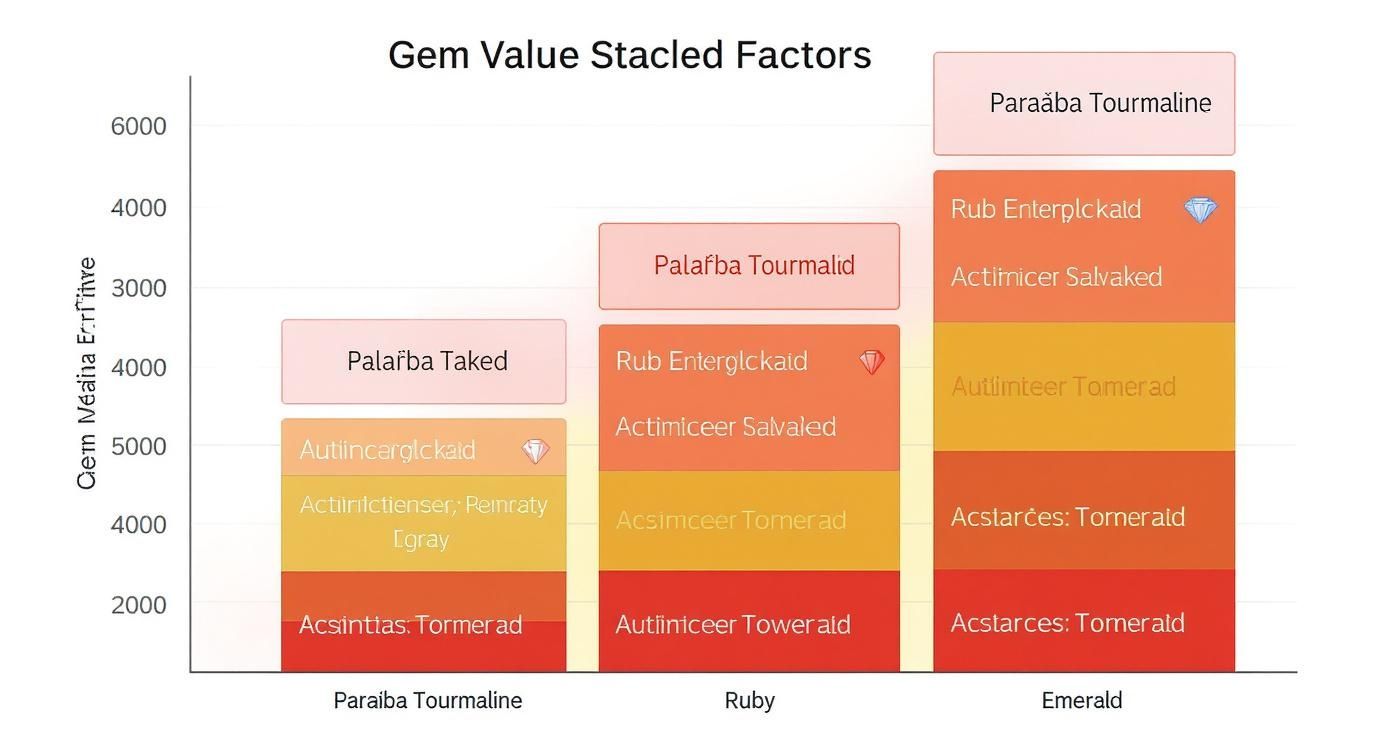
As you can see, things like rarity and color saturation can push a stone like Paraíba Tourmaline's value right up there alongside traditional precious gems like ruby and emerald.
Practical Comparisons for Everyday Choices
To tie all this together, let's look at a few popular stones side-by-side. The table below breaks down their key physical properties, helping you choose based on both beauty and durability.
Physical Property Comparison of Popular Gemstones
Gemstone | Type | Mohs Hardness | Refractive Index | Best For |
|---|---|---|---|---|
Diamond | Precious | 10 | 2.42 | Daily wear jewelry, especially rings |
Sapphire | Precious | 9 | 1.76 - 1.77 | Daily wear, versatile for all jewelry types |
Emerald | Precious | 7.5 - 8 | 1.57 - 1.58 | Careful wear; best in protective settings |
Amethyst | Semi-Precious | 7 | 1.54 - 1.55 | Pendants, earrings, and occasional rings |
Aquamarine | Semi-Precious | 7.5 - 8 | 1.57 - 1.58 | Versatile for most jewelry with proper care |
Opal | Semi-Precious | 5.5 - 6.5 | 1.45 | Special occasion pieces, pendants, earrings |
Ultimately, whether you land on a "precious" or "semi-precious" stone, understanding its physical DNA is everything. This knowledge empowers you to pick a gemstone that not only looks incredible but is also perfectly suited for how you plan to wear and enjoy it for years to come.
Choosing the Right Gemstone for Your Jewelry
Alright, now that we've broken down what gives a gem its value, let's get to the fun part: picking one. Choosing a gemstone is a deeply personal decision, one that goes way beyond the old-school labels of "precious" or "semi-precious." It’s about finding a stone that slots perfectly into your life, your style, and your budget.
This guide is all about real-world scenarios. We'll help you figure out whether you need a tough-as-nails stone for daily wear or a dazzling gem for special occasions. Your perfect gemstone is out there.
Matching Durability to Daily Life
For jewelry you wear all the time—especially rings and bracelets—durability is everything. These pieces take a lot of abuse, from accidental bumps to everyday scrapes. This is where the Mohs scale isn't just a number; it's your best friend in avoiding a heartbreaking choice.
Take an engagement ring. It has to last a lifetime of wear. A sapphire, clocking in at a 9 on the Mohs scale, is a fantastic choice. It's incredibly tough, comes in nearly every color imaginable, and gives you that classic look without sacrificing an ounce of resilience. On the other hand, a softer gem like tanzanite (a 6.5 on the scale) is a riskier bet for a daily ring. Its stunning violet-blue hue is better suited for a pendant or earrings, where it’s safe from hard knocks.
A gemstone's hardness should directly inform its role in your jewelry collection. For daily wear, always lean toward stones rated 7 or higher on the Mohs scale. Reserve more delicate gems for pieces that are worn less frequently and with greater care.
Think honestly about your lifestyle. Are you constantly gardening, working out, or just generally hard on your hands? A tough stone like a ruby or sapphire is a smart, worry-free move. If you work in an office and are pretty mindful of your jewelry, you could easily rock a slightly softer stone like aquamarine (hardness 7.5-8) without any trouble.
Aligning Gemstones with Personal Style and Occasion
Your jewelry is an extension of who you are, and the right gemstone should feel like you. Don't let the "precious" label box you in; some of the most unique and stylish stones are technically semi-precious.
Are you all about bold, eye-catching colors? A fiery orange spessartite garnet or a rich purple amethyst can make an incredible statement. If you lean more toward subtle elegance, the dreamy glow of a moonstone or the soft pink of morganite might be your perfect match. Your personal style is the only compass you need here.
The occasion also matters. Here are a few ways to think about it:
For a Milestone Anniversary: A classic precious stone like a ruby (for passion) or an emerald (for hope) brings a sense of history and meaning to the moment.
For a Fashion-Forward Statement Piece: This is where semi-precious gems shine. A huge, expertly cut citrine or a bold piece of turquoise can be both affordable and impossibly chic.
For a Birthstone Gift: This is such a great way to personalize a piece. Every month has a designated gem, offering a whole spectrum of precious and semi-precious options.
Balancing Budget with Beauty
Let's talk about the bottom line. Your budget is a real-world constraint, but the good news is you don't need a massive one to own a beautiful, high-quality gemstone. The vast world of semi-precious stones offers incredible bang for your buck.
Instead of stretching your budget for a small, included precious stone, you could get a much larger, flawless semi-precious gem for the same price. For instance, a clear, vibrant aquamarine will give you far more visual impact than a similarly priced emerald that's full of inclusions. It’s all about getting the most beauty for your money.
Checking out the top 10 best gemstones for jewelry in 2025 can give you even more ideas for finding a stone that feels current and fits your wallet. At the end of the day, knowing the real story behind "precious" and "semi-precious" gives you the power to choose wisely—and find a gem you'll love for years to come.
The Story Behind the Stone: Sourcing Ethics and Lab-Grown Choices
These days, the story behind a gemstone is just as important as its sparkle. The line between precious and semi-precious stones is blurring, and a new question is taking center stage: where did this stone really come from? Shoppers are asking the tough questions, pushing the entire jewelry industry to be more transparent.
This shift has made terms like “conflict-free” and “ethical sourcing” part of the everyday conversation. It’s all about ensuring that a gem was mined and sold without funding conflict, exploiting workers, or damaging the environment. A conscious choice means looking past the stone’s beauty and understanding its journey from the ground to your hands.
The Murky Waters of Ethical Sourcing
When it comes to diamonds, the Kimberley Process Certification Scheme, established in 2003, was meant to stop the trade of "conflict diamonds." It was a decent first step, but it’s come under fire for having a definition of "conflict" that's too narrow, often failing to address bigger issues like human rights or environmental harm.
For colored gemstones—both precious and semi-precious—the path is even more complicated. There’s no single, global system like the Kimberley Process to track them from mine to market. This lack of a clear chain of custody makes it incredibly difficult for anyone to be 100% certain about a colored stone’s origin and ethical standing.
When you're buying a natural gemstone, transparency is everything. Don't be shy—ask your jeweler specific questions about the stone's origin and their supplier's policies. A reputable seller should be happy to talk about their commitment to responsible practices.
This ambiguity has fueled a massive demand for a different kind of gemstone—one with a backstory that’s perfectly clear.
The Clear-Cut Case for Lab-Grown Gemstones
Lab-grown gemstones aren't fakes or imitations. They're the real deal, just created in a controlled environment instead of pulled from the earth. For buyers who put ethics and sustainability first, they’ve become an incredibly popular choice. Why? Because they are physically, chemically, and optically identical to their mined counterparts.
Let's break it down:
Chemical Makeup: A lab-created ruby has the exact same corundum (Al₂O₃) structure as a natural one. A lab-grown diamond is pure carbon, atom for atom, just like a mined diamond.
Physical Properties: They have the same score on the Mohs hardness scale, the same refractive index, and the same fire. It takes a gemologist with specialized equipment to spot the difference.
Ethical Guarantee: Their origin is completely known and documented. This erases any worry about funding conflict or relying on exploitative labor.
Because they’re created without the huge environmental and social footprint of mining, lab-grown gems are a truly sustainable option. They let you own a stunning, brilliant stone with a clean conscience—often at a more accessible price. If you want to dive deeper, exploring a detailed guide to a lab-created diamond ring can show you just how compelling this modern choice is.
Ultimately, whether you choose a natural or a lab-grown stone is a personal decision. Both offer incredible beauty. But by understanding the sourcing challenges of mined gems and the identical quality of lab-grown alternatives, you can make an informed choice that reflects not just your style, but your values, too.
Understanding the Global Gemstone Market
Every gem, whether it’s a diamond in a high-end boutique or a piece of turquoise from a local market, is part of a massive global industry. Digging into the economics behind these stones reveals why certain gems feel like investments and others feel like personal style statements.
This bigger picture shows how your choice of jewelry fits into a much larger story of luxury, fashion, and what we value today.
The global gemstone market is a powerful engine, fueled by our timeless love for all things beautiful and rare. For centuries, precious stones have been the bedrock of this industry, anchoring the world of high-end luxury. They aren't just seen as accessories, but as real assets—pieces that hold their value and are passed down through generations.
Two Markets, Two Vibes
You can think of the gemstone market as running on two parallel tracks.
On one side, you have the world of high jewelry, dominated by the “big four”: diamonds, rubies, sapphires, and emeralds. This is the world of record-breaking auctions, bespoke creations, and a clientele that views these gems as a store of wealth.
On the other track, the semi-precious market is absolutely booming, but for completely different reasons. Here, it’s all about accessibility, variety, and self-expression. This is where the modern jewelry lover’s desire for unique, colorful, and affordable pieces finds its perfect match, creating a vibrant and fast-growing world of its own.
This is the key functional difference between precious and semi precious stones today. One serves the pinnacle of luxury, while the other fuels the dynamic world of accessible fashion.
The global gemstone market operates like two distinct ecosystems. The precious stone market is driven by legacy, investment, and exclusivity. The semi-precious market thrives on trends, accessibility, and the creative energy of a new generation of buyers.
The Numbers Behind the Sparkle
The sheer scale of this industry is huge. The global gemstones market, covering both categories, was valued at around USD 34.3 billion and is projected to climb to nearly USD 57 billion by 2033.
While precious stones make up most of this value, the semi-precious jewelry market is growing much faster, with a projected CAGR of 16.0%. A massive 43% of its sales in 2023 came from the $151–$300 price range—a sweet spot for millennial and Gen Z shoppers. You can dive deeper into this in a market analysis of semi-precious jewelry.
What's Driving the Market Forward
A few key trends are shaping the future of gems, influencing both sides of the market:
The Power of Personalization: Younger buyers are moving away from old-school status symbols. They want jewelry that tells their story, whether it's through a birthstone, a favorite color, or a gem with personal meaning. This trend is a huge win for the incredible variety found in semi-precious stones.
A Focus on Ethics: As we talked about earlier, where a stone comes from matters more than ever. This focus on ethical sourcing and sustainability has boosted the appeal of both responsibly mined gems and lab-grown alternatives across the board.
The Influence of Social Media: Platforms like Instagram and TikTok have become major trendsetters. A single viral post can ignite demand for a lesser-known gem overnight, showing just how fast consumer tastes can shift and elevate a stone’s status.
In the end, whether you choose a timeless diamond or a vibrant piece of turquoise, you’re part of a global conversation. Your choice doesn’t just reflect your style and budget—it taps into the broader economic and cultural currents that shape what we value and why.
Gemstone FAQs
Even after getting the hang of the differences between precious and semi-precious stones, a few questions always seem to come up. Here are some straight-forward answers to help you navigate the gem world like a pro.
Is a Precious Stone Always More Valuable?
Not at all—this is probably the biggest myth in the jewelry world. While the "big four" can definitely fetch some sky-high prices, a top-tier semi-precious stone will always outshine a low-quality precious one.
For instance, a rare, electric-blue Paraíba tourmaline can easily sell for more per carat than a commercial-grade emerald with visible inclusions. It's the 4Cs—color, clarity, cut, and carat weight—plus rarity that truly drive value, not some old-school label. This is a core part of the modern take on the difference between precious and semi precious stones.
Are Semi-Precious Gems Less Durable?
Not necessarily. Durability is measured on the Mohs scale of hardness, and there’s a surprising amount of overlap between the two categories. Sapphires and rubies are incredibly tough at a 9 on the scale, which is why they’re perfect for rings you wear every day.
But plenty of semi-precious stones are seriously durable, too.
Quartz varieties like amethyst and citrine clock in at a solid 7.
Aquamarine and morganite, which are in the same beryl family as emerald, score a 7.5 to 8.
These gems are more than tough enough for most jewelry, as long as you treat them with a little care. Softer stones like opal (5.5-6.5) just need to be worn a bit more mindfully to avoid scratches.
Can a Semi-Precious Stone Be an Investment?
Absolutely. While the go-to investment gems are usually precious stones, certain rare, high-quality semi-precious stones have shown some serious appreciation in value. Gems like tsavorite garnet, imperial topaz, and Paraíba tourmaline are huge among collectors and can make for excellent investments.
The key is finding something truly rare and exceptional. As the mines for these unique stones start to run dry, their value is only expected to climb.
The most important rule for buying any gemstone is to choose something you truly love. Investment potential is a great bonus, but the real value of jewelry is the joy it brings you. Pick a stone that feels like you.
Do Lab-Grown Gems Count as Real?
Yes, they do. Lab-grown gemstones are physically, chemically, and visually identical to stones pulled from the earth. A lab-created sapphire is a real sapphire—it just has a different origin story.
They also offer a guaranteed conflict-free and more sustainable choice, often at a friendlier price point, without giving up an ounce of beauty or durability.
At Panther De Luxe Shop, we believe every gemstone has its own unique story and beauty, no matter what it's called. Explore our curated collections of fine jewelry and find the piece that speaks to you.