
How to Fix Broken Earrings A DIY Repair Guide
- Luke Zucco
- Oct 26, 2025
- 11 min read

When a favorite earring breaks, it's a special kind of disappointment. That feeling when a beloved hoop won't clasp or a stud post gets bent can sideline a piece you truly love. But here's the good news: most of these problems are surprisingly easy to fix right at home.
Fixing your own jewelry often just comes down to knowing what you're looking at, having a couple of key tools, and using a gentle, steady hand. Many common issues, like a bent post or a loose jump ring, can be sorted out in minutes. It's incredibly satisfying to bring a cherished piece back to life yourself.
Your Essential Guide to Common Earring Repairs
Before you even think about tossing that broken earring, let's figure out what's really wrong. The first step is always to diagnose the problem. From there, you can see if it's a quick fix or something more involved.
Many fixes are simpler than they appear, whether you're straightening a post, re-securing a loose gemstone, or closing a gap in a chain link. To get started, you'll want to have a small, dedicated toolkit. For a complete rundown of what to keep in your jewelry first-aid kit, check out our comprehensive guide on how to repair jewelry at home.
Identifying the Break and What You Need
A successful repair is all about preparation. You wouldn't fix a leaky pipe without a wrench, and the same idea applies here. Having the right tools stops you from causing more damage and helps you create a fix that actually lasts.
For most basic earring repairs, you only need a few essentials:
Needle-nose pliers are perfect for delicate adjustments and gripping tiny components without crushing them.
Jewelry-specific adhesive is a must for securing stones without clouding them or damaging the metal finish.
A soft polishing cloth gives you a clean finish and wipes away any fingerprints or smudges.
This DIY spirit isn't just about saving a few bucks; it's part of a much bigger trend. People are choosing to mend their treasured items instead of replacing them. In fact, the global jewelry repair market was valued at around $7 billion in 2022. It's a clear sign that we're more attached to our accessories than ever, making at-home repair skills incredibly valuable.
Quick Diagnosis for Your Broken Earring
Not sure where to start? This table breaks down the most common issues to help you quickly identify the problem and see what you're up against.
Common Earring Problem | What It Looks Like | DIY Difficulty | Typical Solution |
|---|---|---|---|
Bent Post | The straight pin on a stud earring is crooked or bent at an angle. | Easy | Gently straighten with needle-nose pliers. |
Loose Jump Ring | The small circle connecting a charm or dangle is open, causing it to fall off. | Easy | Close the gap tightly using two pairs of pliers. |
Broken Clasp | The hook or lever-back mechanism won't close securely. | Moderate | May require gentle reshaping or a full clasp replacement. |
Missing Gemstone | A stone has fallen out of its setting. | Moderate | Clean the setting and re-secure the stone with jewelry adhesive. |
Think of this as your starting point. Once you've identified the issue, you can gather your tools and get to work with confidence.
Building Your At-Home Earring Toolkit
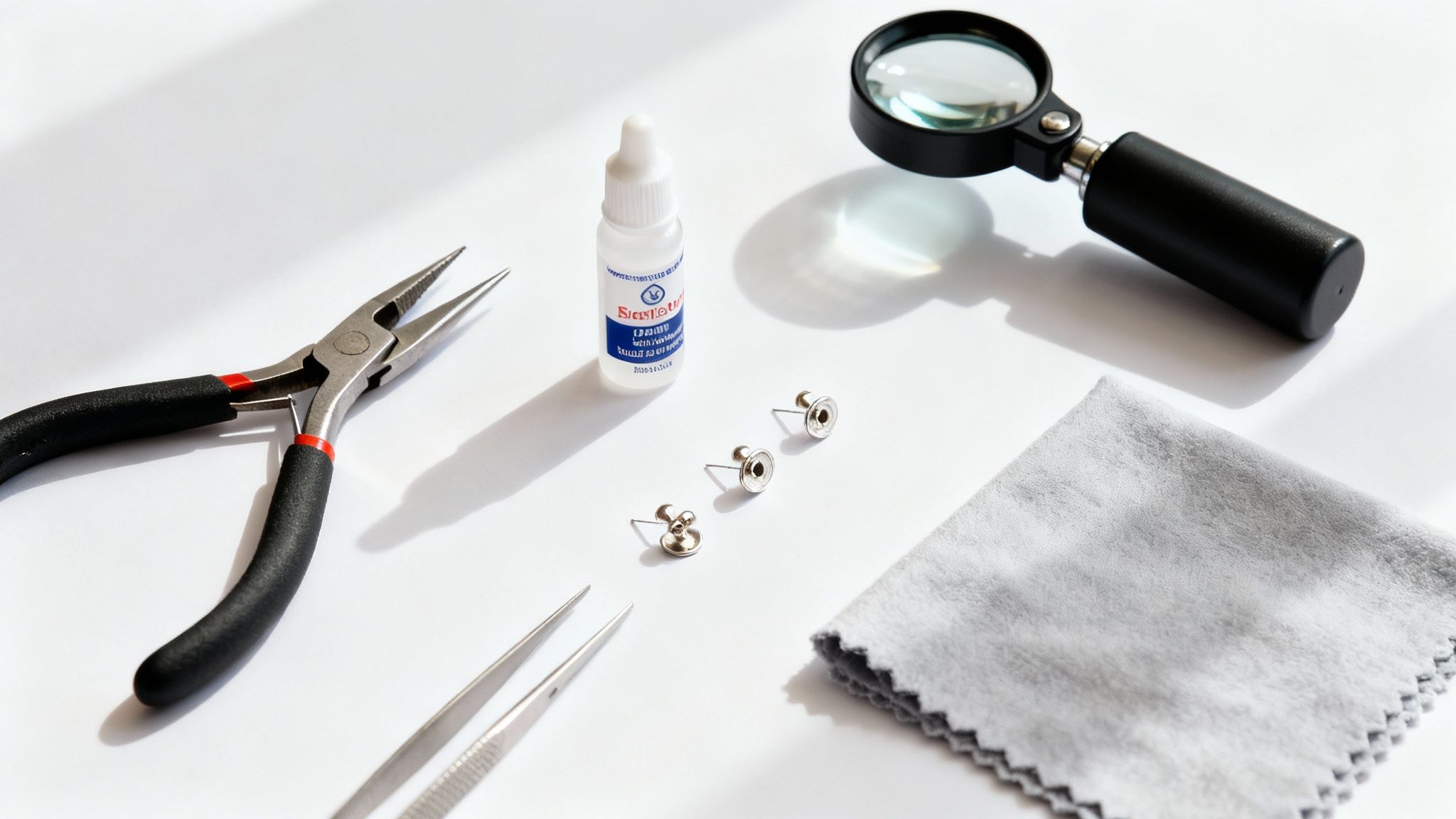
Before you dive into fixing that favorite pair of earrings, let’s talk tools. Trying to muscle a bent post back into shape with the wrong pliers can turn a simple fix into a permanent disaster. Trust me, I’ve seen it happen.
Think of it as creating a first-aid kit for your accessories. You don’t need a professional jeweler's entire setup—just a few key items will empower you to handle most common issues with confidence, from reattaching a charm to straightening a post.
Essential Repair Tools
Most everyday earring repairs can be handled with just a handful of specialized tools. Investing in a few quality basics will pay for itself the very first time you save a piece from the jewelry graveyard.
Needle-Nose and Round-Nose Pliers: These are non-negotiable. Needle-nose pliers give you the precision grip needed for tiny posts and links, while round-nose pliers are your go-to for creating clean, uniform loops.
Jewelry Adhesive: Step away from the super glue. It’s far too brittle for jewelry and can damage metals or stones. Instead, grab a specialized adhesive like E6000 or G-S Hypo Cement, which dries clear and creates a strong, slightly flexible bond that can withstand daily wear.
A Soft Polishing Cloth: Once the repair is done, a quick buff with a polishing cloth removes fingerprints and brings back that beautiful shine. For a deeper clean, check out our guide on how to polish jewelry at home.
Pro Tip: Always use pliers with smooth, non-serrated jaws. Serrated tips will leave marks and scratches on the delicate surface of your earrings. If all you have are the serrated kind, just wrap the tips in a bit of tape to soften their grip.
Your Dedicated Workspace
Even a small, dedicated workspace can make all the difference. It keeps your tiny components from getting lost and lets you focus on the delicate task at hand. If you're tight on space, consider choosing a compact repair workbench to keep your tools organized and your projects contained.
Fixing Bent Posts and Damaged Earring Backs
A bent earring post is probably the most common repair job you'll ever face. It happens all the time—an earring gets snagged on a sweater or tossed into a jewelry box a little too carelessly. The good news? It's usually an easy fix. The bad news? A heavy hand can snap the post right off, turning a tiny problem into a much bigger one.
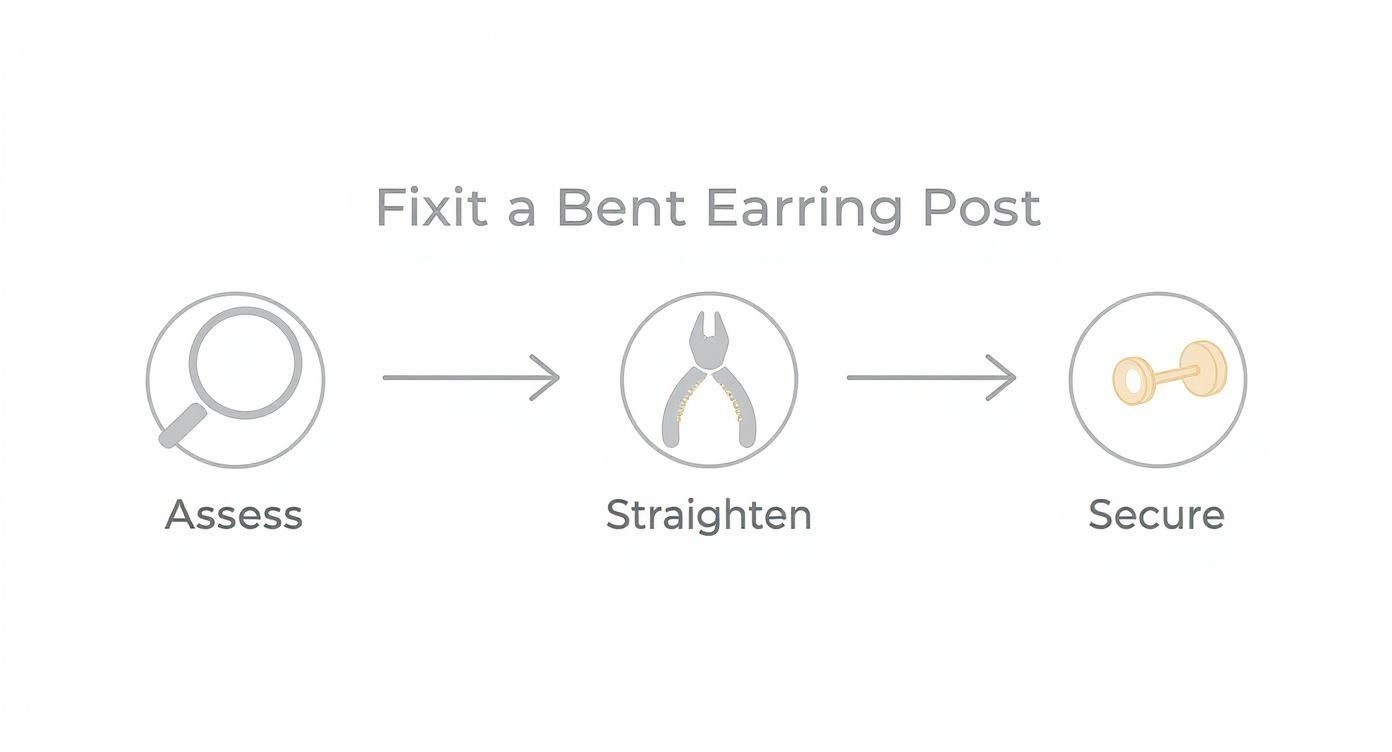
The key here is gentleness. Lay your earring on a flat, stable surface so you have full control. Using a pair of smooth, needle-nose pliers, get a soft grip on the post right at the base, where it meets the earring itself. From there, apply slow, steady pressure to guide it back into its original, straight position. Don't try to force it all at once; small, careful adjustments are always safer.
Adjusting Your Technique for Different Metals
Not all metals are created equal, and the material of your earring post completely changes the game. Some metals are soft and forgiving, while others are tough and require a bit more muscle. Knowing what you're working with is half the battle.
Sterling Silver: This is a very soft and malleable metal, meaning it will straighten with very little effort. Be extra careful here, as it's just as easy to over-bend it or weaken the joint with too much force.
Gold and Gold-Plated: Gold is also on the softer side, but it can get brittle over time. Slow, even pressure is your best friend. If you're working with gold-plated pieces, try to protect the finish by not letting your pliers scratch the surface.
Stainless Steel or Titanium: These are the tough guys. They’re much stronger and more rigid, so you'll need to apply more firm, controlled pressure to get them to budge. On the plus side, they're far less likely to snap from bending, but they are harder to work with.
Dealing with Loose or Lost Earring Backs
An earring is only as good as its back. If you find your butterfly back isn't gripping like it used to, you can often bring it back to life. Just use your pliers to gently squeeze the two looped ends a little closer together. This simple move tightens the tension and gives it a much more secure hold on the post.
A Quick Fix for a Lost BackIf you lose an earring back while you're out and about, don't panic. A tiny piece of a pencil eraser makes a surprisingly effective temporary substitute. It has just enough grip to keep a stud from falling out until you can find a proper replacement.
For other styles, like French hooks that have flattened out, a gentle reshape with round-nose pliers can restore that perfect curve. And if all else fails, replacement backs for almost every style are incredibly cheap and easy to find online or at any craft store.
Reattaching Loose Stones and Embellishments
When a sparkling gem or a pretty little charm falls off an earring, it can feel like the whole piece has lost its personality. It’s a super common problem, especially with more delicate designs, but don't worry—reattaching loose stones is a repair you can definitely handle with a steady hand.
Your first instinct might be to grab the super glue from the junk drawer. Please don't. Standard glues are way too harsh for jewelry, often yellowing over time and becoming so brittle that the stone just pops right back out.
For a fix that actually lasts, you need a specialized jewelry adhesive. Look for something like G-S Hypo Cement or a two-part jewelry epoxy. These are specifically designed to create a strong, clear bond that has just enough flex to handle the bumps of daily wear without cracking.
The Right Way to Secure a Stone
Getting a lasting bond is all about the prep work. Start by cleaning both the loose stone and the setting where it sits. A cotton swab dipped in a little isopropyl alcohol is perfect for getting rid of any oils or dirt that could weaken the glue's grip.
Once everything is clean and totally dry, you’re ready for the adhesive. Squeeze a minuscule amount directly into the setting—not onto the stone itself. A toothpick or the tip of a pin gives you the perfect amount of control here. You need way less than you think.
Pro Tip: Never apply adhesive directly to the stone. Putting it in the setting prevents a messy overflow that can dull the gem’s sparkle and ruin the finish of the metal.
Now, carefully place the stone into the setting using tweezers for precision. Press down gently but firmly to make sure it's seated properly and makes full contact with the adhesive. Then, let it cure for the full time recommended by the manufacturer, which is usually at least 24 hours. Just set it aside somewhere safe and leave it alone.
Understanding the type of setting you're working with can also make a huge difference. If you're curious, you can learn more about the 7 essential types of jewelry settings to get a better handle on these kinds of repairs.
Taking the time to fix a beloved piece is part of a bigger trend. More people are choosing to repair instead of replace, and the global jewelry repair market is projected to hit around $3.9 billion by 2033. It just goes to show how much we value keeping our sentimental items looking their best.
Preventing Future Breaks with Proper Jewelry Care

While knowing how to fix a broken earring is a great skill to have, the best repair is always the one you never have to make. Shifting your focus to preventative care will save you tons of frustration and keep your favorite pieces looking their best. It all starts with how you handle them day-to-day.
Your first line of defense is proper storage. Tossing earrings into a drawer or a cluttered pouch is a recipe for disaster—think tangled chains, scratched gems, and bent posts. Instead, give each pair its own space. A dedicated jewelry box with individual compartments or even a simple hanging organizer can work wonders.
Smart Habits to Protect Your Earrings
Small changes in your daily routine can make a huge difference in the longevity of your jewelry. It’s really just about being mindful of when and where you wear your more delicate pieces.
A few simple but incredibly effective habits can go a long way:
Last On, First Off: This is the golden rule. Always put your earrings on after applying lotions, hairspray, or perfume. The chemicals in these products can tarnish metals and dull gemstones over time. When you get home, take them off first.
Know When to Go Bare: Take your earrings off before swimming, working out, or showering. Chlorine, sweat, and soap residue can cause serious damage, weakening clasps, eroding finishes, and loosening settings.
Give Them a Quick Check-Up: Once a month, take a moment to inspect your collection. Gently wiggle any stones to make sure they’re secure in their settings. Check that clasps and earring backs are still tight and functioning correctly.
To extend the life of your precious items and prevent future breaks, implementing a routine of proper jewelry care is essential. For specific advice on keeping your sparkling pieces in top condition, you can consult a comprehensive diamond care guide.
By adopting these simple practices, you’re not just storing your jewelry; you’re actively preserving it for years to come.
Knowing When to See a Professional Jeweler
There's a special kind of pride that comes with fixing something yourself. But when it comes to jewelry, especially pieces you love, knowing your limits is just as crucial as knowing how to use your tools. Some broken earrings need more than a pair of pliers and a steady hand.
Pushing your luck on a delicate repair can turn a small problem into a permanent one. Think of it this way: you wouldn't perform surgery with a first-aid kit. Some issues simply demand a jeweler's expertise to ensure the repair lasts and the piece retains its beauty and value.
Red Flags That Signal You Need an Expert
It’s one thing to fix a loose jump ring; it's another entirely to mend a broken post. Learning to spot the difference is key to protecting your favorite jewelry. If you see any of these warning signs, it's time to put the tools down and find a pro.
Here are the most common situations where a jeweler is your best bet:
Snapped Posts or Wires: If an earring post has completely broken off, glue is not the answer. A professional will need to solder it back on, a process that uses high heat to create a seamless and incredibly strong metal bond that DIY methods can't replicate.
Repairs Near Gemstones: That same heat from soldering can easily crack or discolor precious stones. Jewelers have specialized techniques to protect gems—or even temporarily remove them—during these tricky operations. Don't risk your favorite stone.
Deep Scratches or Gouges: While you can buff out minor scuffs, deep gouges in precious metals require professional polishing. An expert can restore that smooth, mirror-like finish without removing too much metal and compromising the design.
Damaged or Missing Prongs: Those tiny metal claws holding your gemstone in place are everything. If a prong is bent, broken, or missing, a jeweler needs to rebuild or replace it to make sure your stone doesn't go missing.
Choosing to repair a beloved piece instead of replacing it is a growing trend, reflecting both our emotional attachments and a collective shift toward sustainability. This is fueling major growth in the jewelry repair market, which is projected to hit around $9.21 billion by 2033. You can read more about the expanding repair market and its innovations from Market Report Analytics.
Ultimately, if a piece is valuable to you—either in price or in sentiment—consulting a professional is the safest move. They have the right equipment and years of experience to do the job right, giving your jewelry a second life that will truly stand the test of time.
Your Earring Repair Questions, Answered
Even with a step-by-step guide, you're bound to run into a few tricky situations. When you're learning how to fix your own jewelry, questions are a good thing. Here are a few common ones that come up, along with some straightforward advice to help you finish your repair with confidence.
What's the Best Glue for Fixing Earrings?
Your everyday super glue won't cut it here. For most repairs, especially putting a stone back in its setting, you need a proper jewelry adhesive. I always recommend something like G-S Hypo Cement or a good two-part epoxy.
These create a bond that's strong but also has a little give, which is crucial for something you wear. Regular super glue gets brittle and can crack under pressure, and it can even damage certain metals or gems over time. Always check that the glue is made for non-porous surfaces like metal and stone.
A strong, flexible bond is everything. Super glue cracks, but jewelry-specific adhesives are designed to handle the minor bumps of daily life, keeping your repair from falling apart again.
Can I Fix an Earring Post That Snapped in Half?
If a post snaps clean off, that’s a job for a professional. The only way to create a lasting, wearable bond on a snapped metal post is by soldering. This uses intense heat to literally fuse the metal pieces back together.
Trying to glue a snapped post is a temporary fix at best. It just won’t have the strength to hold up, and it will almost certainly break again—probably when you're wearing it, which is the worst time to lose an earring.
How Should I Clean My Earrings Before Repairing Them?
Don't skip this step—a clean surface is the key to a successful repair. Just gently wipe down the area with a soft cloth and a little bit of isopropyl alcohol.
This gets rid of any oils, dust, or old adhesive residue that could weaken the bond, which is especially important when you’re gluing stones. Let it dry completely before you even think about applying your adhesive.
At Panther De Luxe Shop, we believe every piece of jewelry tells a story worth preserving. Explore our collections and find your next timeless accessory at https://www.pantherdeluxe.com.
Comments