
How to Determine Ring Size Accurately Every Time
- Luke Zucco
- Dec 13, 2025
- 14 min read

Figuring out your ring size is way easier than you think. There are two simple, reliable ways to do it right from your couch: you can either measure your finger directly with something like a string or strip of paper, or you can measure the inside of a ring you already own and love the fit of.
Both methods are straightforward and get the job done, ensuring your next ring fits just right.
Why Your Ring Size Matters
Finding the perfect ring is about more than just a great design—it’s about that flawless fit that feels like it was made just for you. Get the size wrong, and you’re in for some serious frustration. A ring that’s too tight won’t even make it past your knuckle, while one that’s too loose is just a lost treasure waiting to happen.
This guide is here to take the guesswork out of the equation. Whether you’re buying a ring for yourself online, secretly planning a proposal, or just adding to your collection, we’ll help you measure with confidence.
A good fit is everything when it comes to comfort and security. You want to feel great wearing your jewelry without constantly worrying it’ll slip off. This is especially true if you like to explore unique ring watch styles, since those cool, distinctive pieces also need a perfect, snug fit to work.
The Foundation of a Perfect Fit
We're going to walk through two dependable methods you can easily master at home. These are the building blocks for getting an accurate measurement every single time.
Measuring Your Finger Directly: This technique uses simple household items—think a piece of string or a thin strip of paper—to find your finger’s circumference.
Using an Existing Ring: If you already have a ring that fits the right finger perfectly, you can just measure its internal diameter to discover your size.
Finding your ring size is a simple skill that completely transforms how you buy jewelry. It takes you from feeling uncertain to totally confident, making sure every piece you choose is one you can wear and love without a second thought.
The quest for the perfect fit isn't new, either. Ring sizing has come a long way from its early days around 850 AD, when sizing was a bespoke luxury for the elite. By the 20th century, the US and UK had developed standardized systems. Today, digital tools have made things even more precise, slashing resizing errors from a staggering 40% down to under 5%.
Now that you've got the basics, let's get into the practical, step-by-step methods that will empower you to find your ring size accurately and easily.
Reliable At-Home Ring Sizing Methods
Figuring out your ring size at home doesn't have to be a guessing game. In fact, you can get a surprisingly accurate measurement with just a few household items. When you get it right, you can shop for rings online or plan a surprise with total confidence, knowing you've nailed the fit.
The journey often starts with a little frustration but ends with that perfect, comfortable fit you were hoping for.
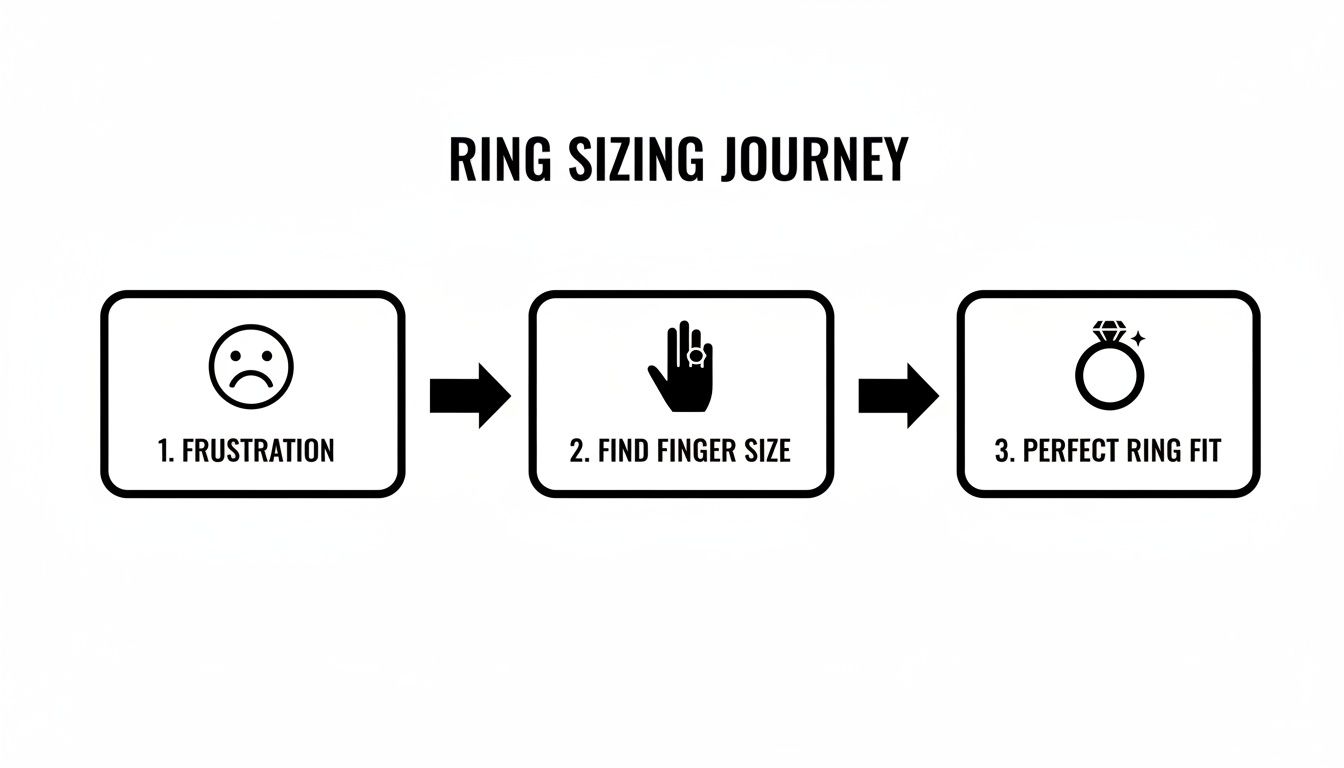
This simple path shows how you move from uncertainty to focusing on the details of your finger and the ring itself, which ultimately leads to a great outcome.
Measure Your Finger with String or Paper
One of the easiest ways to find your ring size is by measuring your finger's circumference. All you need is a thin strip of paper, a piece of string that doesn't stretch, a ruler, and a pen.
It’s a pretty straightforward process. First, wrap the paper or string snugly around the base of your finger—right where the ring will sit. The key is to make it snug enough so it won't fall off, but loose enough that you can still slide it over your knuckle. That's a common mistake people make.
Once it feels right, use your pen to mark the spot where the end overlaps. Then, unwrap it, lay it flat against a ruler, and measure the length from the end to your mark in millimeters. That number is your finger's circumference.
To turn that measurement into an actual ring size, you'll need to consult a chart. We have a detailed engagement ring size chart for the perfect fit that makes it easy to convert your millimeters to the corresponding US, UK, or EU size.
Use a Ring That Already Fits Perfectly
If you already own a ring that fits the intended finger like a glove, you're in luck. This is often the most reliable method because you're starting with a proven, comfortable fit.
You can do this in two ways. The first is to measure the ring's internal diameter. Just lay the ring on a flat surface and use a ruler to measure the distance straight across the inside of the band. Make sure you're measuring the widest part of the circle and jot down the measurement in millimeters.
Another great option is to use a printable ring sizer, which many jewelers (including us) offer online. Just be sure to print it at 100% scale to get an accurate reading. Once printed, place your ring over the circles on the chart until you find the one where the black outline is just barely visible inside your ring. That's your size.
Common Mistakes to Avoid With This Method:
Using the wrong ring for reference. Remember, fingers on your dominant hand are often a half-size larger. Always use a ring that fits the correct finger on the correct hand.
Comparing a wide band to a thin one. A wide band (think 6mm or more) has more surface area and will feel tighter. If your reference ring is wide, a new, narrower ring in the same size might feel too loose.
Critical Tips for an Accurate At-Home Measurement
Getting a good measurement is about more than just wrapping a string around your finger. A few outside factors can throw off your results if you're not careful.
Your fingers actually change size throughout the day due to temperature and activity. It's always best to measure in the late afternoon or evening when your fingers are at their largest. Never measure when your hands are cold—you'll get a reading that's too small.
For the most reliable result, try measuring your finger 3 to 4 times on different days to see if you get a consistent number. If your measurements vary slightly, it’s usually smarter to go with the slightly larger size. It ensures the ring will still be comfortable when your fingers inevitably swell a bit.
Decoding International Ring Size Standards
Shopping for jewelry online opens up a world of incredible designs from artists across the globe. But that excitement can quickly turn to confusion when you hit the sizing drop-down menu. A size 7 in the United States isn't the same as a size 7 in Japan, and understanding these little differences is the key to a perfect purchase.
This global patchwork of standards might seem complicated, but it’s actually pretty straightforward once you get the hang of it. Knowing the basics will give you the confidence to buy a ring from any international jeweler without the fear of it arriving in the wrong size.
The Major Global Sizing Systems
When you're shopping for rings, you'll almost always run into one of three main sizing systems. Each one is built on a different measurement principle, which is why you can't just match the numbers.
Numerical (US/Canada): This system uses a numerical scale that often includes half and quarter sizes. The number is based on the ring's internal diameter.
Alphabetical (UK/Australia): Here, you'll find letters of the alphabet, with half sizes available too. This system is based on the ring's internal circumference.
Millimeter-Based (Europe/Asia): Many countries in Europe and Asia keep it simple. The size directly reflects the ring's internal circumference in millimeters. So, a size 54 means the inner circumference is exactly 54mm.
Just remembering that key difference—diameter versus circumference—is half the battle. It's not about memorizing charts; it's about understanding what each system is actually measuring.
How Different Sizing Standards Measure Up
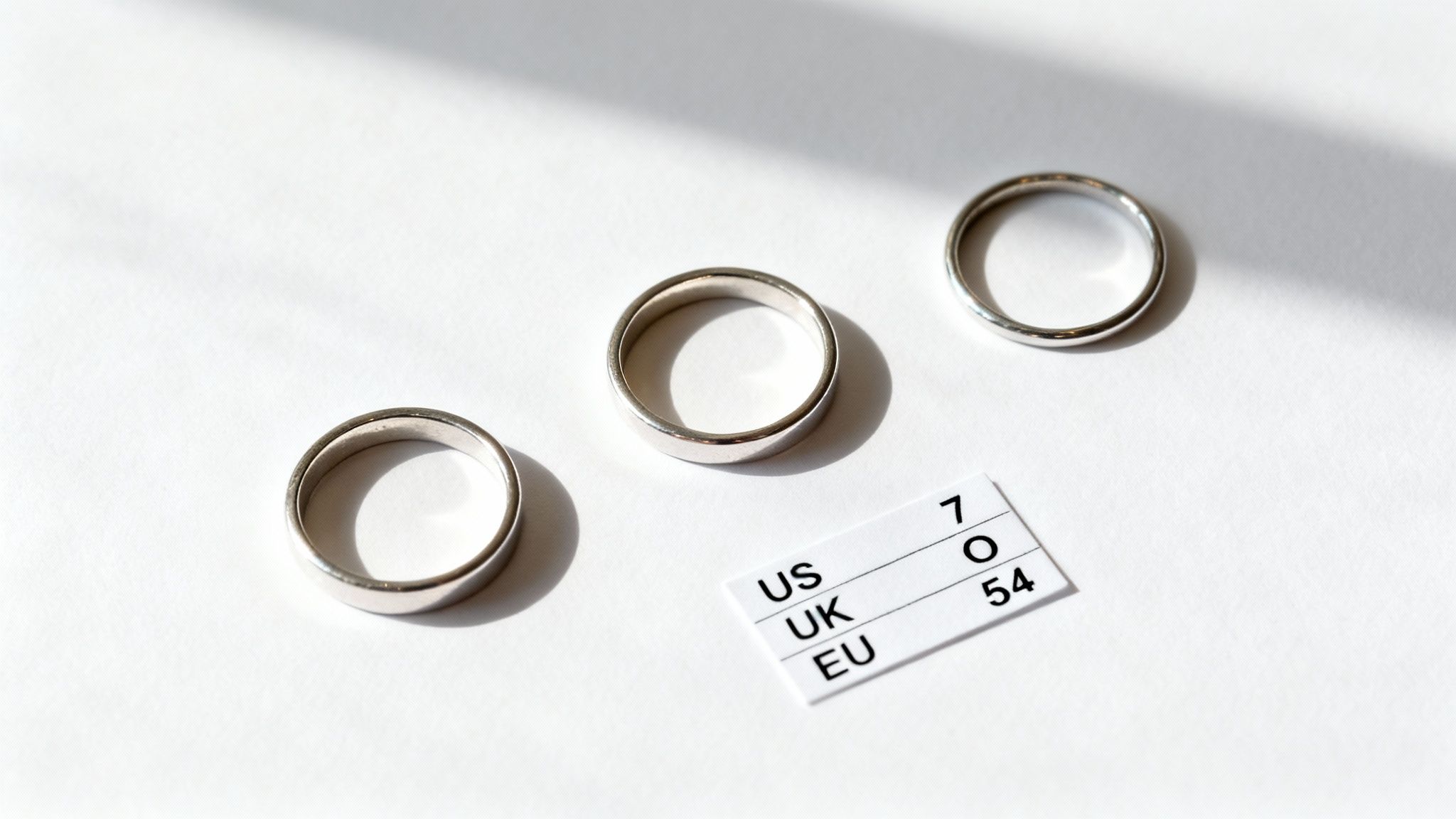
The differences between these systems aren't random. For example, in the North American system, each full size increases the ring's internal diameter by 0.032 inches. In contrast, the UK and Australian alphabetical scale adds 1.25 mm to the circumference for each size up.
Meanwhile, Germany and other European nations base their sizes purely on the inside circumference in millimeters. This is exactly why a US size 7 is the same as a UK size N or a European 54 mm. Getting it right prevents those frustrating returns that nobody wants to deal with.
A simple conversion chart is your best friend for international shopping. Before you even start browsing, figure out your size in the three main systems: US numerical, UK alphabetical, and European millimeter-based. A little prep work makes the whole process smoother and gets rid of any last-minute sizing anxiety.
Navigating Conversion Charts with Confidence
A conversion chart is the most practical tool for bridging these sizing gaps. When you use one, you’re just translating your finger's measurement into different sizing "languages." If you measured your finger's circumference as 57 mm, a quick look at a chart will show you that's a US size 8 or a UK size P ½.
A good, reliable chart is a must-have. Since sizing can be so precise, always use a comprehensive chart from a trusted source, like the one below or the ones provided by jewelers like Panther De Luxe.
To help you get started, we've put together a handy conversion table that covers all the major international sizes.
International Ring Size Conversion Chart
USA/Canada | UK/Australia | EU (Germany) | Japan | Inside Diameter (mm) | Inside Circumference (mm) |
|---|---|---|---|---|---|
3 | F | 44 | 4 | 14.1 | 44.2 |
3.5 | G | 45 | 5 | 14.5 | 45.5 |
4 | H | 47 | 7 | 14.9 | 46.8 |
4.5 | I | 48 | 8 | 15.3 | 48.0 |
5 | J | 49 | 9 | 15.7 | 49.3 |
5.5 | K | 51 | 10 | 16.1 | 50.6 |
6 | L | 52 | 12 | 16.5 | 51.9 |
6.5 | M | 53 | 13 | 16.9 | 53.1 |
7 | N | 54 | 14 | 17.3 | 54.4 |
7.5 | O | 56 | 15 | 17.7 | 55.7 |
8 | P | 57 | 16 | 18.1 | 57.0 |
8.5 | Q | 58 | 17 | 18.5 | 58.2 |
9 | R | 59 | 18 | 19.0 | 59.5 |
9.5 | S | 61 | 19 | 19.4 | 60.8 |
10 | T | 62 | 20 | 19.8 | 62.1 |
10.5 | U | 63 | 22 | 20.2 | 63.4 |
11 | V | 64 | 23 | 20.6 | 64.6 |
11.5 | W | 66 | 24 | 21.0 | 65.9 |
12 | X | 67 | 25 | 21.4 | 67.2 |
12.5 | Y | 68 | 26 | 21.8 | 68.5 |
13 | Z | 69 | 27 | 22.2 | 69.7 |
With this table, you can easily find your size no matter where you're shopping. For a deeper dive, our guide can help you convert ring sizes like a pro with an even more in-depth look at global standards.
Knowing this information empowers you to shop from anywhere without hesitation. You can confidently buy that beautiful silver band from a UK designer or an elegant gold ring from a German artisan, knowing it will fit perfectly when it arrives. This small bit of prep removes the biggest barrier to international jewelry shopping and ensures a happy, hassle-free experience.
Insider Tips for Achieving the Perfect Fit
Getting the numbers right is a great start, but any jeweler will tell you the real secret to a perfect fit goes beyond a ruler or sizing chart. It’s about the little things—the subtle factors that change how a ring feels on your finger from morning to night.
This is the insider knowledge that turns a "correct" size into a comfortable, lifelong piece.
One of the biggest variables is the ring's width. A wider band covers more skin, which creates more friction and a much snugger feel. I’ve seen it countless times: someone knows they're a size 7 in thin bands, only to find a wider ring in the same size is uncomfortably tight.
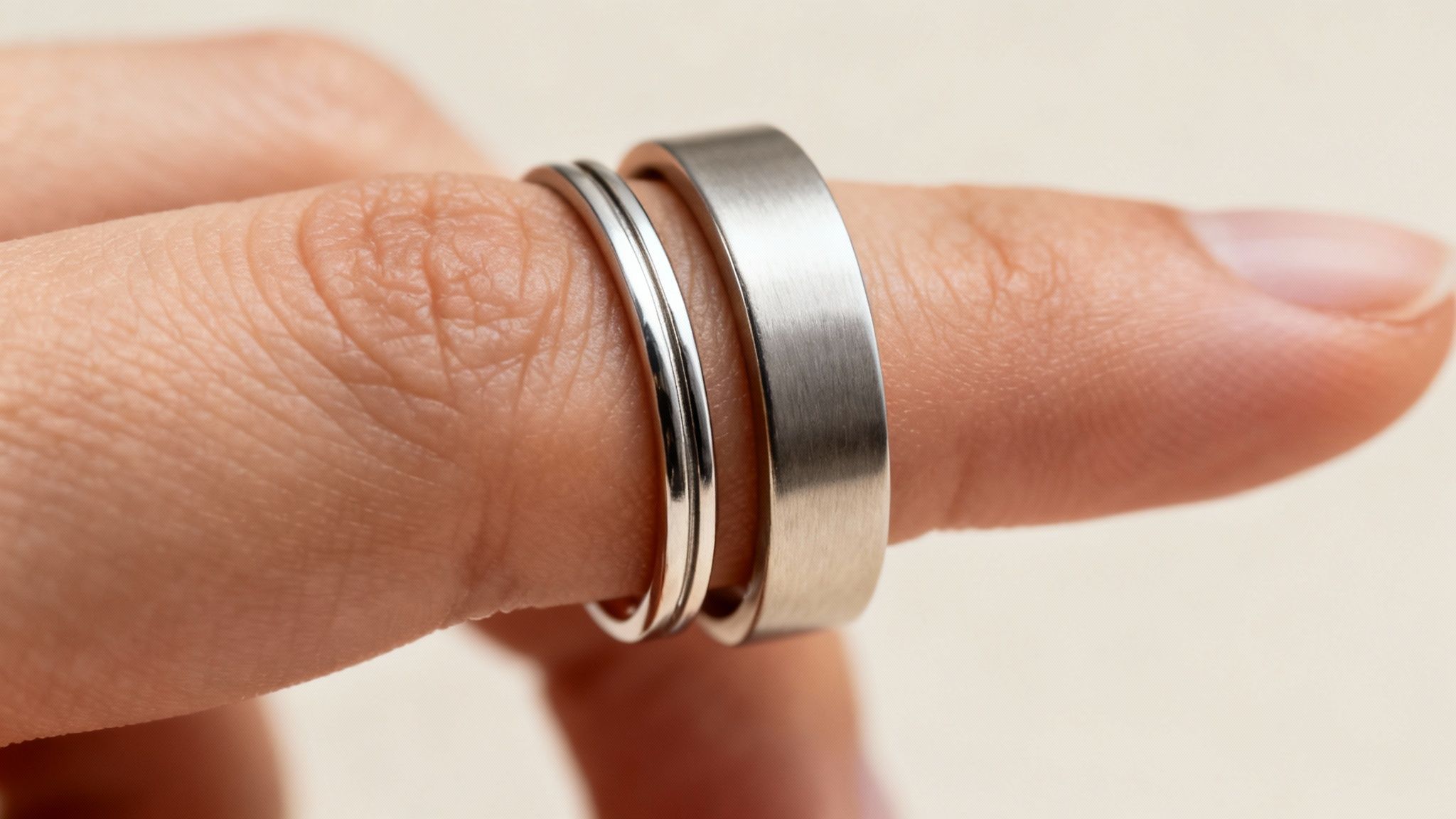
Here's a simple rule of thumb that can save you a lot of hassle: if you're looking at a ring with a band wider than 6mm, it's almost always a good idea to go up a quarter or even a half size.
Timing Your Measurement for Ultimate Accuracy
Ever notice your rings feeling tighter after a long day or during a summer heatwave? That's completely normal. Your finger size actually fluctuates due to temperature, hydration, and even what you’ve been doing.
To get the most reliable measurement, timing is everything. Don't measure first thing in the morning when your fingers are often smaller from the cooler night air. Instead, aim for the late afternoon or early evening. By then, your fingers have naturally settled into their largest size of the day, giving you a measurement that will stay comfortable around the clock.
What makes your finger size change daily?
Temperature: Cold weather makes your fingers shrink a bit, while heat and humidity cause them to swell.
Activity: A good workout or even just carrying heavy groceries can temporarily make your fingers larger.
Diet: A particularly salty meal can cause water retention, leading to puffier fingers for a few hours.
By measuring when your finger is at its largest, you ensure the ring will never feel painfully tight, even on the warmest days.
What Does the Ideal Fit Actually Feel Like?
The "perfect fit" can feel a little subjective, but there are some clear guidelines. A well-sized ring is a delicate balance between security and comfort. It’s not just about getting it on; it’s about how it feels once it's there.
The perfect ring is snug enough that it won’t fall off with a good shake of your hand, but loose enough to slide over your knuckle with just a little bit of gentle resistance. You should be able to twist it on your finger without much effort.
If you need soap and water or have to struggle to get it off, it's too tight. On the flip side, if it spins freely or you can flick it off your hand, it's dangerously loose. A slight indent on your skin after taking it off is totally fine, but it shouldn't be deep or leave you feeling sore.
Navigating the Knuckle Conundrum
For some of us, the knuckle is significantly larger than the base of the finger where the ring actually sits. This creates a classic sizing challenge: a ring that fits over the knuckle might be too loose at the base, causing it to spin around all day.
If this sounds familiar, here’s what to do:
Measure Both Areas: First, measure the circumference of your knuckle. Then, do the same for the base of your finger.
Find the Middle Ground: Your ideal size is probably somewhere between those two measurements. Often, choosing a size that’s halfway between the two is the perfect solution.
Consider Comfort-Fit Bands: These rings have a slightly rounded interior, which makes sliding them over a larger knuckle much easier without having to size up too much.
Understanding these nuances is what elevates finding your ring size from a simple task to an art form. It ensures every piece you get from Panther De Luxe Shop not only looks great but feels like it was made just for you. Analysis of thousands of ring orders confirms how critical these details are; temperature alone can cause fingers to swell by a half to a full size, while wide bands almost always require sizing up. You can read more about the data behind ring sizing to see how these factors play out.
When to Get Professional Sizing and Resizing Help
While at-home methods are fantastic for getting a solid starting point, some moments just call for the precision of a professional jeweler. Think of it as the difference between a good estimate and guaranteed accuracy.
When it comes to a significant, lifelong purchase like an engagement ring or wedding band, leaving things to chance simply isn't an option.
Jewelers have specialized tools you just don’t have lying around at home. Their go-to is a set of calibrated metal ring sizers—a whole keychain of precisely sized rings that let you feel the exact fit. This hands-on experience is something a paper strip can’t replicate, as it accounts for the unique shape of your knuckle and finger.
This professional approach removes all the guesswork, ensuring your ring is comfortable and secure from day one. It's the gold standard for a reason.
Knowing When to Visit a Jeweler
So, when should you put down the string and head to a professional? Certain situations really demand the tools and expertise only a jeweler can offer. Making the trip is a small investment of time that prevents much bigger headaches down the road.
You should always seek professional sizing for:
High-Value Purchases: If you're investing in an engagement ring, wedding band, or any piece of fine jewelry, professional sizing is non-negotiable. The cost and emotional weight are too high for a near-miss.
Unusual Finger Shapes: If your knuckle is significantly larger than the base of your finger, a jeweler can find that sweet spot—a size that’s secure but still easy to get on and off without a struggle.
Finalizing a Big Decision: Even if you think you’ve nailed your size at home, getting it confirmed by a pro provides invaluable peace of mind before you click "buy."
A jeweler doesn't just measure your finger; they assess the fit. They understand how different band widths and styles will feel and can offer advice tailored to the specific ring you're eyeing. That insight is where their true value lies.
Understanding Which Rings Can Be Resized
What happens if, despite your best efforts, a ring doesn't fit perfectly? Or maybe your finger size changes over time—which is completely normal. This is where resizing comes in, but it’s crucial to know that not all rings can be altered.
Understanding a ring's resizing potential before you buy can save you from future disappointment. The material and the design are the two biggest factors. For a deep dive into the whole process, you can explore our complete guide on how to get a ring resized.
Materials that are generally easy to resize include precious metals like:
Gold (Yellow, White, and Rose)
Platinum
Sterling Silver
These metals are malleable enough for a jeweler to cut the band and either add or remove a small piece to change the size. For a simple, plain band, it's a pretty straightforward job.
On the other hand, some materials and designs are difficult or impossible to resize:
Tungsten Carbide & Titanium: These modern metals are incredibly hard and just can't be resized with traditional jewelry tools.
Eternity Bands: Rings with gemstones set all the way around leave no plain metal for a jeweler to work on without disrupting the entire setting. It's a structural challenge.
Intricate Patterns: If a ring has a detailed engraving or pattern that wraps around the whole band, resizing it would create an obvious, unsightly break in the design.
Knowing this ahead of time helps you make a smarter purchase, especially if you think your finger size might fluctuate. At Panther De Luxe Shop, we're always here to offer guidance on the resizing potential of any piece in our collection.
Got Questions? We’ve Got Answers.
Even after you’ve measured, a few questions always pop up. Getting the fit just right often comes down to the little details most people overlook. Here, we're tackling the most common queries we hear from customers, so you can lock in your size with total confidence.
Think of this as the final check-in before you find your perfect ring.
How Should a Ring Actually Feel?
The perfect fit is a balancing act between secure and comfortable. Your ring should be snug enough that it won’t accidentally fly off, but still loose enough to slide over your knuckle with a little bit of gentle guidance.
You should be able to twist it around your finger easily. If it’s leaving a deep mark, making your skin bulge over the top, or requires a serious struggle to take off, it’s too tight. On the flip side, if the ring is constantly spinning or you feel like it might slip off every time you move your hand, it’s definitely too loose. Don't worry if it feels a little different throughout the day—that's completely normal.
Here’s the gold standard: When you make a fist, the ring shouldn’t pinch your skin. When you wash your hands, it shouldn't feel like it’s about to slide down the drain.
Are Both of My Hands the Same Ring Size?
Great question, and the answer is almost always no. For most people, the fingers on their dominant hand—the one you write with—are a little larger. We’re usually talking about a difference of half a size.
Over the years, the muscles and even the bones in your dominant hand get more of a workout, causing them to develop just a bit more. That’s why it’s so important to measure the exact finger on the exact hand you plan to wear the ring on. Never just assume your right-hand size will work for your left.
Can Any Ring Be Resized?
Unfortunately, not every ring can be taken to a jeweler for a quick adjustment. This makes getting that initial measurement right even more critical. Whether a ring can be resized comes down to two things: its material and its design.
Metals that are usually easy to resize include:
Gold (Yellow, white, and rose)
Platinum
Sterling Silver
These precious metals are malleable enough for a jeweler to work with, allowing them to add or remove a small piece of the band without much fuss.
However, some rings are a different story. Modern metals like tungsten, titanium, and stainless steel are incredibly hard, which makes them nearly impossible to resize with traditional tools. Rings with designs that go all the way around the band—like an eternity ring with diamonds set around the entire circle—also can't typically be altered without destroying the pattern. It's always a good idea to check the resizing policy before you buy.
Now that you're armed with all the pro tips for finding your perfect fit, the fun part can begin. Go explore the stunning collections at Panther De Luxe Shop and find the piece that feels like it was made just for you.
Comments