
Engagement Ring Size Chart for the Perfect Fit
- Luke Zucco
- Oct 22, 2025
- 11 min read

Getting the right engagement ring size is the first, most crucial step to a perfect proposal. It's the difference between a ring that feels like it was made just for them and one that needs an immediate trip to the jeweler. Luckily, using an engagement ring size chart and a few simple at-home methods, you can figure out the perfect fit with confidence.
This guide will walk you through everything you need to know, making sure the ring is comfortable and secure from the moment you present it.
Your Quick Guide to Finding the Perfect Ring Size
Figuring out the right ring size can feel a little intimidating, but it’s actually a pretty straightforward process once you have the right tools and information. The whole point is to get a measurement that’s both comfortable and secure—snug enough that it won't fall off, but loose enough to slide over the knuckle without a struggle.
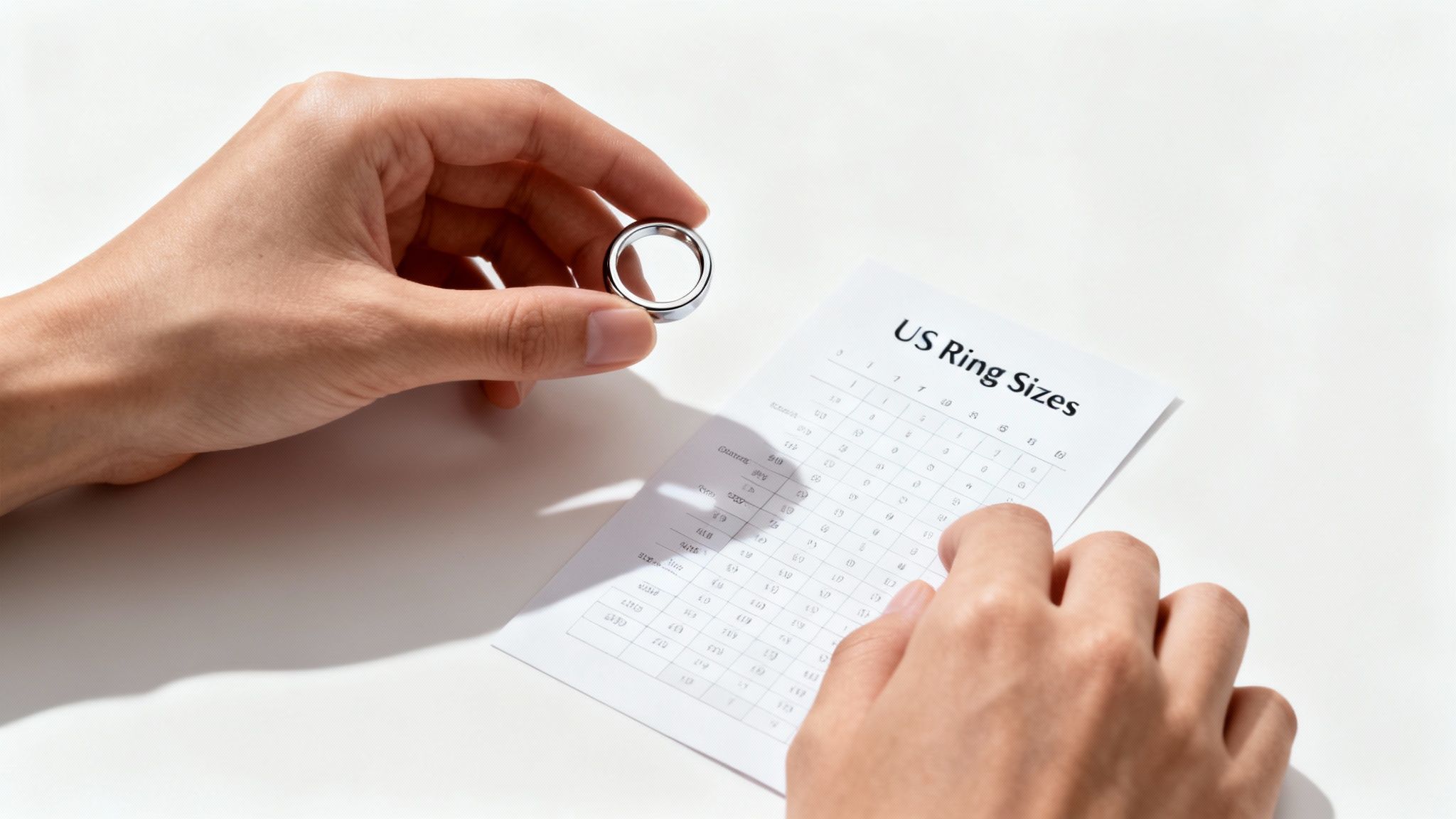
Before you start measuring, there are a few key things that can affect the final fit. Keep these in mind to get the most accurate result.
Finger Shape and Knuckle Size: A ring has to make it over the knuckle, which is often the widest part of the finger. If your partner has larger knuckles, you'll need a size that can pass over them but still fit the base of the finger well.
Temperature and Time of Day: Believe it or not, our fingers change size throughout the day. They tend to swell in the heat or after a workout and shrink when it's cold. For the truest measurement, it's best to measure in the evening when they're at room temperature.
Band Width: This is a big one people often overlook. A wider band has more surface area touching the skin, which makes it fit more snugly than a thinner one. For a wide band, you might need to go up by a quarter or even a half size.
Thinking about these details will make any at-home measurement method far more reliable. Once you've got a number you feel good about, you can browse our beautiful rings collection without the guesswork. A little prep now goes a long way in avoiding resizing hassles later on.
The Complete International Ring Size Conversion Chart
Shopping for an engagement ring online is amazing—until you hit the sizing snag. A US size 7 isn't a size 7 everywhere else, and figuring out the difference between global sizing systems can feel like a guessing game. Get it wrong, and you've ordered a beautiful ring that just won't fit.
This is where a solid engagement ring size chart becomes your best friend. Think of it as a universal translator that makes sure the size you order from a jeweler in London or Paris is a perfect match for your partner's finger back home.
Why Do Ring Sizes Differ So Much?
Different countries developed their sizing standards long before online shopping was a thing, which is why we have so many different systems today. The ISO 8653:2016 standard, for example, is used across much of Europe and bases its sizes on the inner circumference of the ring in millimeters. Simple enough.
But then you have the US and Canada, which use a numerical scale (like size 6, 7, 8), while the UK and Australia use an alphabetical one (L, M, N). If you want to dive deeper, you can explore more about these global standards to see why conversions are so critical.
Key Takeaway: An international engagement ring size chart clears up all the confusion. It directly translates between the numerical US sizes, alphabetical UK sizes, and circumference-based European systems, making it easy to shop globally with confidence.
To make things simple, we’ve put together a detailed conversion table below. It lets you quickly compare sizes and includes the inner diameter and circumference in millimeters—the two measurements you can trust no matter where you're shopping. Use it to cross-reference sizes so you can make your final choice without any second-guessing.
International Ring Size Conversion Chart
Finding the right fit is everything. This chart helps you convert ring sizes between the most common international standards: US/Canada, UK/Australia, and Europe. We've also included the precise inner diameter and circumference in millimeters (mm) for total accuracy. Just find the size you know in any column to see its equivalent across the board.
US & Canada Size | UK & Australia Size | European (ISO) Size | Inner Diameter (mm) | Inner Circumference (mm) |
|---|---|---|---|---|
3 | F | 44 | 14.1 | 44.2 |
3.5 | G | 45 | 14.5 | 45.5 |
4 | H | 47 | 14.9 | 46.8 |
4.5 | I | 48 | 15.3 | 48.0 |
5 | J | 49 | 15.7 | 49.3 |
5.5 | K | 51 | 16.1 | 50.6 |
6 | L | 52 | 16.5 | 51.9 |
6.5 | M | 53 | 16.9 | 53.1 |
7 | N | 54 | 17.3 | 54.4 |
7.5 | O | 56 | 17.7 | 55.7 |
8 | P | 57 | 18.1 | 57.0 |
8.5 | Q | 58 | 18.5 | 58.2 |
9 | R | 60 | 19.0 | 59.5 |
9.5 | S | 61 | 19.4 | 60.8 |
10 | T | 62 | 19.8 | 62.1 |
10.5 | U | 63 | 20.2 | 63.4 |
11 | V | 65 | 20.6 | 64.6 |
11.5 | W | 66 | 21.0 | 65.9 |
12 | X | 67 | 21.4 | 67.2 |
12.5 | Y | 69 | 21.8 | 68.5 |
13 | Z | 70 | 22.2 | 69.7 |
Remember, a perfect fit is snug enough not to fall off but loose enough to slide over your knuckle. When in doubt, it’s always better to size up slightly, as it’s much easier to make a ring smaller than it is to make it larger.
How to Measure Ring Size Accurately at Home
Getting the ring size right is essential, and the good news is you don’t need to be a professional jeweler to do it. With a few simple items you probably already have, you can get a reliable measurement right from home. It's perfect for planning a surprise or just figuring out your own fit.
Let’s walk through a few of the most trusted at-home methods.
The String or Paper Method
This is the classic DIY approach, and for good reason—it’s simple and surprisingly effective. The goal is to measure the circumference of the finger, which you can then match up to a standard ring size chart.
Grab a piece of non-stretchy string or a thin strip of paper and wrap it snugly around the base of the finger you're measuring.
Use a pen to mark the spot where the end overlaps.
Now, just unwind the string or paper and use a ruler to measure the length from the end to your mark. Make sure you measure in millimeters for the most accuracy.
Take that measurement and use our conversion chart to find the perfect ring size.
Another great trick, especially if you’re planning a surprise, is to borrow a ring your partner already wears on the correct finger. It’s discreet and gets you a very accurate size. Just place the ring on a sizing chart or measure its inner diameter with a ruler.
The infographic below shows just how important getting the right system is. It breaks down how a single US ring size converts to its international counterparts.
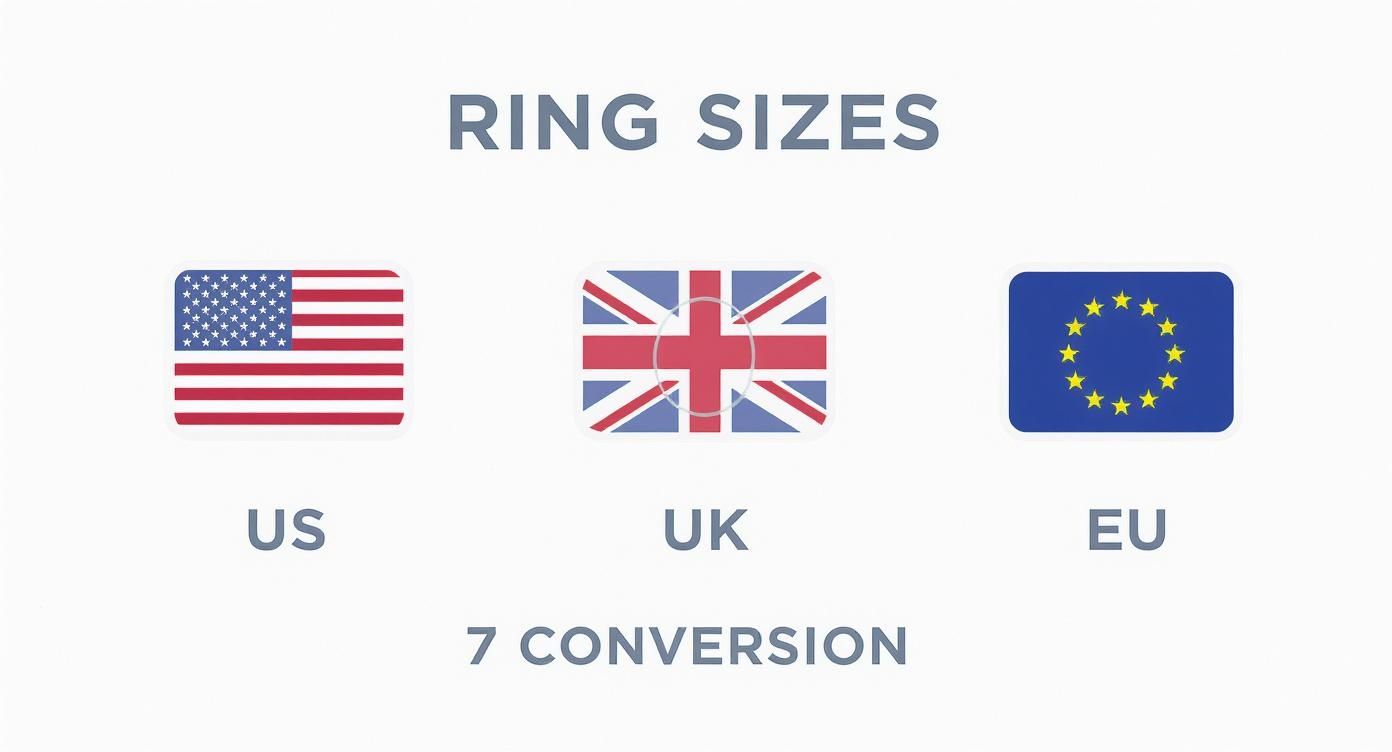
As you can see, a US size 7 is the same as a UK size N or an EU size 54. It really highlights why having a good conversion chart on hand is a must.
Using Printable Tools for Precision
If you want to step up your accuracy, a printable sizer is an invaluable tool. It combines the ease of the paper strip method with the precision of a professional jeweler's sizer, taking a lot of the guesswork out of the equation.
You can download and print a reliable printable ring sizer to get started. Just be absolutely sure you print it at 100% scale, otherwise your measurements will be off.
Pro Tip: Your fingers naturally swell and shrink throughout the day. To get the most dependable result, measure the finger three to four times at different times (like morning and evening). Average those measurements together. Also, try to avoid measuring when your hands are cold, as your fingers will be smaller than usual.
How Ring Style and Width Affect the Fit
An engagement ring size chart is a great starting point, but it's not the whole story. The ring's design itself plays a huge role in how it actually feels on the finger. A size 7 in a delicate solitaire might feel perfect, but that same size 7 in a wide, substantial band could feel uncomfortably tight.
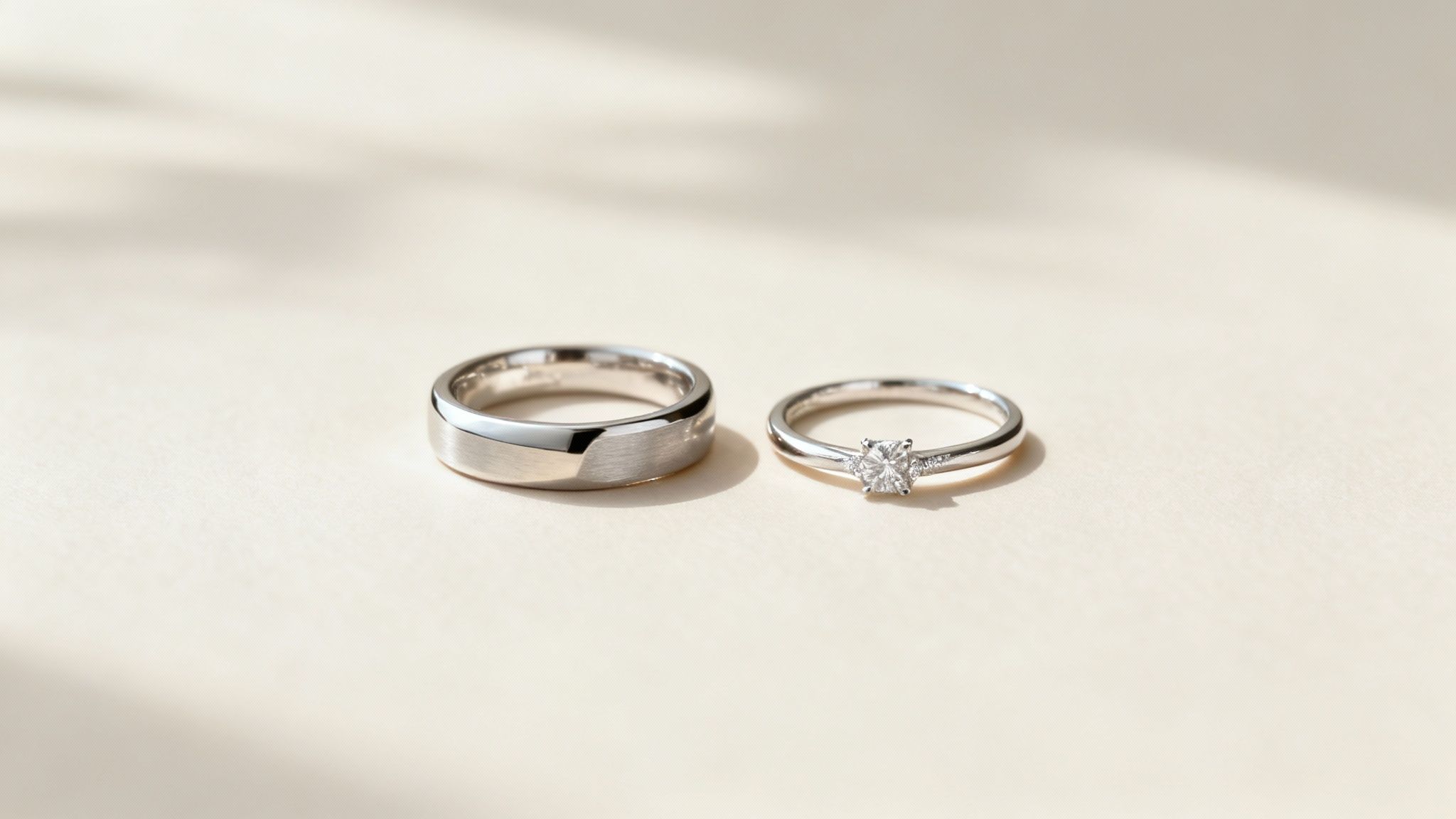
This happens because a wider band covers more of your finger, which means more friction and less room for your skin to move. Think of it like the difference between a thin chain bracelet and a wide cuff—the cuff always feels more restrictive, even if the circumference is the same.
As a general rule of thumb, for any band wider than 6mm, it's smart to consider going up by a quarter or even a half size. This little bit of extra room makes all the difference in comfort.
How Carat Weight and Setting Change the Feel
It’s not just the band you have to think about. The center stone's size and its setting can also completely change how a ring wears. A larger stone, especially when it’s held up high in a classic prong or cathedral setting, can make a ring feel top-heavy. If the fit isn't spot-on, you'll find it constantly spinning or sliding around on your finger.
The trend toward bigger stones isn't slowing down. Right now, the average carat weight for an engagement ring in the U.S. is around 1.7 carats, a big jump from just a few years ago. While a larger diamond delivers that incredible sparkle, a secure fit is what keeps it comfortable and safe for daily wear. You can dive deeper into what buyers are looking for in the full study from The Knot.
Here’s a quick breakdown of how the setting style impacts the feel:
High-Profile Settings: These lift the diamond high off the finger. While they maximize light and sparkle, they can sometimes catch on clothing or feel a bit bulky if the band isn't balanced correctly.
Low-Profile Settings: Styles like bezel or tension settings hold the diamond closer to the finger. This creates a smoother, more secure feel that's far less likely to snag on your favorite sweater.
Ultimately, the goal is to find that perfect balance between the look you love and the comfort you need for everyday life. When you’re browsing different styles, like the variety you see in gold plated rings, always remember to consider how the design will translate to the physical fit on your hand.
Getting the Right Fit: What Affects Your Finger Size?
Finding the perfect ring size isn't a one-and-done measurement. Our fingers are dynamic—they change throughout the day, month, and even year. Understanding what makes them swell and shrink is the secret to choosing a ring that feels just right, for the long haul.
One of the biggest players is temperature. Ever notice your rings feel tight in the summer and loose in the winter? That’s because our fingers naturally swell in the heat and contract in the cold. To get the most stable reading, it's always best to measure your finger at the end of the day, when you're at a comfortable room temperature.
Daily Habits and Long-Term Changes
What you eat and how you move also have a surprising impact on how a ring fits. A salty meal can cause water retention, making your fingers feel puffy and tight. The same goes for a tough workout—increased blood flow can cause temporary swelling.
Expert Tip: For the most accurate measurement, wait a few hours after exercising, waking up, or eating a particularly salty meal. Let your body find its normal rhythm first.
Beyond these day-to-day shifts, other life events can change your ring size more permanently:
Pregnancy: Hormonal changes and fluid retention often lead to significant swelling in the hands, sometimes requiring you to temporarily size up or set your rings aside.
Weight Fluctuations: It makes sense—gaining or losing weight can affect your finger size, occasionally enough to need a professional resizing.
Arthritis: Swelling in the knuckle joints can make it tricky to slide a ring on and off comfortably.
It's also interesting to see how preferences change from place to place. For example, engagement ring trends in the U.S. lean toward larger stones, with the average diamond coming in at about 1 carat—a size that's much bigger than the average in many other countries. You can dive deeper into these fascinating diamond industry trade statistics if you're curious.
Common Ring Sizing Mistakes to Avoid
Getting the ring size right is one of those final details that can feel a little stressful, but it doesn't have to be. A few small, common missteps can easily lead to a fit that’s just a little bit off. Knowing what to watch out for ahead of time makes all the difference.
One of the biggest culprits of a bad measurement? Using a stretchy string. It seems like a good idea, but materials like yarn or elastic cord can stretch just enough to give you an inaccurate, smaller size. Stick to something with no give, like a strip of paper or even dental floss, for a much more reliable result.
Another thing people often forget is the knuckle. It’s easy to focus on the base of the finger where the ring will sit, but it has to get there first! The ring needs to be just large enough to slide over the knuckle but snug enough that it won’t feel loose once it's on. Always test your measurement to make sure it can pass over the widest part of the finger.
Crucial Tip: Timing is everything. Your fingers naturally change size throughout the day—they're often smaller in the morning or when you're cold. For the most accurate read, measure at the end of the day when your fingers are at their largest and you’re at a comfortable room temperature.
Final Checklist Before You Buy
Before you commit, run through this quick checklist. These are the most common oversights that send people back for a resize.
Measuring Too Tightly: The measuring tool should feel snug, but it shouldn't be digging into the skin or leaving an indent.
Ignoring Band Width: This is a big one. Wider bands—think anything over 6mm—have a much snugger fit because they cover more of your finger. It's a good rule of thumb to go up a quarter or even a half size for these chunkier styles.
Measuring Only Once: Don't trust a one-and-done measurement. Our fingers can swell and shrink slightly day to day. Measure three or four times on different days to find a consistent, comfortable average.
Frequently Asked Questions About Ring Sizing
Even with the best engagement ring size chart in hand, a few questions always seem to come up. It's totally normal. This section is here to give you quick, clear answers to the most common worries, so you can feel completely confident in your choice.
First off, don't panic if the size isn't a perfect match right away. Most jewelers offer a complimentary resizing service within a certain time after you buy the ring. Just keep in mind that some styles, like full eternity bands, are tricky—or even impossible—to alter. If you're thinking about adjustments, understanding the process of engagement ring resizing can give you some valuable insight before you commit.
How to Find a Partner's Ring Size Secretly
Keeping the proposal a surprise is half the fun, right? Here are a few clever ways to figure out their ring size without giving the game away:
Borrow an Existing Ring: This is the most reliable trick in the book. Sneak a ring they already wear on their ring finger and either measure its inner diameter yourself or, even better, take it to a jeweler.
Trace It: If you can’t borrow the ring for long, place it on a piece of paper and carefully trace the inside circle. A skilled jeweler can usually get a very accurate size from a good tracing.
Ask for Help: Bring a close friend or family member into the fold. They might already know the size, or they can casually bring it up in conversation without raising any red flags.
Important Note: While sizing numbers (like a US size 7) are unisex, men's rings are typically designed with a wider band and come in a broader range of sizes than women's rings.
If you’ve tried everything and you’re still stuck, it’s always safer to go a little bigger. Making a ring smaller is almost always an easier and less expensive job for a jeweler than making it larger. And if you need a bit more personalized advice, please don't hesitate to contact us—we're here to help.
At Panther De Luxe Shop, we want to help you find the perfect ring and the perfect fit. Explore our collection today.
Comments