
How to Appraise Jewelry Yourself A Practical Guide
- Luke Zucco
- Jan 4
- 17 min read

So, you want to figure out what your jewelry is worth. The first step is to get a clear idea of what an at-home appraisal can actually tell you. Think of it less as becoming a certified gemologist overnight and more about giving yourself the tools to make smart decisions.
Whether you're curious about an inherited necklace or want to know the value of a flea market find before selling it, a DIY appraisal is your starting point.
Setting Realistic Expectations for a DIY Appraisal
Let's be clear: what you're doing here is figuring out a piece's fair market value. This is the price a real person would likely pay for it today, say, in a private sale or on an online marketplace. It’s a practical, real-world number.
This is completely different from its replacement value, which is the much higher price an insurance company would pay to replace the item with a brand-new, similar piece from a retailer.
Defining Different Types of Value
Getting these terms straight is the key to understanding what you’re looking at.
Market Value: This is all about what a pre-owned item is worth right now. It’s influenced by everything from current style trends and brand name recognition to the piece's overall condition. For older items, this gets even more nuanced. If you're dealing with heirlooms, looking into the specifics of valuing antique jewellery can give you some great context.
Replacement Value: This is almost always the highest value. It's the full retail price you'd pay at a jeweler for a new equivalent, and it's the number that matters for insurance policies.
Intrinsic Value: Think of this as the "melt" value. It’s the base worth of the raw materials—the precious metals and the wholesale cost of the gemstones. This is the absolute floor for your item's value.
Key Takeaway: Your DIY appraisal is going to nail down the market value and intrinsic value. Only a certified professional can give you a formal appraisal for replacement value to use for insurance.
This handy visual breaks down how to get started in three simple stages.
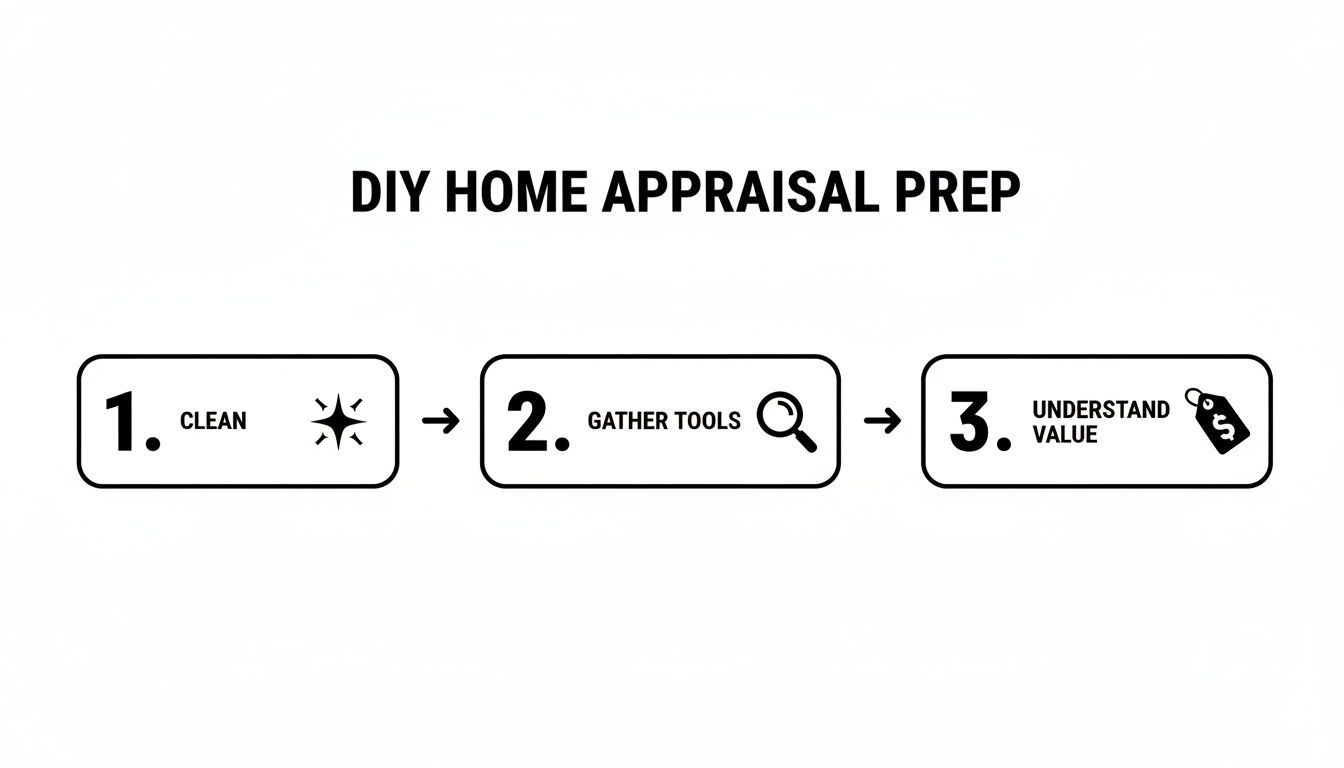
Following this process ensures you're looking at a clean piece, you have the right tools on hand, and you know exactly what kind of value you’re trying to uncover.
Seriously, don't skip the cleaning step. Dirt and grime can easily hide tiny hallmarks or obscure flaws in a gemstone that will tank its value. A little prep work from the start makes the whole process smoother and way more accurate.
Building Your At-Home Appraisal Toolkit
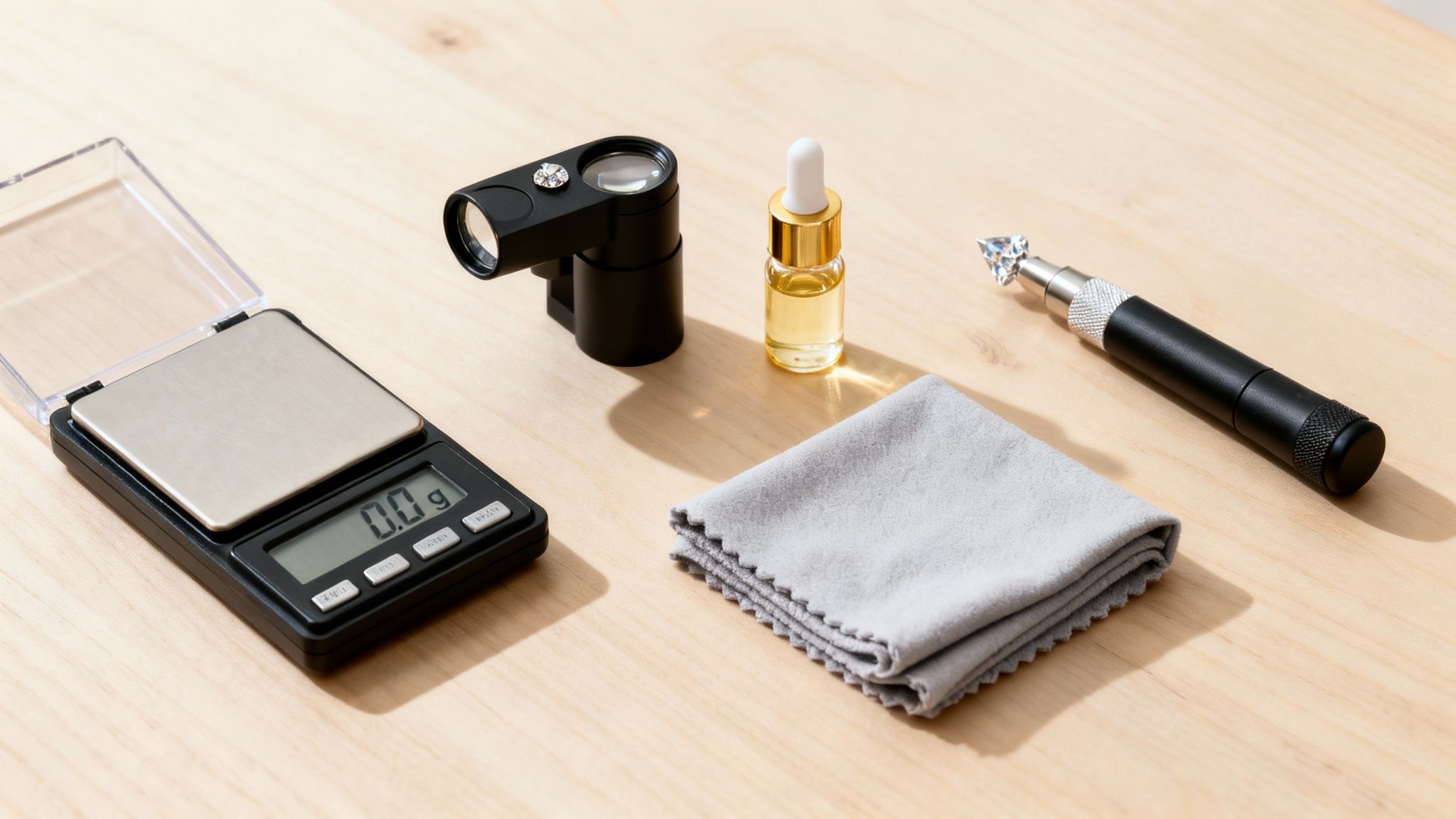
If you want to appraise jewelry yourself, you need to see what the pros see. The good news? You don’t need a full-blown gemology lab to get started. A small, smart investment in a few key tools will empower you to uncover the hidden details that separate a treasure from a trinket.
Think of this as your "eyes and ears" for the appraisal process. Each tool has a specific job, from revealing microscopic stamps to providing the precise weight needed for value calculations. Let's get into the essentials.
The Most Important Tool: A Jeweler's Loupe
If you buy only one thing, make it this. The single most important tool in your kit is a jeweler's loupe. Don't just grab any old magnifying glass; you need one designed for the job. The industry standard is a 10x magnification loupe, which is the perfect balance—strong enough to read tiny hallmarks and spot inclusions in gemstones, but not so powerful that it distorts the view.
For example, a faint "750" stamp on a gold ring is nearly invisible to the naked eye. Under a 10x loupe, it becomes crystal clear, instantly identifying the piece as 18-karat gold. That tiny detail changes everything about its value.
A quality 10x loupe is your gateway to understanding your jewelry. It reveals the story told by hallmarks, maker’s marks, and gemstone clarity—details you simply can't see otherwise, and they directly impact your final valuation.
Next Up: A Precision Digital Scale
Weight is money, especially when it comes to precious metals. That's why your next purchase should be a reliable digital gram scale. The weight of the gold, silver, or platinum is a huge part of its intrinsic value, so precision is non-negotiable. Look for a scale that measures to at least one-tenth of a gram (0.1g), though one that measures to a hundredth (0.01g) is even better.
This level of accuracy really matters. A difference of just half a gram could mean a significant change in the melt value of a heavy gold chain, especially when gold prices are high. Make sure your scale has a "tare" function, which lets you zero out the weight of any container you use.
Basic Testing Kits for Authenticity
Once you can see and weigh your pieces, the next step is verification. This is where basic testing kits come in, helping you confirm that the metals and stones are what they claim to be.
Here are the most useful kits for a home appraiser:
Gold Acid Test Kit: This is the classic, old-school method for determining gold purity. These kits usually come with a testing stone and small bottles of nitric acid calibrated for different karats (like 10k, 14k, and 18k). You scratch the metal on the stone, apply a drop of acid, and watch the reaction to confirm its purity.
Diamond Tester: A handheld electronic diamond tester is an affordable way to quickly tell a real diamond from common look-alikes like cubic zirconia. It works by measuring how quickly heat or electricity moves through the stone—a property unique to diamonds.
A Strong Magnet: It sounds simple, but a small, strong magnet (a rare-earth magnet is best) is incredibly effective. Precious metals like gold, silver, and platinum are not magnetic. If that "gold" chain you're testing snaps firmly to a magnet, it’s an immediate red flag that it's just gold-plated steel or another base metal.
To make it easier, here’s a quick-glance table of what you'll need to get your appraisal toolkit started.
Your DIY Jewelry Appraisal Toolkit
Tool | Primary Use | Estimated Cost (USD) | Why It's Essential |
|---|---|---|---|
Jeweler's Loupe (10x) | Reading hallmarks, identifying maker's marks, and inspecting gemstone clarity. | $10–$30 | Reveals microscopic details crucial for identification and valuation. |
Digital Gram Scale (0.1g or 0.01g) | Accurately weighing precious metals to determine their intrinsic value. | $15–$40 | Weight is a primary factor in calculating the melt value of gold, silver, and platinum. |
Gold Acid Test Kit | Verifying the karat purity of gold (10k, 14k, 18k, etc.). | $20–$50 | Confirms the metal's authenticity and purity, which directly affects its worth. |
Electronic Diamond Tester | Distinguishing real diamonds from common simulants like cubic zirconia. | $15–$50 | Provides a quick, non-destructive way to test for a genuine diamond. |
Rare-Earth Magnet | Quickly identifying non-precious, magnetic base metals in counterfeit items. | $5–$15 | A simple pass/fail test; real gold, silver, and platinum won't react. |
Putting this toolkit together is your first real step. With these items in hand, you're no longer just guessing—you're gathering actual, tangible data about your jewelry.
Identifying Precious Metals and Calculating Value
The heart of most jewelry's value is locked in its precious metal content. Before you even think about the gemstones, understanding the metal—its type, purity, and weight—gives you a solid baseline for your appraisal. This is where your digital scale and loupe really earn their keep.
Most of the time, you'll be working with gold, silver, or platinum. Each has its own system of markings, but the fundamental approach is the same: identify the metal, figure out its purity, weigh it, and calculate its "melt" value based on current market prices.
The World of Gold Purity and Karats
Gold is the king of jewelry metals for a good reason, and its purity makes a huge difference in your valuation. Knowing your jewelry’s gold content can literally save you thousands when appraising it at home. In 2023, the global gold jewelry market was valued at a staggering USD 202 billion and is projected to hit USD 318 billion by 2032.
This massive market is built on the karat system. Pure gold is 24 karats, but it’s too soft for everyday wear, so it’s usually mixed with other metals (alloyed) for strength.
Here’s a quick breakdown of what those little numbers mean:
24K (Karat): This is 99.9% pure gold. It has a deep, almost orange-yellow color and is incredibly soft. You won't see it often in pieces meant for daily wear.
18K (Karat): This is 75% pure gold (18 parts gold, 6 parts alloy). It’s the sweet spot for rich color and durability, very common in high-end European jewelry.
14K (Karat): Made of 58.3% pure gold (14 parts gold, 10 parts alloy), this is the most popular choice in the U.S. for its blend of durability and affordability.
10K (Karat): At 41.7% pure gold (10 parts gold, 14 parts alloy), this is the minimum purity that can be legally sold as "gold" in the United States.
To get a firm handle on your gold's value, you need to know its purity. You can find more on the different methods in a practical guide to gold purity testing. Once you’ve identified the karat, it’s time for some simple math.
Calculating Gold's Melt Value
Let's walk through a real-world example. Say you have a 14k gold chain that weighs exactly 10 grams on your digital scale.
Find the Spot Price: First, do a quick online search for the "spot price of gold" per gram. Let's assume it's $75 per gram. Keep in mind, this price is for pure, 24k gold.
Calculate Karat Purity: Your chain is 14k, which is 58.3% pure gold. Convert that to a decimal: 0.583.
Find the Price Per Gram for 14k: Now, multiply the spot price by the purity decimal: $75 x 0.583 = $43.73. This is the melt value of one gram of 14k gold for today.
Calculate Total Value: Finally, multiply this per-gram price by the weight of your chain: $43.73 x 10 grams = $437.30.
This $437.30 is the intrinsic or "melt" value of your chain. It’s the baseline worth of the raw metal, a crucial starting point for your overall appraisal. If you need a refresher on verifying it's the real deal, check out our guide on how to tell if gold is real.
Identifying Silver and Platinum Marks
While gold uses karats, silver and platinum have their own marking systems to show purity. They're often simpler to read but just as vital for a proper valuation.
Silver Markings The most common mark you'll find on silver jewelry is "925" or "Sterling."
Sterling Silver (925): This stamp means the piece is 92.5% pure silver, with the other 7.5% usually being copper to add strength. Anything marked "925" is high-quality solid silver.
Silver Plate: If you see markings like "EPNS" (Electro-Plated Nickel Silver) or find no purity mark at all, the item is almost certainly silver-plated. It has only a microscopic layer of silver over a cheap base metal, giving it virtually no melt value.
Pro Tip: Don't be fooled by a stamp that just says "silver." Authentic sterling will almost always have a "925" or "STER" mark. The absence of a clear purity mark is a huge red flag.
Platinum Markings Platinum is rarer and much more durable than gold, so its markings are key.
950 Plat / PLAT: This is the most common stamp for platinum jewelry, indicating it's 95% pure platinum.
900 Plat / 900 Pt: This signifies the piece is 90% pure platinum.
Because platinum is so dense and pure, its melt value can be higher than gold's, even if the spot price per gram is lower. And always, always do the magnet test—real platinum, like gold and silver, is not magnetic.
A Beginner's Guide to Evaluating Gemstones
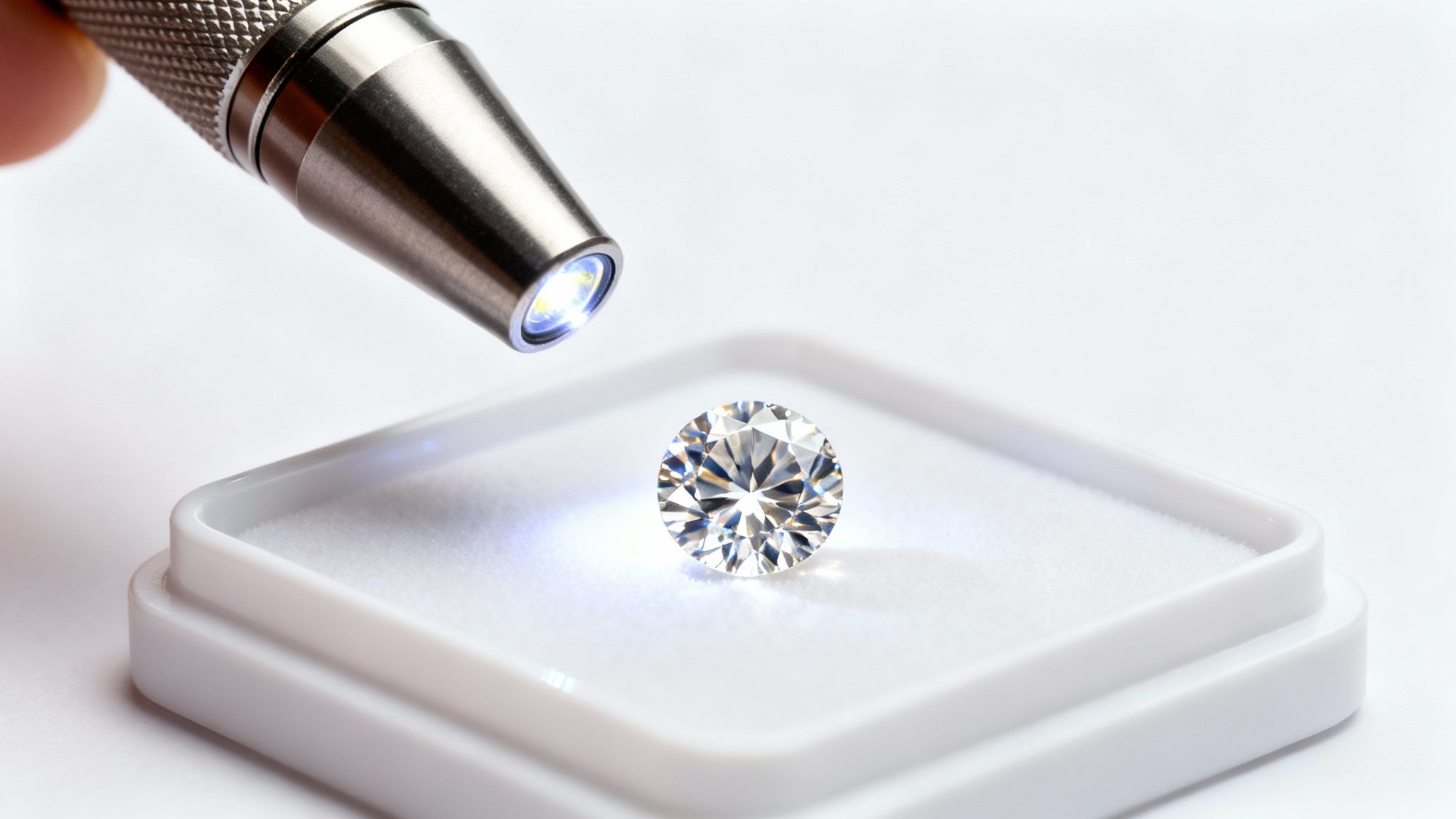
Once you've sized up the metal, it's time for the main event: the gemstones. A brilliant diamond or a rich sapphire can easily be the most valuable part of a piece, often dwarfing the melt value of the metal. But figuring out what they're worth takes a bit of know-how.
You don't need to be a certified gemologist to get a solid initial estimate. For diamonds, it all comes back to the classic 4Cs: Cut, Color, Clarity, and Carat. These four pillars work together to determine a diamond's sparkle, beauty, and ultimately, its market price. The same principles apply to other gems, though with a much heavier emphasis on the richness of their color.
The Foundation of Diamond Value: The 4Cs
Diamonds are dazzling, but getting a handle on their value means mastering the 4Cs. It's a game of details, and those details matter. Consider this: the U.S. engagement ring market was projected to hit $12.5 billion in 2025, with the average ring hovering around $5,800. That value is driven by these metrics.
It starts with the carat. One carat is just 0.2 grams, but value isn't a simple weight calculation. A one-carat diamond might be worth $10,000, while a two-carat stone of the same quality could leap to $50,000 simply because larger stones are much rarer.
Using your 10x jeweler's loupe, you can get a feel for the cut. An "Excellent" cut reflects roughly 95% of the light that enters it, boosting its price by up to 25% compared to a "Poor" cut that might only reflect 60%. The global diamond jewelry market is growing at a 5.3% rate, all based on these tiny but critical distinctions.
Let's look at each 'C' one by one.
Quick Guide to the 4Cs of Diamonds
Before we dive deep, here's a quick cheat sheet to keep the 4Cs straight. Think of this table as your starting point for any diamond evaluation.
The 'C' | What to Look For | Impact on Value |
|---|---|---|
Carat | The physical weight of the diamond (1 carat = 0.2g). | Higher carat weight dramatically increases value, especially for larger stones. |
Cut | The quality of the facets, symmetry, and polish. | Arguably the most important 'C' for beauty. An excellent cut maximizes sparkle. |
Color | The absence of color in a white diamond (D-Z scale). | The closer a diamond is to colorless (D), the rarer and more valuable it is. |
Clarity | The lack of internal flaws (inclusions) or external blemishes. | Fewer imperfections mean higher value. Flawless diamonds are extremely rare. |
This table simplifies it, but understanding the nuances of each factor is where you'll find the real story behind a diamond's worth.
Carat: The Measure of Weight
This is the most straightforward of the 4Cs. Carat is a unit of weight, not necessarily size, although the two are closely related. If you have a loose stone, your digital scale will give you an exact carat weight. For a mounted stone, you'll need to estimate based on its dimensions—less precise, but it gets you in the ballpark.
Cut: The Source of Sparkle
People often confuse cut with shape (like round, princess, or pear). The cut actually refers to how well the stone's facets interact with light. A masterfully cut diamond is a tiny disco ball, reflecting light back through the top to create that fire and brilliance.
Here's a quick way to assess it:
Hold the stone under a bright light. Does it sparkle intensely from edge to edge? A good cut has life across its entire surface.
See any dark, dull spots? That could mean a poor cut is letting light "leak" out the bottom instead of returning to your eye.
A diamond’s cut is arguably the most important factor for its visual appeal. A smaller, well-cut diamond will often look more brilliant and valuable than a larger one with a mediocre cut.
Color: The Absence of Hue
When it comes to white diamonds, value lies in the absence of color. The industry uses a D-to-Z scale. D is perfectly colorless and the most valuable, while Z has a noticeable yellow or brown tint. To get a rough idea, place the diamond face-down on a piece of pure white paper. This simple trick helps neutralize the sparkle and reveals any underlying color.
Assessing Clarity and Identifying Other Gems
Clarity: The Measure of Purity
Clarity is all about the tiny imperfections found in nearly every diamond. Internal flaws are called inclusions, while external ones are blemishes. A "flawless" diamond is incredibly rare and commands a premium price.
This is where your 10x jeweler's loupe is non-negotiable. Look closely for tiny black spots, white "feathers," or cloudy areas inside the stone. The smaller and fewer the inclusions, the higher the clarity grade and the more valuable the diamond.
For a deeper dive into stone identification, our guide on how to identify gemstones at home provides some excellent, practical advice, especially as you venture beyond diamonds.
Beyond Diamonds: Colored Gemstones
For stones like rubies, sapphires, and emeralds, the rules of the game change a bit.
Color is King: Unlike with diamonds, here it's all about the richness and saturation of the color. A deep, vibrant "pigeon's blood" ruby is exponentially more valuable than a pale, pinkish one.
Clarity Still Matters: While some inclusions are expected and even accepted (especially in emeralds), large flaws that distract from the color will bring the value down.
Origin Can Be a Factor: This is harder to determine yourself, but it's good to know. Where a gem was mined can have a huge impact on its value. For example, sapphires from Kashmir or rubies from Burma are legendary and command top dollar.
Finally, an electronic diamond tester is a fantastic tool for a quick reality check. It measures thermal conductivity to instantly tell you if you're holding a real diamond or a common lookalike like cubic zirconia. Just touch the probe to the stone, and you'll have your answer.
Decoding Hallmarks and Maker's Marks

Alright, you’ve got a feel for the metal and gemstones. Now it's time to play detective and look for the tiny, hidden stamps that tell the real story of your piece. These are hallmarks and maker's marks, and learning to read them is a total game-changer for any DIY appraisal.
Think of them as a secret language. These little marks are your best evidence of authenticity in a global jewelry market worth over $366 billion in 2024. Hallmarking has been mandated in parts of Europe since the 1300s, serving as a guarantee of an item's purity. Today, over 90% of genuine fine jewelry will have them, while fakes often skip this crucial detail.
These stamps don't just confirm metal purity. Sometimes, they reveal a famous designer, instantly elevating a piece’s value far beyond its raw material weight.
Locating the Stamps
This is where your 10x jeweler's loupe really shines. Hallmarks are almost always tucked away in discreet spots to avoid messing with the design. You just have to know where to look.
Common hiding spots include:
Rings: Almost always on the inside of the band.
Necklaces and Bracelets: Check the clasp, the tiny tag near the clasp, or the end caps.
Pendants: Flip it over and look on the back or along the bail (the loop that connects to the chain).
Earrings: The posts and earring backs are your best bet. Sometimes they’re on the back of the earring itself.
Don't get discouraged if you can't find them right away. On older, well-loved pieces, these marks can be worn down or stamped very faintly. Good lighting is your best friend here—turn the piece slowly and inspect it from every angle.
Key Takeaway: A clear, legitimate hallmark is one of the strongest signs of authenticity. On the flip side, a missing or sloppy-looking stamp on a piece that's supposed to be high-end is a major red flag.
Understanding Common Purity Marks
Purity marks, or hallmarks, tell you the exact precious metal content. They’re standardized, so a stamp in one country generally means the same thing in another.
Here’s a quick guide to the most common marks you'll run into:
Gold Hallmarks
By Karat (USA): Simple and straightforward. Look for stamps like , , or .
By Fineness (Europe/International): These are three-digit numbers representing parts per thousand of pure gold. * = 10K (41.7% gold) * = 14K (58.5% gold) * = 18K (75% gold)
Silver and Platinum Hallmarks
Sterling Silver: The magic number here is , which means the item is 92.5% pure silver. You might also see , , or .
Platinum: Look for , , or a fineness number like (95% pure) or (90% pure).
Getting familiar with these numbers is a huge first step. For a deeper dive, our post on identifying jewelry hallmarks is a great quick-reference guide.
The Value of a Maker's Mark
Besides the purity mark, you might find another stamp—the maker's mark. This is the signature of the person or company that created the piece. It could be a name, a set of initials, or a unique symbol.
This is where things get really interesting. For example, a simple silver bracelet marked "925" is worth its weight in silver. But if that same bracelet also has the mark "Tiffany & Co.", its market value could easily be ten times its melt value. The brand's reputation and desirability add a massive premium.
If you find a maker's mark you don't recognize, it’s time to do some digging. Online hallmark databases and jewelry forums are fantastic resources for identifying symbols. You might just uncover a hidden gem from a respected, but lesser-known, designer.
When You Need a Professional Appraiser
Learning to appraise your own jewelry is a fantastic skill. It’s perfect for understanding your collection, selling pieces online, or just satisfying your curiosity. But it's just as important to know where the DIY route ends and the professional’s work begins.
An at-home assessment, no matter how carefully done, has its limits. There are times when calling in a certified appraiser isn’t just a good idea—it’s absolutely essential. Think of it this way: your work is for your own knowledge and estimation. Their work is for official validation.
For Insurance and Legal Matters
This is the big one. If you need to insure a piece of jewelry against loss, theft, or damage, your insurance company won’t accept your personal valuation. They require a formal, written appraisal from a qualified gemologist appraiser. Period.
This official document gives a detailed description of the item and assigns it a replacement value—what it would cost to buy a new, similar item from a retail jeweler. This number is almost always higher than the resale or market value you've been estimating.
A professional appraisal is non-negotiable for insurance. Without that certified document, you won't be able to file a successful claim. You’d be facing a major financial loss on top of the emotional one.
The same rule applies to any other official paperwork:
Estate Planning: For a will or trust, a formal appraisal ensures assets are divided fairly and taxes are assessed correctly.
Divorce Proceedings: Legal settlements require impartial, documented values for shared assets like high-value jewelry.
Charitable Donations: If you’re donating jewelry and want to claim a significant tax deduction, the IRS requires a qualified appraisal to back it up.
When the Stakes Are Too High
Beyond the official stuff, some pieces are just too valuable or complex for an amateur to get right. Your home toolkit is great for most things, but it can’t compete with a professional lab when you’re dealing with exceptional jewelry.
It’s time to call an expert if your piece has:
Potentially Rare Gemstones: Telling the difference between a natural, untreated Burmese ruby and a more common treated one can be a matter of tens of thousands of dollars. An expert can make that call.
Significant Historical Provenance: Think your piece belonged to a historical figure or is from a famous design house from the Art Deco period? That story adds immense value, but only an expert can verify and quantify it.
A Major Diamond: For any diamond over one carat, a professional grading report from an institution like the GIA (Gemological Institute of America) is the gold standard. Don’t even try to guess.
Designer Signatures: A suspected piece from a top-tier designer like Cartier or Van Cleef & Arpels requires expert authentication to confirm its value.
In these situations, a pro doesn’t just give you a number; they give you certainty. They have advanced equipment and a depth of market knowledge you can't replicate at home, ensuring your most precious items are fully understood and protected.
Your Top Questions About DIY Jewelry Appraisal, Answered
Once you start looking closer at your jewelry, a few questions always seem to pop up. Getting those sorted out first makes the whole process feel less intimidating and a lot more straightforward.
The biggest point of confusion I see? People mixing up the reason for their appraisal. Are you trying to get a fair price to sell that old ring your aunt gave you, or do you need a number for your insurance policy? These are two totally different goals, and they lead to two very different values.
Insurance Value vs. Resale Value
When a professional appraiser gives you a formal document for insurance, they’re calculating the replacement value. Think of this as the full, top-dollar retail price you'd pay to buy an identical, brand-new piece from a jewelry store today. It's always the highest number because it includes things like retail markup, labor, and current material costs.
Your DIY appraisal, on the other hand, is all about finding the resale value—what someone would realistically pay you for it right now, as a pre-owned item. This number is shaped by the current market, the piece's condition, and the raw melt value of the metal. It’s the practical figure you need for a private sale or an online listing.
Key Insight: Never, ever use your DIY resale estimate for insurance. Insurers require a certified appraisal from a professional to ensure you're properly covered. Guessing here could leave you seriously underinsured if something happens.
Another question that comes up a lot is how to track down current prices. For metals, it's easy—just search for the daily “spot price” of gold, silver, or platinum. For gemstones, a great real-world gut check is to browse big online jewelers like Blue Nile or James Allen. See what diamonds with similar 4C ratings are actually selling for. It gives you a solid baseline.
Finally, don’t make the classic mistake of overlooking the maker's mark. It’s so easy to get fixated on the gold content and the sparkly gems that you miss a tiny, almost invisible stamp. That little mark could link your piece to a famous designer, instantly making it worth far more than just its raw materials. Get that loupe out and check every single surface.
Ready to discover the hidden stories and true value of your jewelry collection? Panther De Luxe Shop offers a curated selection of beautiful pieces and the inspiration to appreciate your own. Explore our collections today.
Comments