
How to Tell If Gold Is Real A Practical Guide
- Luke Zucco
- Dec 15, 2025
- 14 min read

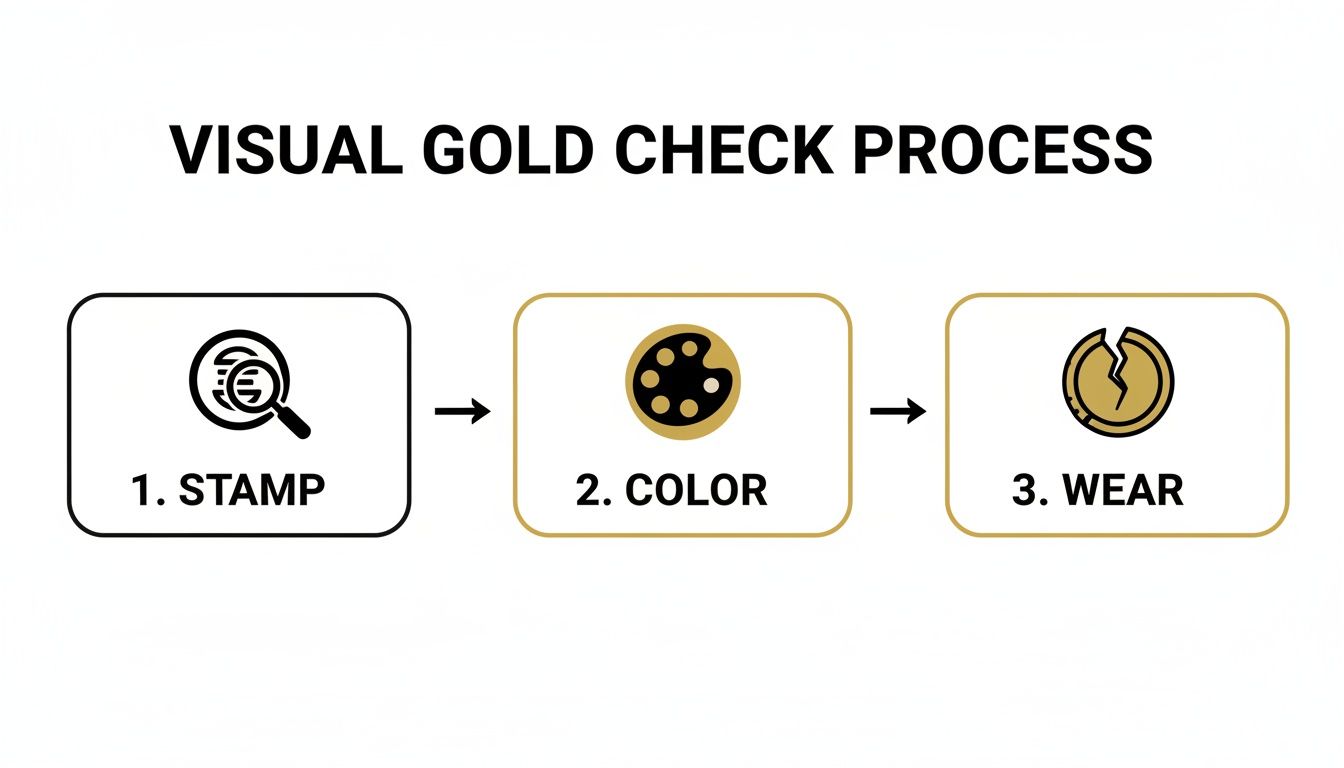
Before you start messing with magnets or acid kits, your best tool is right in front of you: your eyes. A quick, careful look can often weed out the most obvious fakes, saving you a ton of hassle. This first glance is all about knowing the subtle tells that separate real gold from clever imitations.
Many people think gold has one specific color, but its hue can actually shift depending on the other metals it's mixed with. The key isn't the exact shade, but its consistency.
If you spot areas of discoloration—especially on the edges, clasp, or anywhere the piece gets a lot of friction—that’s a huge red flag. It's a classic sign of cheap plating wearing off and exposing the dull base metal underneath.
I once bought a vintage-looking bracelet at a flea market that seemed perfect. After wearing it for just a few weeks, I noticed a coppery tone starting to peek through on the links. That was all I needed to see. Real gold is tough; it doesn't tarnish or rust, so any hint of corrosion means you can stop right there. Before getting technical, learning some easy tips to identify fake gold is a great first step.
Reading the Story in the Stamps
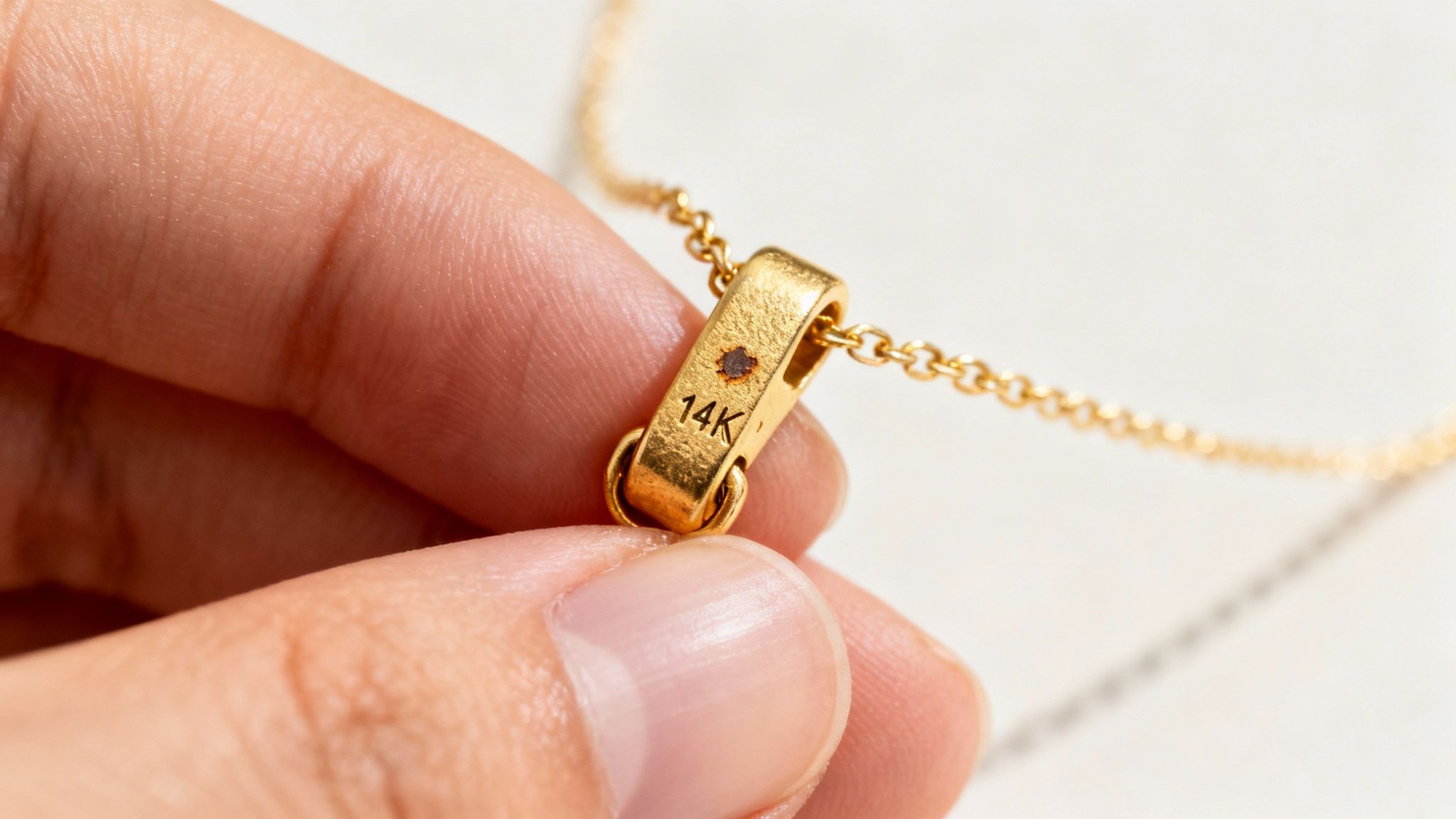
The single most reliable visual clue is the hallmark. This tiny stamp, usually hidden on the inside of a ring band or near a necklace clasp, tells you the gold’s purity.
These marks typically follow one of two systems:
Karat System (e.g., 10K, 14K, 18K, 24K): This is the standard in the U.S., measuring purity out of 24 parts. A 14K stamp means the item is 14 parts gold and 10 parts other metals.
Fineness System (e.g., 585, 750, 999): Used more in Europe, this number represents purity in parts per thousand. A "750" stamp is 75% pure gold, which is the same as 18K.
Now, the absence of a stamp doesn't automatically mean it's fake. On very old or heavily worn pieces, the hallmark can rub off. But if a stamp is present, it’s a very good sign. For a deeper dive into these markings, our guide on identifying jewelry hallmarks can help you crack the code.
Key Takeaway: The hallmark is your best friend. Look for '14K' or '585'. If you see stamps like 'GP' (Gold Plated), 'GF' (Gold Filled), or 'GEP' (Gold Electroplated), you’re not looking at solid gold. It’s that simple.
What to Look for in Wear and Tear
Pay extra attention to high-friction spots. The edges of a coin, the prongs holding a stone, or the links of a bracelet are where fakes tend to give themselves away first.
Solid gold is gold all the way through. When it wears down, you just see more shiny gold. Plated pieces, on the other hand, will eventually chip, flake, or fade, revealing a completely different colored metal underneath.
Also, trust your hands. Gold is one of the densest metals on earth. Real gold jewelry has a satisfying weight to it that's really hard to replicate with cheaper materials. If a piece looks chunky but feels surprisingly light, your instincts are probably telling you something's off.
Simple At-Home Tests for Gold Authenticity
Once you've given your piece a good once-over, it's time to get a little more hands-on. You can run a few simple, non-destructive tests with stuff you probably already have lying around the house. Think of these as your first line of defense—quick checks that can give you strong clues about whether you're holding solid gold or a convincing fake.
Each test builds on the last, helping you piece together the story of your item.
The Magnet Test: A Quick First Step
This is one of the fastest and easiest ways to start your investigation. Gold is a non-ferrous metal, which is just a fancy way of saying it isn't magnetic. This simple fact makes the magnet test a fantastic initial screening tool.
Grab a powerful magnet—not a weak one from your fridge, but something with a bit of pull, like one you'd find at a hardware store. Hold it right up to your jewelry.
If your item shows no reaction at all, that's a great sign. It's behaving exactly like real gold should.
If the item jumps to the magnet, it's definitely not solid gold. You're likely looking at a base metal like iron or nickel with a thin gold plating on top.
One small catch to be aware of: the clasp on a necklace or bracelet often has a tiny steel spring inside, which is magnetic. Make sure you test the main part of the piece, like the chain links or a pendant, for an accurate reading.
The Ceramic Scratch Test
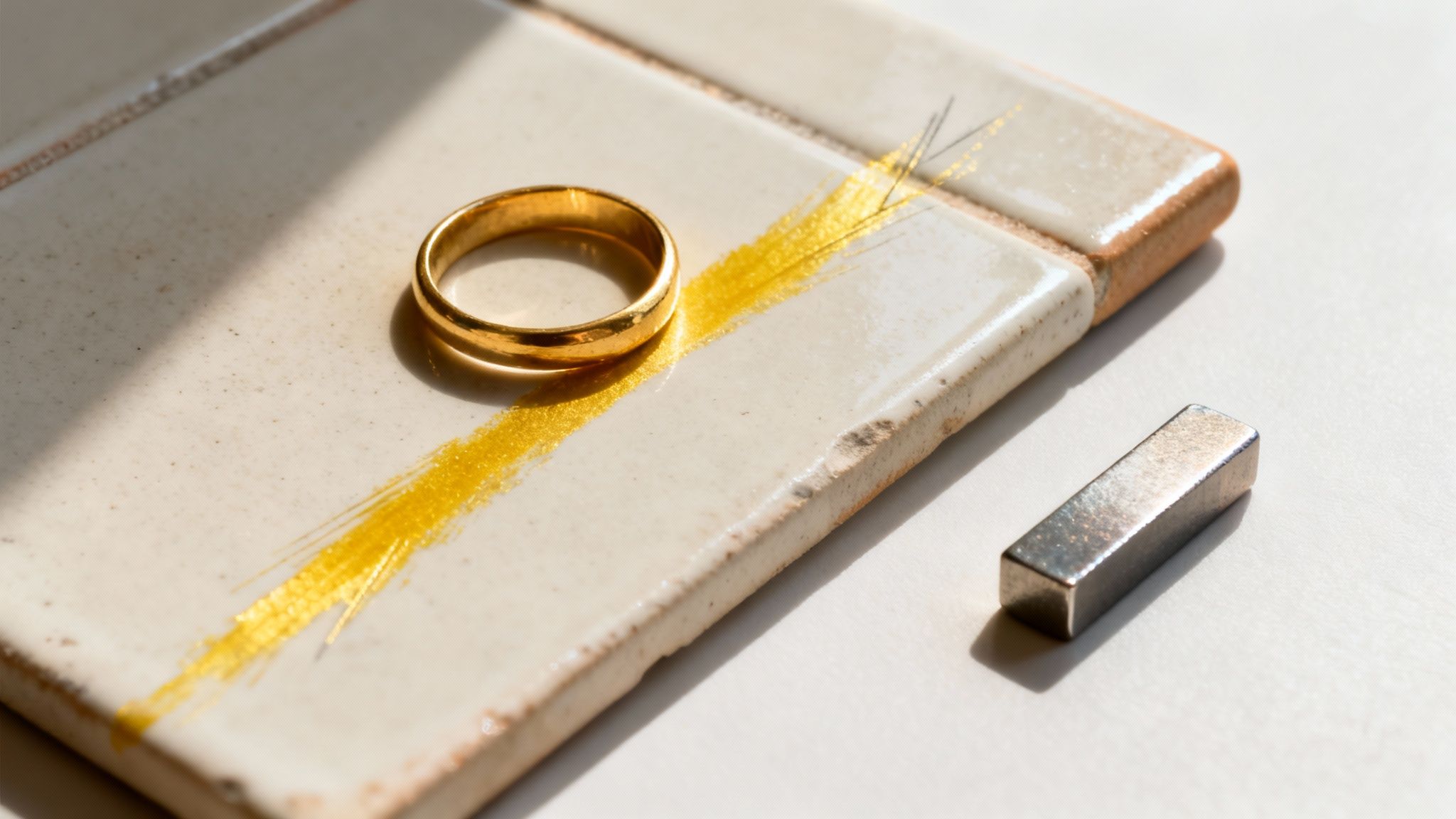
Ready for something a little more revealing? Grab a piece of unglazed ceramic. An unglazed plate, a tile, or even the rough bottom ring of a coffee mug works perfectly. Just be gentle, as this test is slightly abrasive.
Find a spot on your jewelry that isn't too visible and gently drag it across the ceramic. You only need to apply enough pressure to leave a faint mark. Now, take a close look at the color of the streak you just made.
A golden-yellow streak is what you want to see. This strongly suggests your item is real gold.
A black or gray streak is a major red flag. This indicates the piece is made of a different metal and is likely just gold-plated.
This test is more definitive than the magnet test because you're interacting with the actual metal. It's simple, but the results are incredibly telling.
Pro Tip: You don't need to press hard. The goal is to create a faint line just to see the color, not to scratch or damage your piece.
The Skin Discoloration Test
Ever worn a cheap ring only to find a green or black stain on your finger later? That's a chemical reaction between the acids in your skin and metals like copper or nickel. Pure gold doesn't do that.
This test just requires a bit of patience. Wear the jewelry against your skin for a full day, especially when you might be active or sweat a bit.
At the end of the day, take the item off and check your skin. If there's no discoloration, you have another good sign that your jewelry is real gold. But if you see a green, black, or even bluish mark, it's almost certain the piece is gold-plated over a reactive base metal.
Remember, these home tests are excellent for an initial check, but they aren't 100% foolproof. They provide strong indicators, and using them together builds a more complete picture. For more insights on spotting counterfeits, check out our complete guide on how to tell real jewelry from fake. Each test you do helps build a stronger case before you decide if it's worth getting a professional opinion.
Using Density to Uncover Counterfeits
Once you've done the basic visual checks, it's time to get a bit more scientific. This is where we can use a physical property that counterfeiters have an incredibly hard time faking: density.
Gold is one of the densest metals on Earth. It's what makes a real gold chain feel so substantial and heavy in your hand compared to a plated imitation that feels suspiciously light. This test, often called a specific gravity test, puts that unique characteristic to work for you. The concept is simple—measure an item's mass and volume to calculate its density. If that number lines up with gold's known density, you’ve got a very good sign it's the real deal.
Performing the Water Displacement Test at Home
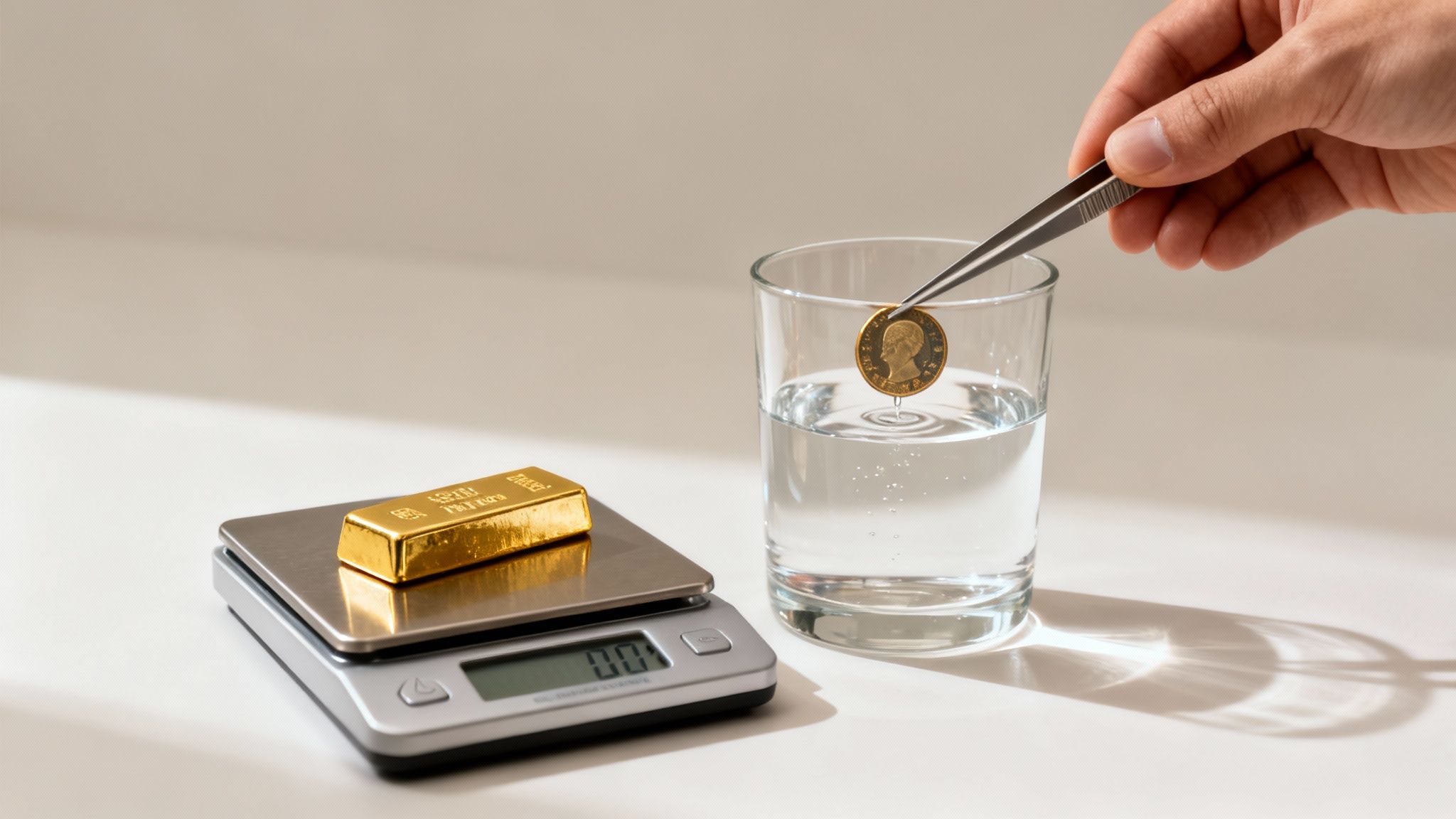
This might sound like something out of a science lab, but you can get surprisingly accurate results with just a few household items. Just a heads up—this method works best for solid pieces without any gemstones, as the stones will throw off the final calculation.
Here’s what you’ll need to get started:
A precise digital scale (one that measures to at least 0.01 grams).
A cup or small beaker of water big enough to fully submerge your item.
A bit of string or thin wire to hang the item.
The process boils down to taking two key measurements. First, you weigh the item dry. Easy enough. Then, you weigh it again while it’s completely submerged in water. The difference between those two weights is what lets you calculate its volume, and from there, its density.
Calculating and Interpreting Your Results
Got your two weights? Great, the math part is pretty straightforward.
Let’s walk through a real-world example.
Get the dry weight. Let’s say your gold ring weighs 38 grams. Write that down.
Get the submerged weight. While hanging from the string in the water, the scale now shows the ring weighs 36 grams.
Find the difference. Just subtract the submerged weight from the dry weight: 38g - 36g = 2 grams. This number is your volume in cubic centimeters (cm³).
Calculate the density. Now, divide the dry weight by the volume you just found: 38g / 2 cm³ = 19 g/cm³.
That result, 19 g/cm³, is extremely close to the known density of pure 24K gold (19.32 g/cm³). A result like this should give you a ton of confidence that the ring is genuine.
Key Insight: Even without the full calculation, just dropping an item into a glass of water can offer a clue. Real gold sinks fast and hard. Fakes often float for a moment or sink slowly. But for a much more precise answer, the specific gravity calculation is the way to go. You can find more info on how pros use DIY testing methods to identify real gold.
Of course, not all gold is pure. Most jewelry is an alloy, which means the gold is mixed with other metals, and this changes the expected density. The table below shows you what to look for.
Gold Karat vs. Density Comparison
This table shows the approximate density for common gold karats, helping you compare your test results to the expected values.
Karat Value | Purity (% Gold) | Approximate Density (g/cm³) |
|---|---|---|
10K Yellow | 41.7% | 11.57 g/cm³ |
14K Yellow | 58.3% | 13.07 g/cm³ |
18K Yellow | 75.0% | 15.58 g/cm³ |
22K Yellow | 91.7% | 17.73 g/cm³ |
24K (Pure) | 99.9% | 19.32 g/cm³ |
Check your calculated density against this chart. If your numbers are in the right ballpark for the item's stamped karat, you're on the right track.
The Big Limitation: Tungsten Fakes
As effective as the density test is, it has one major blind spot: tungsten.
Tungsten has a density of 19.25 g/cm³, which is almost identical to pure gold. This makes it the perfect material for sophisticated counterfeiters who create fake gold bars and coins. A tungsten core with a thick gold plating can fool a density test every single time.
While you're less likely to find this in intricate jewelry, it's a huge concern for anyone buying gold bullion. It's a perfect example of why you can never rely on just one test. Even a scientific method like this can be beaten, which is why a multi-test approach is the only way to be completely sure.
The Acid Test: A Classic Method with Cautions
When you're ready to move beyond the simple at-home checks, the acid scratch test is the old-school, definitive way to determine gold purity. For decades, it's been the go-to method for jewelers and pawnshop owners. It's a straightforward chemical test involving nitric acid, a special black stone, and a bit of know-how.
The science behind it is pretty cool. Real gold is what’s called a "noble metal," which just means it’s tough and resists corrosion and acid. By scraping a tiny, unnoticeable bit of your item onto the stone and dropping some acid on it, you can see if it holds up or simply dissolves away.
How to Perform the Acid Test Safely
First things first: you're working with strong acid. Safety is non-negotiable. Always wear gloves and protective eyewear, and make sure you're in a well-ventilated space to avoid breathing in any fumes.
Here's how you do the test correctly:
Make a Streak: Find a hidden spot on your jewelry—like the inside of a ring or near a clasp—and gently rub it against the black testing stone (often called a touchstone). You only need to create a small, visible golden line on the stone's surface.
Apply the Acid: Gold testing kits come with different bottles of acid, each labeled for a specific karat (e.g., 10K, 14K, 18K). Start with the acid that matches the karat you think your item is. Carefully place a small drop right onto the gold streak you made.
Watch What Happens: This is the moment of truth. Pay close attention to how the streak on the stone reacts to the acid.
Interpreting the Chemical Reaction
The result shows up almost instantly, and it’s usually pretty clear. Let's say you used the 14K acid on your streak. Here's what you might see:
The Streak Stays Strong: If the gold line on the stone doesn't change color and stays bright, your item is at least 14K gold.
The Streak Fades or Dissolves: If the line changes color or disappears entirely, the item is less than 14K gold or is just a gold-plated fake.
From there, you can narrow it down. If it vanished under the 14K acid, you'd make a new streak and try again with the 10K acid to see if it holds up.
Important Takeaway: The acid test is, by its very nature, destructive. While you're scratching a stone and not the item directly, you're still filing away a tiny bit of metal. It's best reserved for pieces where a tiny, hidden test mark won't matter. I'd never recommend doing this on a delicate heirloom without serious thought.
The Major Downsides of Acid Testing
The acid test is a classic, but it has some serious limitations. This is exactly why so many professionals are moving to modern, non-destructive methods. Its biggest flaw? It only tests the surface.
A heavily gold-plated piece can easily fool an acid test. If the plating is thick enough, the streak you rub onto the stone will be pure gold. It'll pass the test with flying colors, even if the metal underneath is worthless brass. While these kits are accessible, their accuracy depends on your skill, and they're notoriously bad at detecting good fakes. You can discover more about the challenges of various gold testing methods and see why pros are upgrading their tools.
This surface-level reading is precisely why the acid test is falling out of favor. For anything high-value, or if you need absolute certainty, it's just not reliable enough on its own. Think of it as a decent first-pass screening tool, but never the final word.
When You Need a Professional Opinion
At-home tests are fantastic for spotting obvious fakes, but there are times when "pretty sure" just isn't good enough. If you're dealing with a high-value piece, family heirlooms, or gold bullion, you need absolute certainty. When the stakes are high, a magnet and a ceramic plate simply won't cut it.
This is where the pros come in. A certified jeweler or appraiser has access to serious equipment that leaves zero room for doubt, giving you a definitive answer you can trust.
The Power of Professional Technology
When you take your item to an expert, they won’t be reaching for vinegar or a basic acid kit. Professionals use sophisticated, non-destructive tools that analyze the exact elemental composition of your piece without leaving so much as a scratch.
The gold standard in modern authentication is the X-Ray Fluorescence (XRF) analyzer. This powerful handheld device is a complete game-changer for verifying gold.
How It Works: The XRF gun shoots high-energy X-rays at the item. This excites the atoms in the metal, which then emit their own unique secondary X-rays. The machine reads this feedback to identify every single element present and its exact percentage.
What It Detects: This tech instantly uncovers fakes, even the most convincing ones. It can see straight through thick gold plating to find a tungsten or brass core that would easily fool a density or acid test.
The Results: You get a precise, digital readout of the item’s purity—something like 58.5% gold, 25% copper, and 16.5% silver, confirming it's 14K gold.
The XRF test is hands-down one of the most reliable ways to tell if gold is real. Modern devices can deliver incredible precision, with reproducible values as low as 0.06% for gold concentration. Unlike acid tests that only scratch the surface, an XRF penetrates deeper and gives you results in as little as five seconds. It’s no surprise that globally, 60% of buyers now prefer gold certified with advanced methods like these. To see how it works, you can find more details about these non-destructive gold analysis techniques.
Finding a Reputable Expert
Not all jewelers are created equal. For a trustworthy appraisal, you need to find a professional with real credentials. Look for someone with a Graduate Gemologist (GG) certification from the Gemological Institute of America (GIA) or membership in a respected appraisal association.
Ask friends for recommendations or check online reviews for local appraisers with a solid reputation. A good expert will be completely transparent about their process and their fees.
Expert Tip: Never leave a high-value item with an appraiser who insists on taking it to a "back room" out of your sight. A legitimate professional will perform all testing and evaluation right in front of you.
What to Expect During an Appraisal
A professional appraisal is a pretty straightforward process. The expert will usually start with a visual inspection, looking for hallmarks and signs of wear, just like you did.
Next, they’ll weigh and measure the item with precision before moving on to the advanced stuff, most likely with an XRF analyzer. The whole thing is usually quick, and they should walk you through the results clearly.
Be prepared for a fee, which can range from a small charge for a simple verbal confirmation to a more significant cost for a detailed, written appraisal for insurance. Always ask about the cost upfront to avoid any surprises. This final step gives you more than just an answer—it provides the confidence and documentation you need for your valuables.
Common Questions About Testing Gold
Even after you’ve got a handle on the basics of gold testing, there are always a few specific questions that pop up. Let's run through some of the most common ones I hear, because getting these details right can save you from a costly mistake or a lot of confusion.
Knowing the answers to these helps you sidestep the common pitfalls, like damaging a piece you thought was fake or misreading a test result that seems contradictory.
Can I Use Vinegar to Test Gold?
You've probably seen this DIY hack floating around online. The idea is that since gold is a non-reactive metal, it won't be affected by the mild acetic acid in vinegar. While that part is true—real gold won’t react—the problem is that many fake materials won't react either.
It's just not a reliable test, and it can easily give you a false sense of security. Worse, if the item is gold-plated, the vinegar can sometimes damage that thin outer layer or react with the base metal underneath, causing permanent discoloration. It's best to stick with more dependable methods that won't risk harming your jewelry.
What Does a 925 Stamp Mean?
If you spot a "925" stamp on your item, it’s a great clue about the metal content, but it doesn't mean you have gold. This hallmark is the international standard for sterling silver. It certifies that the piece is 92.5% pure silver mixed with 7.5% other metals (usually copper) for durability.
Sometimes you'll find a gold-colored item stamped "925." This is almost always a piece of sterling silver that has been plated with gold, a technique often called "gold vermeil." While it has value, its worth is based on the silver core, not solid gold.
Key Takeaway: A 925 stamp means your item is sterling silver, not gold. It's a key piece of information that tells you exactly what you're holding.
Why Did My Real Gold Jewelry Fail the Magnet Test?
This is a classic head-scratcher. You know a piece is real gold, but a strong magnet shows a faint pull. Don't panic; this almost never means your gold is fake. The pull is almost always coming from something else in the jewelry.
The most common culprit is the clasp. The clasps on necklaces and bracelets need a spring to function, and that tiny spring is almost always made of steel. Steel is magnetic, and even that little bit is enough for a powerful magnet to grab onto. To get a true reading, make sure you test the body of the piece—like the chain links or a pendant—away from any hardware.
It's also worth noting that some gold alloys, especially white gold, can contain nickel, which has very weak magnetic properties. For a deeper dive into what makes up different gold purities, check out our complete comparison guide on 10K vs 14K gold.
How Much Does Professional Gold Testing Cost?
When you need 100% certainty, a professional is your best bet. The cost for an expert opinion can vary quite a bit, depending on what you need.
Verbal Confirmation: If you just want a quick, informal check to see if something is real, many jewelers will do this for a small fee—sometimes even for free as a courtesy. You can expect to pay around $10 to $25.
Written Appraisal: For insurance purposes or a high-value sale, you’ll need a formal written appraisal. This is a much more detailed document that includes weight, measurements, a full description, and an official valuation. This service is more involved and typically costs between $75 and $150 per item.
My advice? Always call a few local jewelers ahead of time to ask about their services and fees. A reputable professional will be happy to explain their pricing upfront.
At Panther De Luxe Shop, we believe in the timeless beauty and lasting value of authentic gold jewelry. Explore our curated collections to find your next treasured piece with confidence. Visit us today at https://www.pantherdeluxe.com.
Comments