
A Savvy Buyer's Guide to Diamond Cut Clarity Color
- Luke Zucco
- Dec 7, 2025
- 16 min read

When you hear experts talk about diamond quality, the terms cut, clarity, and color will always come up. Along with carat weight, these are the famous "4Cs"—the universal language that defines a diamond's beauty, rarity, and ultimately, its price.
Getting comfortable with these terms is the first step toward making a smart, confident purchase. It's the difference between just looking at diamonds and truly seeing them.
Decoding the Language of Diamonds
Before you even think about styles or settings, you need to understand the foundation of a diamond's quality. The 4Cs—Cut, Clarity, Color, and Carat—are the globally accepted standards for grading every stone on the market. Think of them as a diamond’s DNA, a detailed report card that tells you everything you need to know about its unique character.
This guide is designed to demystify these core principles. The goal isn't for you to memorize definitions, but to genuinely understand how these elements work together to create the fire, sparkle, and personality of each individual stone.
The Foundation of Diamond Value
Each of the 4Cs plays a distinct role, but they all influence a diamond's appearance and price tag. Mastering these concepts gives you a clear roadmap, turning you from a casual browser into a well-informed buyer. For a deeper dive into the official grading process, our guide on understanding diamond grades offers expert knowledge.
Here’s a quick breakdown of what each 'C' really means:
Cut: This isn't about the shape (like round or oval). It’s all about the quality of a diamond's angles and facets, which control how light bounces around inside. This is the source of its sparkle.
Clarity: This grades the presence of tiny imperfections, both inside (inclusions) and on the surface (blemishes). The fewer the flaws, the rarer and more valuable the diamond.
Color: This actually measures the absence of color. The scale runs from D (completely colorless) down to Z (light yellow or brown).
Carat: This one is simple—it’s the diamond’s weight, which is a good indicator of its physical size.
Understanding the trade-offs between cut, clarity, and color is the secret to finding incredible value. A diamond with a truly excellent cut can make slightly lower color or clarity grades look far more brilliant, letting you maximize your budget without sacrificing that head-turning sparkle.
To help you get a feel for how these elements come together, we've put together a quick reference table. It's a great starting point before we explore each characteristic in more detail.
The 4Cs of Diamond Quality At a Glance
This table breaks down what each of the 4Cs measures and how it influences a diamond's look and cost. Keep it handy as you start your search.
Characteristic | What It Measures | Impact on Appearance | Impact on Price |
|---|---|---|---|
Cut | Proportions, symmetry, and polish of the facets | The primary factor for brilliance, fire, and sparkle | Can significantly increase value; a poor cut devalues a stone |
Color | The absence of color (whiteness) | Affects the icy-white appearance of the diamond | Price increases dramatically for colorless grades (D-F) |
Clarity | The absence of internal or external flaws | Affects the stone's purity and visual flawlessness | Flawless diamonds are rare and command the highest prices |
Carat | The physical weight of the diamond | Directly relates to the diamond's size | Price increases exponentially with weight |
Now that you have the big picture, we can start to unpack how each of these factors plays out in the real world—and how you can use that knowledge to find the perfect diamond for you.
Why Cut Is the Secret to a Diamond's Brilliance
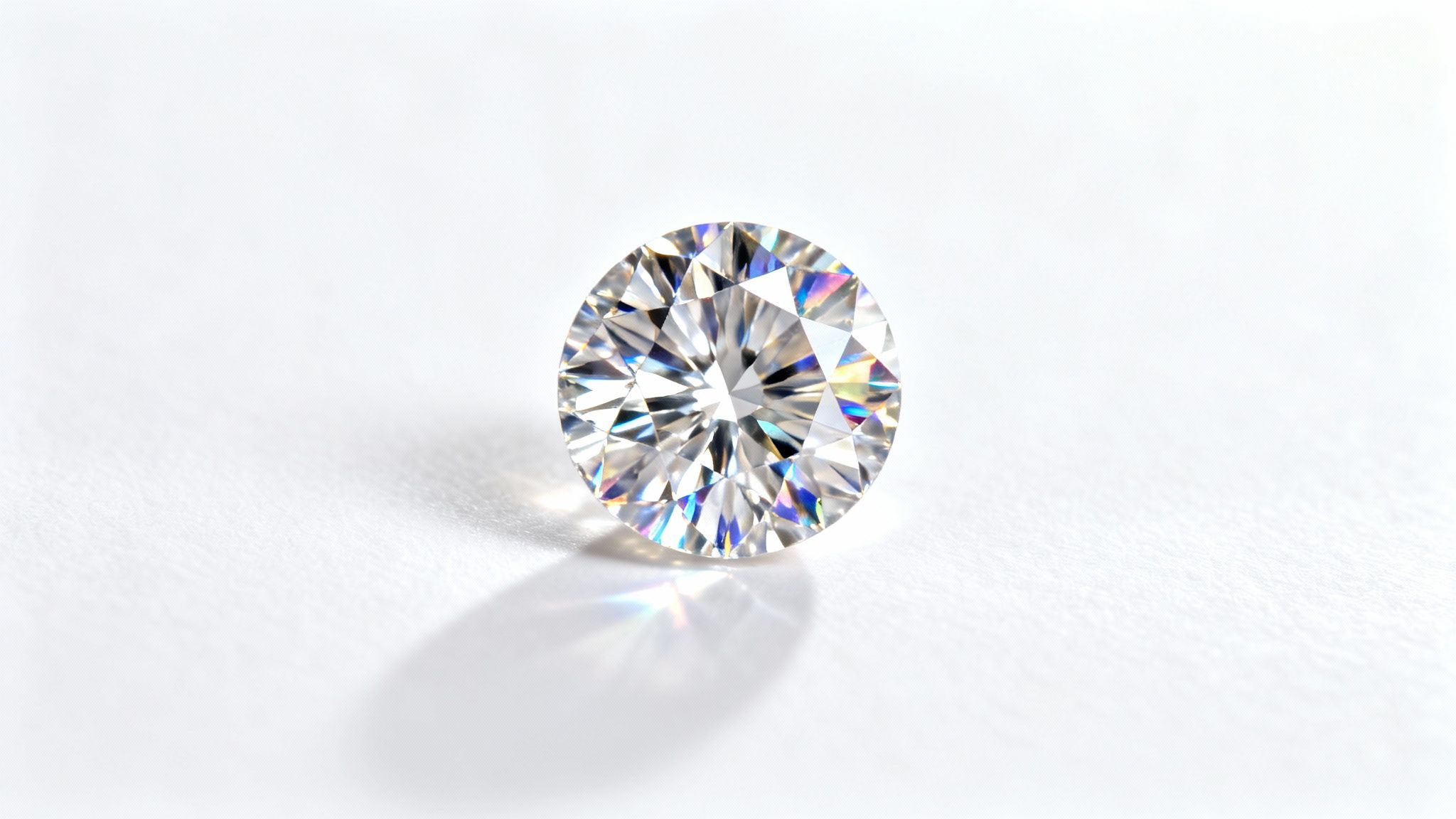
While nature gets all the credit for a diamond’s clarity and color, the cut is where human artistry takes over. It’s the single most important part of the process, transforming a humble rough stone into a gem that seems to have a life of its own. In fact, when it comes to a diamond's beauty, cut is arguably the most important factor. It’s what determines how the stone plays with light.
Think of an expertly cut diamond as a tiny room full of perfectly angled mirrors. When light enters, it bounces from one facet to another, getting brighter and more intense before it shoots back out to your eye. That explosive sparkle? That's all thanks to the cut.
Each of those tiny, polished surfaces—called facets—is meticulously designed to catch, bend, and reflect light. This is what creates that iconic fire and flash. When you’re evaluating cut, clarity, and color, the cut will always have the most dramatic and immediate impact on how a diamond looks.
The Three Pillars of Diamond Sparkle
A diamond's sparkle isn't just one thing. It's a gorgeous combination of three different optical effects, and they all come down to the quality of the cut. Getting familiar with these will help you see why a great cut is non-negotiable.
Brilliance: This is the pure, white light that reflects from the top of the diamond. It's that intense, bright flash that grabs your attention.
Fire: Ever seen a diamond shoot off a rainbow of colors? That's fire. It happens when light splits into a spectrum as it passes through the stone, just like a prism.
Scintillation: This is the dynamic "twinkle" you see when the diamond moves. It’s the beautiful pattern of light and dark areas that makes the stone come alive with every little gesture.
An excellent cut balances all three of these perfectly. On the flip side, a poorly cut diamond lets light leak out of its sides or bottom, making it look dull and lifeless, no matter how great its color or clarity is. To see how this applies to different shapes, you can learn more about the different diamond cuts explained in our detailed guide.
A well-cut diamond is a performance masterpiece. It can make a stone with a lower color grade look whiter and even hide minor inclusions, giving you the best possible look for your budget. It’s why so many experts will tell you to put your money on the cut, every time.
Understanding the GIA Cut Scale
The Gemological Institute of America (GIA) sets the industry standard for grading the cut of round brilliant diamonds—the most popular shape. The scale is all about measuring how well a diamond’s proportions and facets work together to handle light.
GIA Cut Grade | Light Performance | Description |
|---|---|---|
Excellent | Superior | Reflects nearly all light that enters, creating maximum brilliance and fire. |
Very Good | High | Captures most of the diamond's potential but has slightly less sparkle than Excellent. |
Good | Adequate | Reflects a good amount of light but is noticeably less brilliant than higher grades. |
Fair | Limited | Leaks a significant amount of light, appearing duller and less lively. |
Poor | Minimal | Leaks most light out of the bottom or sides, resulting in very little sparkle. |
The Smartest Investment for Your Budget
Let's break this down with a real-world example. Say you have a budget for a one-carat diamond. You could get a stone with a high color grade (like F) and high clarity (VS1) but only a "Good" cut. Or, you could choose a diamond with slightly lower color (H) and clarity (SI1) but an "Excellent" cut.
Which one looks better? The second one, almost every single time.
The superior cut maximizes light performance, making the stone appear whiter and brighter while masking those small imperfections. The "Good" cut diamond, even with its better stats on paper, will just fall flat and lack that essential fire.
This is exactly why we always tell our Panther De Luxe customers to prioritize the cut grade. Investing in an Excellent or Very Good cut ensures your diamond performs at its peak, giving you that head-turning sparkle that makes a diamond so special. It’s the best way to make any diamond—regardless of its other grades—truly shine.
Navigating Diamond Color Beyond the Myth of Perfection
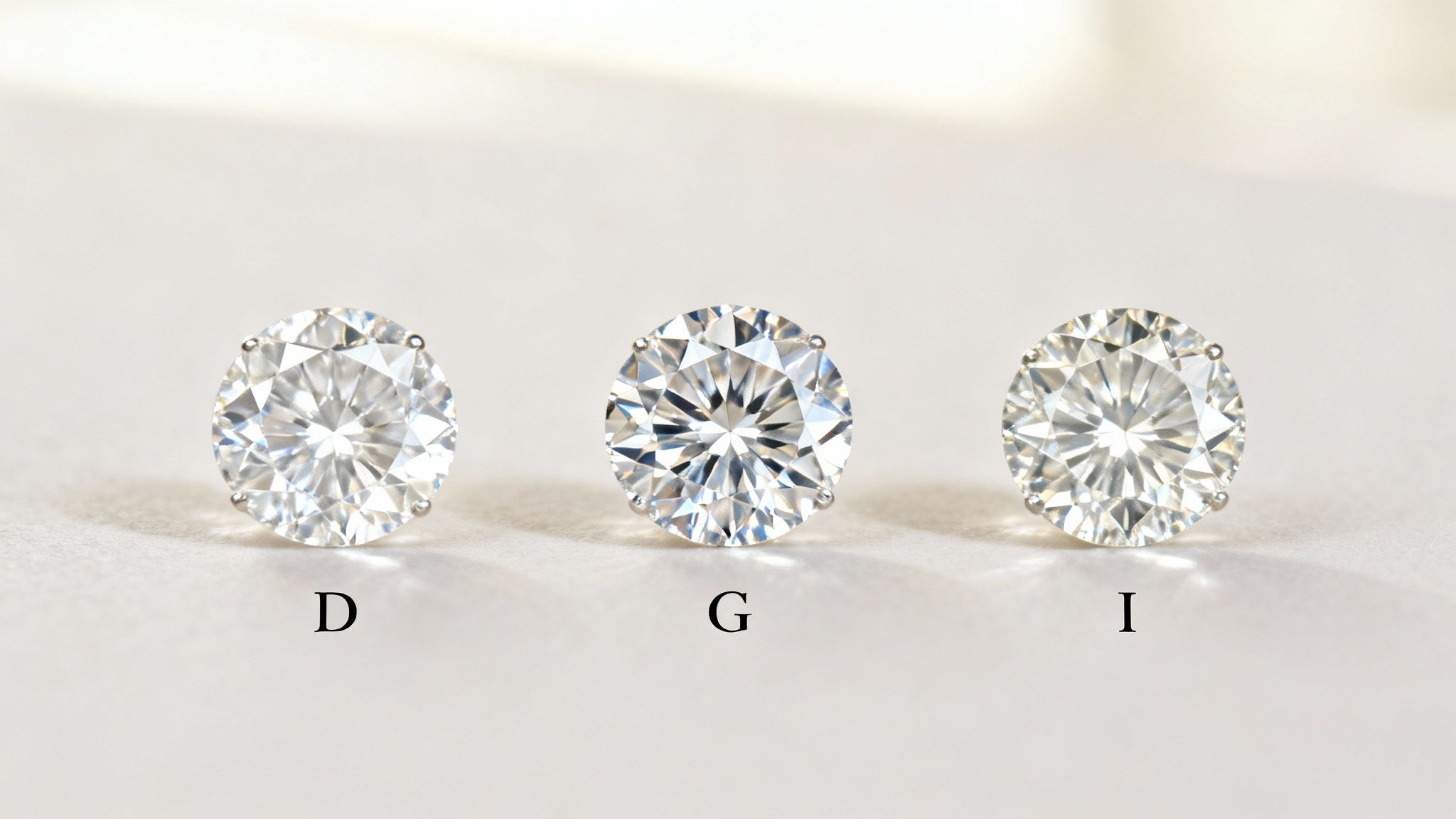
When people talk about diamond color, there’s a common mix-up. The grading scale isn’t about finding a diamond with a beautiful hue; it’s actually about the absence of color. A truly perfect diamond is like a drop of pure water—completely transparent and colorless.
Think of it like this: picture a perfectly clear glass of water. Now, imagine adding a single, tiny drop of yellow food coloring. You might not notice it at first glance, but the water is no longer truly colorless. That’s exactly how diamond color grading works. It’s a measure of the subtle yellow or brown tones within the stone.
While cut, clarity, and color are all essential, color is often the most forgiving 'C' to the naked eye. The differences between grades sitting next to each other on the scale are so slight that you'd need to compare them side-by-side under special lighting to see them.
Understanding the D-to-Z Color Scale
To bring some consistency to the industry, the GIA created the D-to-Z color grading scale, which is now the standard. D is the highest grade you can get—flawlessly colorless and incredibly rare. At the other end, Z has a noticeable light yellow or brown tint.
Here’s a more practical way to think about the scale:
Colorless (D-F): These are the rarest and most expensive grades. Even a trained gemologist would have a hard time spotting any color here. A D-grade diamond is the pinnacle of icy-white perfection.
Near-Colorless (G-J): This is the sweet spot and the most popular range for engagement rings and other fine jewelry. These diamonds have traces of color so faint that, once set in a piece, they’re basically impossible for the average person to detect.
Faint (K-M): You'll start to notice a slight, warm yellow tint in these grades, especially in larger stones or when you put one next to a higher-grade diamond.
Very Light (N-R): The yellow or brown color becomes more obvious in this range, even without another diamond for comparison.
Light (S-Z): Color is easy to see in these diamonds. They aren’t typically used in high-end jewelry unless the color is strong enough to be considered a "fancy" colored diamond.
The secret to getting incredible value lies in the Near-Colorless range. A G, H, or I color diamond will look virtually identical to a colorless stone once it's mounted, but it comes at a much friendlier price. This is the smart buyer’s sweet spot.
This isn’t just an insider tip; it’s what drives the market. The global diamond jewelry market was valued at USD 90.01 billion in 2023, and the Near-Colorless (G-J) category is a huge part of that. In fact, it held a massive 56.59% market share in 2022 simply because it offers the perfect balance of beauty and cost. You can read more about these diamond jewelry market trends on Grand View Research.
How Your Setting Changes Everything
One of the best ways to get the most out of your budget is to think about the metal you’re setting your diamond in. The setting has a huge influence on how the diamond’s color looks to the eye.
A diamond will naturally pick up and reflect the colors around it. You can use this to your advantage—either to make a diamond look even whiter or to complement its natural warmth. It’s a design trick that our Panther De Luxe Shop customers use all the time to create stunning pieces.
Here’s how it works in practice:
For an Icy Look: If you’ve chosen a diamond in the D-F or G-H range, setting it in a white metal like platinum or white gold will really amplify its colorless look. The bright, neutral backdrop makes the diamond appear exceptionally white.
For Warm Elegance: If you love a diamond with a little warmth, like an I or J grade, setting it in yellow or rose gold is a brilliant move. The warm tone of the metal complements the diamond’s faint color, making it look whiter in comparison and creating a beautiful, cohesive style.
This is exactly why paying a premium for a D-color diamond only to put it in a yellow gold setting often doesn’t make sense. The metal’s reflection will essentially erase the tiny difference between a D and a G grade. That frees up your budget to focus on a better cut or a larger carat size. Choosing the right color is all about finding a stone that looks amazing in its final home, not just on a piece of paper.
Finding Beauty in Imperfection with Diamond Clarity
If a diamond’s cut is its artistry and its color is its purity, then its clarity is its unique natural fingerprint. No two diamonds are exactly alike. Formed deep within the Earth under immense heat and pressure, nearly every single one carries tiny characteristics that tell the story of its creation.
Think of these features as a birthmark, not a flaw. They’re what make each stone a one-of-a-kind treasure. While the idea of a "flawless" diamond sounds perfect, the reality is that most of these characteristics are completely invisible without a jeweler's loupe.
For a smart buyer, understanding how cut, clarity, and color work together is the real secret. The goal isn't to find a flawless diamond, but to find one that appears flawless to the naked eye. This distinction is where you can find incredible value.
Inclusions and Blemishes: The Diamond's Story
A diamond’s clarity is graded based on the number, size, and placement of its internal and external characteristics. They fall into two main camps:
Inclusions: These are tiny characteristics enclosed within the diamond. They might be microscopic crystals or even tiny structural quirks that got trapped as the diamond formed.
Blemishes: These are marks on the surface of the diamond, like tiny scratches or nicks that can happen during the cutting and polishing process.
Remember, we’re talking about features that are usually microscopic. A diamond with a few small, well-placed inclusions can still be absolutely stunning and look perfectly clean to anyone admiring it on your hand.
Decoding the GIA Clarity Scale
The GIA Clarity Scale is the industry's universal standard, with 11 distinct grades. Understanding this scale helps you know exactly what you’re paying for.
Clarity Grade | Abbreviation | What It Really Means |
|---|---|---|
Flawless | FL | Zero inclusions or blemishes visible under 10x magnification. The rarest of the rare. |
Internally Flawless | IF | No inclusions, but might have tiny surface blemishes visible under 10x magnification. |
Very, Very Slightly Included | VVS1, VVS2 | Inclusions are so minor they’re extremely difficult for even a skilled grader to spot. |
Very Slightly Included | VS1, VS2 | Minor inclusions that are tough to see under 10x magnification. |
Slightly Included | SI1, SI2 | Inclusions become noticeable to a grader under 10x magnification. |
Included | I1, I2, I3 | Inclusions are obvious under 10x and may affect the diamond's sparkle and transparency. |
Here’s the key takeaway: everything from FL down to SI1 can potentially be "eye-clean," meaning you can't see any imperfections just by looking at the stone.
The ultimate goal for most buyers is to find an eye-clean diamond. A stone that appears flawless to the naked eye provides the exact same visual appeal as a Flawless diamond but at a significantly lower price point, allowing you to allocate more of your budget toward cut quality or carat size.
The Sweet Spot for Value: VS and SI Grades
While Flawless and Internally Flawless diamonds are incredible, they command a premium for a level of perfection that’s invisible in everyday wear. This is why the Very Slightly Included (VS) and Slightly Included (SI) grades are the most popular choices for engagement rings and fine jewelry.
These grades hit that perfect balance between beauty and budget. It’s no surprise that VS2 and SI1 are the most common selections for engagement rings worldwide—they master the trade-off. While top-tier diamonds make up about 10% of high-end sales, most people wisely choose clarity grades with minor inclusions that are only visible under a microscope. You can explore more of these diamond industry statistics and consumer trends to see for yourself.
Using Cut and Setting to Your Advantage
The location of an inclusion matters just as much as its size. A tiny dark crystal right in the center of the diamond's table will be more noticeable than a larger, transparent inclusion tucked away near the edge.
This is where your knowledge of the other 'Cs' becomes your superpower. A brilliant cut with its intense sparkle does a fantastic job of masking minor inclusions. The flash and fire from all those facets can distract the eye, making it very difficult to spot small imperfections.
Here are a few tips our Panther De Luxe Shop customers use to make smart choices:
Prioritize a Brilliant Cut: Shapes like the round brilliant, oval, and radiant cut are masters of disguise, hiding inclusions with their incredible sparkle.
Consider Your Setting: A bezel or prong can be strategically placed to cover an inclusion near the diamond's edge, making it completely disappear from view.
Always Ask for High-Res Images: When shopping online, make sure to view high-resolution photos and videos of the actual diamond to check if it's eye-clean from every angle.
By focusing on an eye-clean diamond in the VS or SI range, you can get a stone that looks perfect in its setting while saving a significant amount of money. That's money you can put toward achieving the perfect balance of cut, clarity, and color for your dream piece.
How AI Is Revolutionizing Diamond Grading
For generations, diamond grading has been a delicate art, relying on the trained eye of a human expert. But that tradition is getting a powerful high-tech partner. Artificial Intelligence (AI) and machine learning are stepping in to bring a whole new level of precision and consistency to how we evaluate a diamond's cut, clarity, and color. This isn't about replacing human skill—it's about enhancing it.
Think of it this way: AI systems use incredibly sophisticated imaging to see a diamond in a way the human eye simply can't. They can map microscopic inclusions and detect the faintest color nuances with total objectivity, time after time. For you, the buyer, this means the small, subjective differences that might exist between two gemologists' opinions are smoothed out, ensuring a diamond's certificate is a rock-solid reflection of its quality.
This isn't just a future concept; it's happening now and changing the game, especially for clarity. As of 2024, AI grading has already captured over 30.6% of the diamond grading market, with clarity grading alone making up more than 34.2% of that share. These systems are trained to spot the tiniest details, dramatically improving how accurately diamonds are evaluated. You can find more details on the rise of AI in diamond grading on Market.us.
Removing Subjectivity for Greater Trust
The real magic of AI in diamond grading is its ability to remove human bias and fatigue. A machine doesn't get tired. It can analyze thousands of diamonds with the exact same strict standards, making sure that a G color grade from one lab is truly identical to a G color from another.
This consistency creates a more transparent and trustworthy market for everyone. When you see a grading report that's been backed by AI analysis, you can feel more confident that the grades aren't just an expert's opinion but a data-driven fact.
AI acts as the ultimate quality control, creating a universal standard for assessing cut, clarity, and color. It ensures that every diamond is judged on its own merits, providing a level playing field for both sellers and buyers.
A Deeper Understanding of Diamond Quality
AI does more than just assign a grade; it helps us understand diamonds on a deeper level. By analyzing massive datasets, these systems can identify subtle patterns—like how a certain type of inclusion might affect a diamond's sparkle, or how tiny tonal differences impact its overall look. This creates a much richer, more detailed profile for each stone.
This same principle of turning complex data into clear, valuable insights is being used across many industries. To get a better sense of how AI transforms raw information into useful assets, you can explore AI-powered product data enrichment.
Here at Panther De Luxe Shop, this technology allows us to give you more precise information than ever before, helping you make a choice that feels truly informed. The future of buying a diamond is one where technology empowers confidence.
Smart Strategies to Maximize Your Diamond Budget
Now that you have a handle on cut, clarity, and color, it’s time to put that knowledge to work. Shopping for a diamond is really a game of smart trade-offs. The secret isn't just about spending more—it's about knowing where to invest your budget for the biggest visual impact and where you can pull back without anyone noticing.
Everyone’s priorities are a little different. Do you want a diamond that throws off intense, fiery sparkle from across the room? Or is your main goal to get the biggest stone you can? Nailing down what matters most to you is the first step. Think of this as your playbook for building the perfect diamond on your terms.
Define Your Buying Persona
Most shoppers fall into one of a few categories. Figuring out which one sounds like you makes the whole process way easier, because it gives you a clear road map for the 4Cs.
The Sparkle Maximizer: For this buyer, brilliance is everything. The goal is a diamond that just lights up a room. The one non-negotiable here is Cut—everything else comes second.
The Size Seeker: This person wants the most impressive carat weight their budget allows. The focus is all on Carat, which means getting clever with color and clarity grades to free up more of the budget.
The Value Hunter: This is the most common approach. The Value Hunter wants a beautiful, balanced diamond that looks stunning to the naked eye, without paying a premium for grades you can't even see in the real world.
Think of your budget like a set of points you can assign to cut, clarity, and color. When you know which of these has the biggest effect on what you see, you can allocate those points wisely to get the exact look you're after.
Actionable Tips for Smart Trade-Offs
Once you know your top priority, you can start making informed compromises. The key is finding that sweet spot in each category—the point where you get the most visual bang for your buck.
For example, choosing an "eye-clean" SI1 clarity diamond over a flawless-looking VVS1 can literally save you thousands of dollars. That money can then be put toward a higher cut grade for more sparkle or a larger carat size. This is the core strategy for stretching your budget, and it applies to both natural and lab-created diamonds. To learn more, our guide to a lab-created diamond ring breaks down how this technology delivers incredible value.
Putting It All Together in Practice
To see how this works, let's create a few scenarios. We’ll give three different buyers a budget of $5,000 for a round brilliant diamond and see how their priorities lead them to three totally different, but equally perfect, stones.
Budget Allocation Scenarios For a $5,000 Diamond
This table shows how different goals change where you should put your money.
Buyer Priority | Recommended Cut | Recommended Color | Recommended Clarity | Resulting Carat Size (Approx.) |
|---|---|---|---|---|
Maximize Sparkle | Excellent | H | SI1 | 0.90 ct |
Maximize Size | Very Good | I | SI2 | 1.10 ct |
Maximize Value | Excellent | I | VS2 | 1.00 ct |
As you can see, the choices really matter. The Sparkle Maximizer invests heavily in an Excellent cut, which helps an H color diamond look incredibly white and bright. The Size Seeker, on the other hand, compromises on cut and color to get over that coveted one-carat mark. And the Value Hunter finds that perfect middle ground, getting a brilliant cut and great clarity on a beautiful one-carat stone.
This whole idea of optimizing for the best visual result is a principle used in a lot of other fields, too. For instance, technologies like AI-powered image enhancement do something similar by boosting clarity and detail in digital photos to make them pop. In the end, it’s all about making smart choices to achieve the most beautiful result possible.
Common Questions About Cut, Clarity, and Color
Even after getting a handle on the 3 Cs, there are always a few final questions that come up right before making a decision. Nailing down these last details is what gives you the confidence to pick the perfect diamond.
So, which of the Cs should you never compromise on? For almost everyone, the answer is Cut. It has the single biggest impact on a diamond's sparkle. A fantastic cut can even hide minor imperfections in color or clarity, making it the smartest place to put your money.
Another thing people always ask is whether a diamond’s shape changes how it looks. Absolutely. Elongated shapes like ovals and marquise cuts often appear larger than a round diamond of the same carat weight. The trade-off? Their shallower depth can make color more noticeable, so you might want to aim for a slightly higher color grade with these shapes.
Which Diamond Is Right for You?
To help you figure out where to focus your budget, this simple decision tree lays out three common paths buyers take, depending on what they value most.
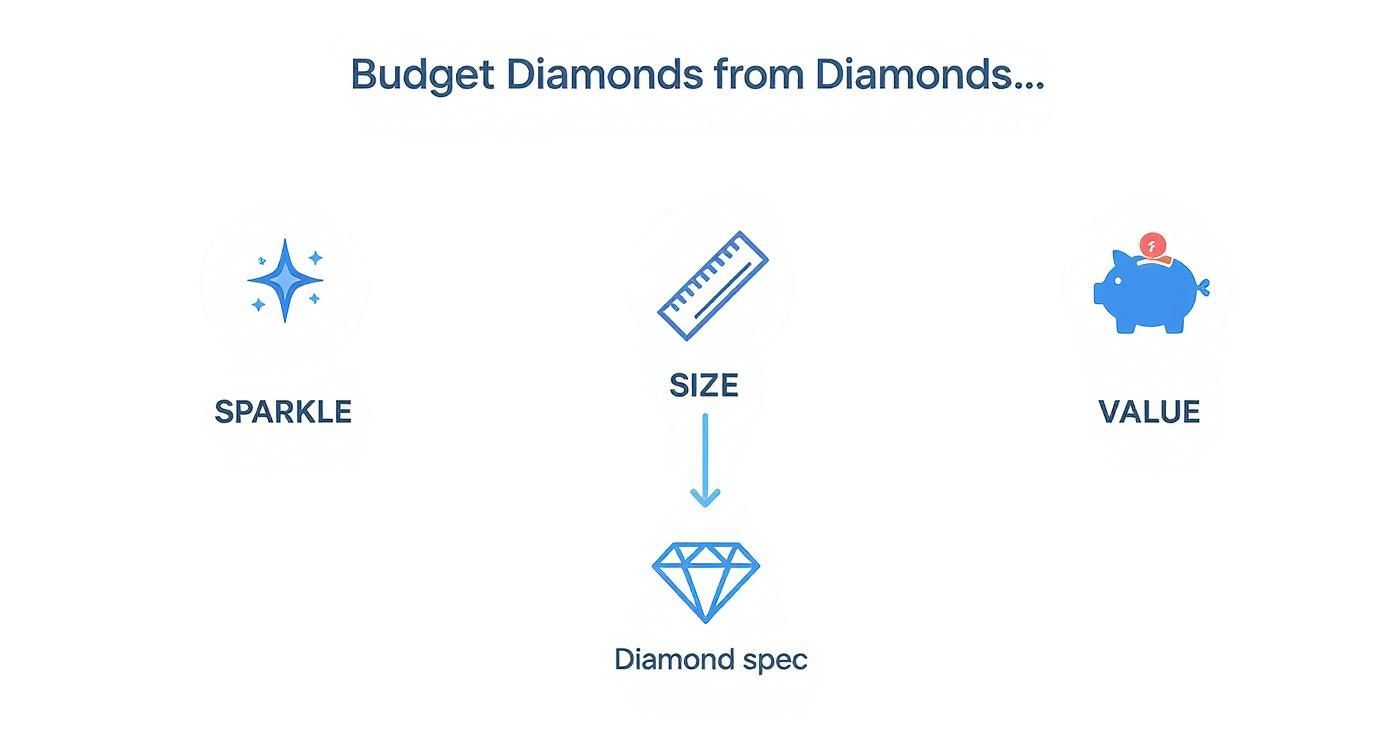
As the visual shows, whether you’re chasing sparkle, size, or just the best all-around value, there’s a smart way to get there. Each path leads to a different, but equally beautiful, choice.
The Importance of Certification
Finally, is a GIA certificate really that big of a deal? Yes. It’s non-negotiable. A report from the Gemological Institute of America (GIA) is the industry's gold standard. It’s your unbiased proof that the grades for cut, clarity, and color are accurate. Think of it as your diamond's guarantee of authenticity and quality—the ultimate protection for your investment.
At Panther De Luxe Shop, we believe an informed choice is a confident one. Explore our curated collection of beautifully crafted diamond jewelry and find the perfect piece that balances brilliance, beauty, and value. Discover your dream diamond today at Panther De Luxe Shop.
Comments