
Jewelry Design Process Explained: From Idea to Finish in 60 Seconds
- seanmawhinney
- May 26, 2025
- 17 min read
Understanding Your Jewelry Design Process Journey
Starting the journey of jewelry making is thrilling. However, creating pieces that truly attract buyers and achieve sales requires more than just raw artistic talent. A well-executed jewelry design process combines artistic flair with careful planning. This process is about knowing how to turn an initial idea into a physical item that connects with customers and makes an impact in a competitive environment.
Designers need to find a middle ground between their creative ideas and practical realities. For instance, the materials chosen or how intricate a design is will directly affect production costs and how long it takes to make. Managing what clients expect, while maintaining one's artistic style, is also very important.
This careful balance often separates a professional designer from someone doing it as a hobby, demanding good problem-solving and clear ways of talking to people. The worldwide jewelry market reflects this energy; it was valued at approximately $232.94 billion in 2024. It's expected to grow to $343.90 billion by 2032, which is a compound annual growth rate (CAGR) of 5.10%.
This expansion points to more people wanting luxury and modern designs. As a result, more designers are entering the field, making a solid design process essential for standing out. Learning more about market trends can provide useful context for any designer.
Defining Your Design Path: Custom Work Versus Collections
The approach to jewelry design can differ greatly if you are making one-of-a-kind custom items or putting together themed collections. Each direction offers its own set of difficulties and benefits.
Custom Design: This method involves working very closely with a client. The aim is to turn their specific ideas into a real piece. Good communication and understanding what the client wants are key to creating a wearable artwork.
Collection Design: Creating a collection needs a clear central idea and knowledge of current market preferences. The objective is to produce a group of connected pieces that share a common style or theme, attracting a specific group of buyers.
No matter which direction you take, setting up a dependable design workflow is crucial. This means having established steps for coming up with ideas, finding materials, making prototypes, and making improvements. A system like this helps maintain steady quality and work speed, important for lasting success.
Additionally, it's very important to cultivate your own distinct design identity, especially in a market with many skilled designers. This identity is your personal style—the specific features that make your jewelry easy to identify and sought after. It goes beyond just how things look; it includes the narratives and principles your pieces represent.
Knowing how jewelry relates to self-expression can help shape this identity. For more on this, you might find this article interesting: Why Jewelry Plays a Big Role in Fashion. By developing this individual viewpoint, designers can find their special place in the market and build genuine connections with their target customers.
Finding Inspiration That Actually Converts Into Designs
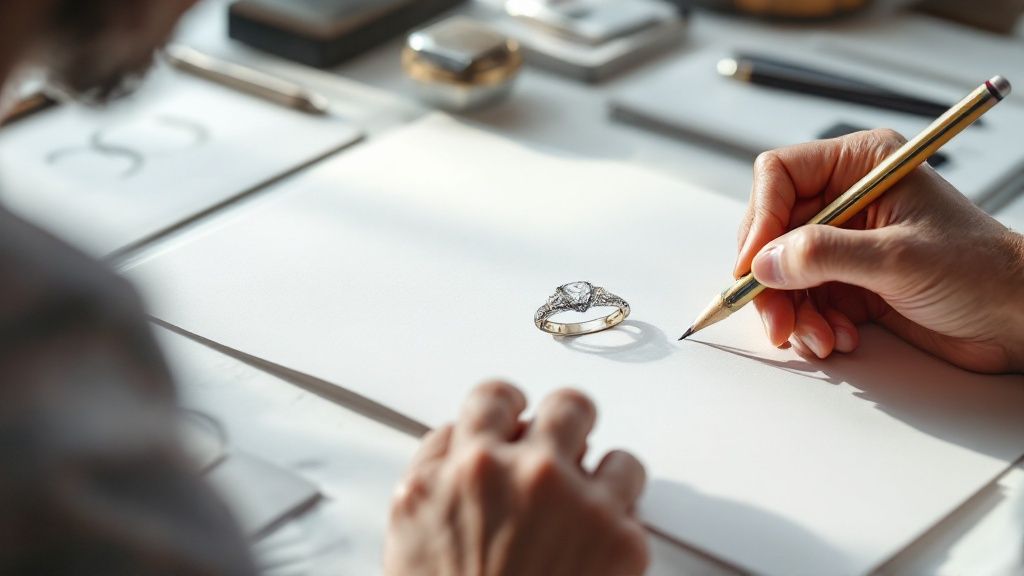
Once your design path becomes clearer, the jewelry design process truly flourishes with compelling inspiration. Great concepts don't happen by chance; they are nurtured through consistent, deliberate practice. This means actively searching for ideas that will connect with your audience and can be shaped into desirable pieces of jewelry.
Sourcing Diverse Inspiration for a Unique Aesthetic
Potent inspiration often comes from unexpected places, far removed from common jewelry motifs. You might consider exploring:
Nature's detailed patterns, such as the veins in a leaf or the facets of a crystal.
Architectural forms, ranging from the grandeur of historic buildings to the clean lines of modern design.
Various artistic expressions, including paintings, sculpture, or even music.
The narratives held within found objects; some designers excel by reimagining old jewelry, embracing an open-ended design process where the history of the materials sparks new forms.
Actively seeking out varied sources of stimulation is crucial for developing a personal aesthetic – a signature style that makes your work stand out.
Translating Concepts with Mood Boards
A mood board is an extremely helpful tool for bridging the gap between abstract thoughts and concrete design. It acts as a strategic visual collection, bringing together images, textures, color palettes, and relevant keywords. For instance, a theme like "celestial" could feature deep blues, star charts, and metallic fabric swatches. This carefully assembled guide clarifies your theme and its emotional core, helping to keep your vision focused throughout the jewelry design process.
Sketching for Clarity and Communication
Sketching is the step where refined concepts begin to take visual shape, which is essential for exploring forms, proportions, and how different components will interact. This method offers a quick, low-cost way to experiment with designs and identify potential challenges early on. Effective sketches are also vital for communication, clearly conveying your design intent to clients or team members, ensuring everyone is aligned before investing significant resources in the jewelry design process.
Curating and Refining Your Best Ideas
Not every spark of an idea will evolve into a feasible design. It's important to evaluate concepts for their alignment with your brand, appeal to your target audience, and technical practicality. To foster your strongest ideas, maintain an inspiration library – a personal collection of images, notes, and material samples. Regularly reviewing and organizing this resource can trigger new connections, ensuring your jewelry design process is always fueled by concepts with high potential, rather than just fleeting moments of insight.
Mastering Digital Tools Without Losing Your Creative Soul
The most effective jewelry design process today frequently involves a thoughtful combination of established craftsmanship and current technology. Rather than seeing these as conflicting approaches, accomplished designers thoughtfully incorporate digital instruments to augment, not substitute, their creative insight and traditional abilities. This careful incorporation allows for improved exactness and efficiency without losing the distinct artistic quality that characterizes their creations.
For instance, Computer-Aided Design (CAD) software, such as the widely used Rhino3D in the jewelry sector, allows for the creation of highly detailed and intricate shapes that can be difficult to produce by hand alone. These digital designs can then be materialized through 3D printing, yielding precise prototypes for evaluating fit and form before committing to costly materials. This method complements traditional hand-drawing, which remains essential for initial idea generation and capturing the natural development of concepts, preparing the way for selecting appropriate tools.
To better understand how these approaches fit into the jewelry design process, the following table compares traditional jewelry design techniques with modern digital tools.
Traditional vs Digital Design Methods Comparison
A detailed comparison of traditional jewelry design techniques versus modern digital tools, showing advantages, limitations, and best use cases for each approach.
Method | Advantages | Limitations | Best Use Cases | Skill Level Required |
|---|---|---|---|---|
Traditional Handcrafting (e.g., Sketching, Wax Carving, Metalsmithing) | Unique artistic expression, direct interaction with materials, established and respected techniques, tactile feedback. | Can be time-intensive for complex designs, exact replication is challenging, material costs for trial and error. | One-of-a-kind artistic pieces, initial concept development, bespoke items emphasizing a handcrafted aesthetic. | High manual dexterity, deep knowledge of materials, mastery of traditional techniques. |
Digital Design (e.g., CAD Software, 3D Printing) | High precision and accuracy, creation of complex geometries, easy modification and iteration, efficient prototyping, photorealistic renderings for clients. | Can feel less "hands-on," risk of generic results without strong artistic input, software learning curve, initial investment in software/hardware. | Intricate patterns, symmetrical designs, master models for casting, producing design variations, client visualization before production. | Proficiency in specific software, understanding of 3D modeling, digital visualization abilities. |
This comparison illustrates that both traditional and digital methods possess distinct strengths. Often, the most successful outcomes arise from a synergistic use of both.
Choosing the Right Digital Companions
When deciding which digital instruments to bring into your jewelry design process, it's important to pick software that matches your particular design aesthetic and financial plan. Some programs are excellent for organic sculpting, perfect for pieces inspired by nature, while others are more adapted for exact, geometric forms. Many designers discover that beginning with more readily available or even free versions helps them assess capabilities before committing to professional-level software, making the visualization of these digital outputs even more important.
Visualizing the results from these digital instruments can be very effective. The image below displays a 3D CAD model of an elegant necklace pendant being adjusted on a computer screen, showing how designers digitally shape fine details.

This image highlights the precision and visual polishing achievable with current digital tools, enabling designers to refine complex shapes and show realistic renderings to clients early in the jewelry design process. Such visualizations are extremely useful for communication and adjustments, particularly as the market changes.
Indeed, the capacity to create attractive digital presentations is becoming progressively more vital. Jewelry design development has been significantly affected by shifting consumer preferences and the adoption of technology, especially in key markets. Online jewelry sales, for example, are expected to climb from $75.3 billion in 2023 to nearly $104 billion by 2030. This notable move towards e-commerce means designers need to prepare their work for digital display and direct-to-consumer channels, particularly since more than 60% of global jewelry buyers now acquire some items online. Discover more insights about jewelry consumer trends. While adjusting to these digital requirements, the artist's individual mark continues to be essential.
Preserving Your Artistic Signature in a Digital Workflow
With the growing use of technology, a primary task is to retain your distinct creative identity. It is crucial to recall that digital instruments are merely aids. They should support your vision, not control it; this involves actively incorporating your personal style and artistic feelings into each phase, from the first digital drawing to the final presentation, maintaining a careful equilibrium.
While digital aids can quicken the jewelry design process and permit intricate modifications, they might sometimes result in overly polished or unoriginal products if not directed by a firm artistic hand. Prosperous designers often establish a flow, perhaps beginning with hand sketches to seize initial creativity, then transitioning to CAD for exactness, and finally returning to manual bench work for finishing elements that give the piece its character. This equilibrium ensures technology supports, rather than obstructs, the creative endeavor, helping designers truly command the tools at their disposal.
Sourcing Materials That Align With Your Values And Budget
Beyond the skills to craft jewelry, the materials you select truly give each piece its character. This choice is a vital part of the jewelry design process, influencing the final look, the story it tells, and how customers receive it.
Careful thought about metals, gemstones, and even unique alternative materials can transform a design from merely attractive to genuinely resonant. It's about matching materials to your artistic vision and intended audience.
Understanding Material Properties And Their Impact
The inherent qualities of your chosen materials directly influence what you can create. For example, gold's malleability makes it suitable for detailed work, while the strength of platinum is perfect for holding precious stones securely.
Designers need to think about how a material's color, weight, toughness, and perceived value will work with their artistic goals and the jewelry's everyday use.
Exploring a range of materials, from classic silver and gold to newer choices like titanium or eco-friendly composites, broadens your design horizons. Each material behaves differently and adds its own unique touch.
A solid grasp of how these materials react during making is key to a smooth jewelry design process. This knowledge helps avoid expensive mistakes and makes sure your designs can be brought to life effectively.
Ethical And Sustainable Sourcing In Modern Jewelry Design
Material selection now extends beyond physical traits, as ethical sourcing heavily influences many customers. The origin of materials can be as critical as their appearance. With sustainability a top concern—nearly 40% of global buyers prefer ethically-sourced, sustainable jewelry—designers are increasingly using recycled metals and lab-grown gemstones. The rise of lab-grown diamonds, sometimes outpacing natural diamond demand, also reshapes sourcing and marketing. Explore this topic further for more detailed statistics to see these market shifts.
This changing landscape encourages designers to consider choices such as:
Recycled Metals: Using recycled gold and silver helps lessen the environmental effects of mining fresh materials.
Ethically Sourced Gemstones: Partnering with suppliers who can verify gemstone origins and confirm fair working conditions.
Lab-Grown Gemstones: Providing an option that typically has a reduced environmental impact and can be more cost-effective.
Repurposed Materials: Some designers embrace an open-ended design process, giving new life to old or donated jewelry. This approach celebrates both creativity and sustainability.
Embracing these methods meets ethical expectations and also attracts a growing number of consumers who look for openness and responsible practices in the products they buy.
Navigating Suppliers And Budget Constraints
Securing the ideal materials involves managing the logistics of sourcing and staying within budget. Developing strong connections with reliable suppliers is essential for consistently acquiring quality materials at reasonable prices. Such partnerships can also open doors to special materials and important industry insights, greatly aiding your jewelry design process.
Balancing material quality and cost is a continuous task. For high-end custom pieces, sourcing rare gemstones might be prioritized over budget to achieve uniqueness. For broader market collections, designers often select materials providing visual appeal and durability at an accessible price.
This means understanding trade-offs between gemstone grades or metal types. Selecting the right gemstones can be complex; our guide on the Top 10 Best Gemstones for Jewelry in 2025 offers more insights. Ultimately, thoughtful material selection is vital. It ensures final pieces are beautiful, well-made, and align with your brand's values and financial goals.
Prototyping That Saves Time And Prevents Costly Mistakes

Planning Your Prototyping Strategy
A solid prototyping effort starts with a well-defined plan, customized for the unique needs of every design. How complex the piece is and the project timeline will guide how much prototyping is needed. For instance, a basic earring stud will likely involve fewer prototype versions compared to a complex necklace featuring articulated components. Experienced designers carefully outline their prototyping phases, making sure each version helps to fine-tune the design and spot mistakes early, which ultimately saves time and money.
This forward-thinking method allows designers to identify and correct any issues related to comfort, function, or appearance before using valuable materials like precious metals or gemstones. The aim here is not to achieve perfection immediately, but to refine the design through careful development.
From Low-Fidelity Sketches to Functional Samples
The path of prototyping usually includes several steps, with each one providing unique perspectives. It often begins with straightforward, low-fidelity prototypes:
Paper or card models: These are great for rapidly checking size, balance, and how a piece might rest or hang when worn.
Clay or modeling wax: These materials enable a more tangible, three-dimensional study of shape and mass with minimal expense.
Once the initial design takes shape, more refined prototypes are required. Techniques like CAD modeling (Computer-Aided Design) and 3D printing using substances such as resin enable the creation of very precise physical models. These models are useful for examining fine details and can also function as primary patterns for casting. In time, working samples, possibly made from a cheaper base metal or even the final selected materials, are produced. These advanced prototypes are crucial for a complete assessment within the jewelry design process prior to starting full production.
Gathering Feedback and Iterating Effectively
Prototypes serve as excellent instruments for communication, making it easier to get clear input from customers, colleagues, or for your own assessment. Having a physical model in hand can highlight subtle details that might be missed in 2D drawings or computer-generated images. Every comment received is a chance to improve the design.
Therefore, documenting changes with care during these repeating cycles is crucial. Such a record helps monitor the piece's development and also acts as a useful reference for upcoming projects. Refining the design step-by-step, with the help of physical prototypes, is much more effective than finding a major design problem after investing heavily in final materials and work. This focus on specifics can also relate to how a piece embodies a brand's foundational values. For instance, you might find it interesting to explore Top Ethical Jewelry Brands for 2025: Sustainable & Stylish to see brands where these principles are central.
Testing for Success: Wearability, Durability, and Aesthetic Appeal
An essential role of prototyping is to check the practical elements of the jewelry. How comfortable is it? Is the fastening mechanism user-friendly? Can it endure regular wear? Physical prototypes are the best way to find answers to these questions.
Wearability tests can show if an earring is excessively heavy, a ring has an uncomfortably sharp edge, or if a pendant doesn’t hang correctly.
Durability tests, even when conducted with less expensive materials, can mimic points of stress and uncover potential weak spots in the structure.
Aesthetic appeal can also be assessed more precisely when a physical piece can be viewed from every angle and under various lighting.
Finding out that a clasp is likely to break with a $5 resin model is far better than learning this after making 100 units in silver. This focus on testing forms an essential part of a solid jewelry design process.
In the end, designers find a balance between thorough prototyping and the knowledge gained from their experience. For jewelry that builds on existing designs or uses familiar methods, an experienced jeweler might simplify the prototyping steps. Nevertheless, when dealing with new ideas, complex working parts, or custom pieces of high value, extensive prototyping is a vital approach to make sure the finished item is attractive, works well, lasts long, and is ready for the market.
Planning Production That Actually Works In The Real World
Once a prototype has been thoroughly tested and approved, the jewelry design process moves into a pivotal stage: figuring out how to make your pieces effectively and profitably. Even the most stunning design isn't practical if it can't be manufactured in a way that supports your business. Smart designers often consider these manufacturing details early on, sometimes even during the initial sketching phase, to make sure their ideas can actually be brought to life.
This early thinking is vital because the choices made during design directly influence how an item is produced, the time it takes, and its final cost. Considering production from the start helps ensure your design is not just beautiful, but also manufacturable and marketable.
Evaluating Production Feasibility Early On
Incorporating a production feasibility check early in the jewelry design process is a sign of a well-considered approach. This means asking some down-to-earth questions: Can this complex detail be made consistently? Will the chosen clasp hold up to daily use and still be easy to make? Does the intricacy truly add value for the customer, or does it just drive up production costs and extend timelines for no real gain?
For instance, a highly delicate filigree pattern might be fine for a one-off artisan piece. However, it could create significant delays if you're aiming for a larger collection. Weighing the technical complexity of your design against your production capacity and target costs can prevent expensive redesigns down the line. The aim is to add complexity that boosts the piece's appeal and worth, not to create avoidable manufacturing challenges.
Adapting Designs for Different Production Scales
A design that’s perfect for a single custom order might need some tweaks when you're thinking about a larger production scale. Moving from bespoke items to small or even large collections often means adjusting the design to make it easier to manufacture. This could involve simplifying some features, selecting materials that are more readily available in larger quantities, or creating components that can be produced efficiently through methods like casting or stamping.
The trick is to make these changes without losing the core appeal of the original design. To help with this, it's useful to consider how different production volumes affect planning.
Production Scale Planning Matrix
The following table offers a comprehensive look at how production considerations, timeframes, cost factors, and design needs shift based on the volume of jewelry being produced. This matrix can be a helpful guide in the jewelry design process as you plan for different levels of output.
Production Scale | Design Complexity | Timeline | Cost Per Unit | Quality Control Requirements |
|---|---|---|---|---|
One-of-a-Kind/Bespoke | Very High, intricate details accepted | Weeks to Months | High | Artisanal precision, adherence to client specs, unique material sourcing |
Small Batch (10-50 units) | Moderate to High, some simplification | Days to Weeks | Medium to High | Consistency across the batch, material quality, finishing touches |
Medium Scale (50-500 units) | Moderate, designed for replication | Weeks | Medium | Standardized parts, efficient assembly, batch testing procedures |
Large Scale (500+ units) | Simplified for mass production | Months | Low to Medium | Strict process controls, minimizing defect rates, consistent tooling |
As the matrix highlights, increasing production volume generally means moving from a focus on unique, detailed work towards greater efficiency, standardization, and consistency in both design and quality checks.
Costing, Pricing, and Market Positioning
After determining feasibility and scale, getting an accurate handle on production costs is essential. These costs encompass materials, labor, overhead, and any specialized equipment. With these figures clear, you can establish pricing structures that not only cover your expenses but also reflect the jewelry's perceived value and secure healthy profit margins. It's also important to keep an eye on wider market trends. For example, the gems and jewelry market, which is closely linked to jewelry design processes, is expected to grow from $431.57 million in 2024 to $608.38 million by 2030, showing a compound annual growth rate (CAGR) of 5.95%. A significant part of this growth comes from the expanding middle class in developing nations such as India, China, and Brazil, where greater purchasing ability and changing fashion tastes are increasing demand. You can find more detailed statistics here about the global gems and jewelry market.
This market growth can influence how you decide to place your work within various market segments. Your production methods, material choices, and pricing need to resonate with your intended audience to connect with the right customers. Consequently, thorough production planning is a direct contributor to your brand's standing and overall success in the active jewelry industry.
Key Takeaways
Effectively managing your jewelry design process is a way to turn your artistic passion into a lasting business. The following points provide a clear guide to help you improve how you work, keep your creative spirit alive, and make jewelry that truly appeals to customers. These steps are useful whether you're making your very first item or looking to improve an existing line of products.
Honing Your Unique Design Voice
A crucial part of a memorable jewelry design process is developing your own unique artistic style. It starts with regularly finding inspiration and turning those ideas into a consistent look and feel that customers will associate with your brand.
Actionable Strategy: Make it a habit to create and maintain an inspiration library. This can include anything from architectural forms and patterns in nature to elements from historical art.
Realistic Milestone: For every new collection or important custom order, put together a detailed mood board. This should outline the theme, choice of colors, and the overall feeling you want to convey.
Progress Indicator: You'll know you're on the right track when your collection of work starts to display a distinct style that differentiates you, showing a steady artistic direction.
Balancing Artistry with Technology
When you bring digital tools into your work, the idea is to use them to support your creative instincts, not to let them take over. The aim is to achieve accuracy and better workflow while keeping the unique character of your designs intact.
Actionable Strategy: Pinpoint areas in your jewelry design process where tools like CAD software or 3D printing can provide real benefits. This could be for intricate symmetrical designs or precise models needed for casting.
Checklist Item: Look at different software options, considering your design approach and financial plan. If available, try out free versions first to see if they fit your needs.
Maintaining Momentum: Set aside short periods to try out new digital methods or software functions on projects that aren't urgent. This helps build your skills and comfort with these tools.
Sourcing Materials with Integrity and Foresight
The materials you select have a big effect on the look, ethical standing, and cost of your jewelry. Careful consideration in this area is key to a responsible and enduring jewelry design process.
Actionable Strategy: Make an effort to find and establish connections with dependable suppliers whose ethical practices match yours, especially for materials like recycled metals or gemstones with clear origins. Think about adopting an open-ended design process, where you give new life to existing materials to create distinct, eco-friendly jewelry.
Realistic Milestone: Compile a list of your go-to suppliers, noting details about their material quality, costs, and commitment to ethical sourcing.
Progress Indicator: A good sign of progress is being able to clearly communicate your material selections and sourcing methods to customers, which helps build their trust in your brand.
Refining Designs Through Iterative Prototyping
Creating prototypes is an excellent way to avoid expensive errors and to perfect the comfort and attractiveness of your pieces. This step provides essential feedback within the jewelry design process.
Actionable Strategy: Use a prototyping method with several stages. This could range from basic paper models to 3D printed versions or samples made from less expensive metals, based on how intricate the design is.
Checklist Item: With every prototype, have a clear set of questions you want to answer. For instance, "Is the clasp user-friendly?" or "Does the piece feel comfortable when worn?"
Maintaining Momentum: Treat each version of your prototype as progress. Each one gives you information to make the final jewelry better, rather than seeing it as a setback.
Navigating Production and Market Realities
An attractive design truly succeeds when it can be made in a cost-effective and timely manner. Careful planning of production is vital for both new and experienced jewelry designers.
Actionable Strategy: Assess production feasibility at an early stage of designing. Think about how the complexity of a design will influence the time and money needed for manufacturing, based on how many pieces you plan to make.
Realistic Milestone: Work out a precise cost for each item you design. This calculation should include the expense of materials, work involved, and other general business costs.
Progress Indicator: You'll see progress when your pricing approach helps you meet your business objectives, and your production system can smoothly handle increased orders, strengthening your overall jewelry design process.
These key points offer a structure for improving your jewelry design process. By concentrating on these important aspects, you can develop a jewelry practice that is more efficient, creative, and successful.
Explore our exquisite collections and find your next signature piece at the Panther De Luxe Shop.
Comments