
Cost of gold necklace: A Practical Pricing Guide (cost of gold necklace)
- Luke Zucco
- Dec 19, 2025
- 14 min read

You can find a simple, lightweight 14K gold chain for under $200, while a heavy, high-karat piece from a luxury designer can easily climb past $20,000. So, what's behind that massive price gap? It all comes down to a blend of the gold's raw value, the artist's touch, the power of a brand name, and any sparkling extras.
Unpacking the Price Tag on Your Gold Necklace
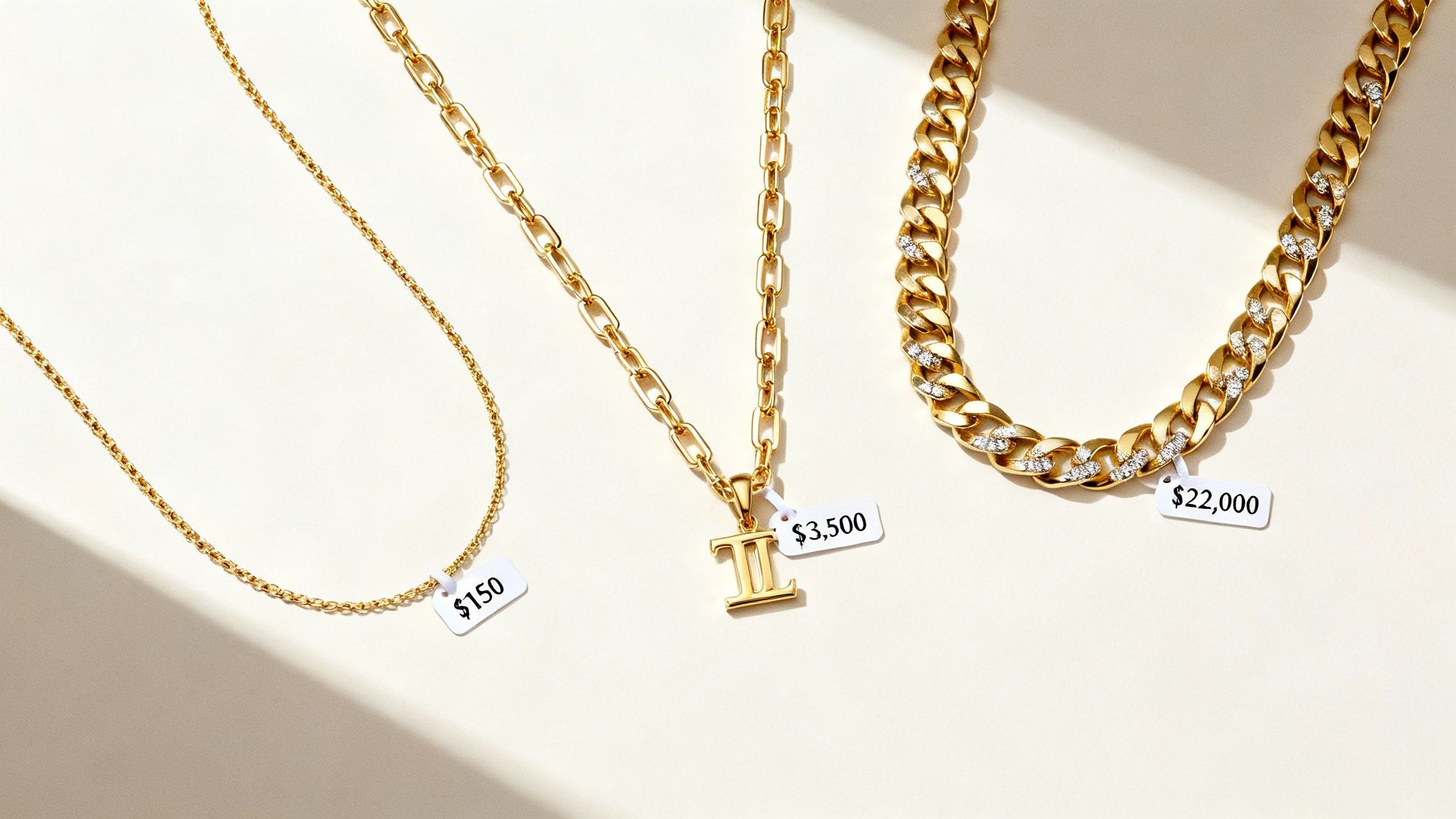
Trying to figure out why one gold necklace costs what it does can feel like solving a puzzle. Why can two chains that look almost identical have wildly different prices? The short answer is that you’re not just buying a piece of metal—you’re investing in a story told through material, artistry, and reputation.
Think of it like buying a car. The base model gets its price from the steel and the engine. But the final sticker price reflects the sleek design, precision engineering, luxury features, and that iconic badge on the hood. A gold necklace is no different. Its price journey starts with the raw value of the gold and builds from there.
The Core Ingredients of Cost
The final price you see on the tag is really a mix of four key ingredients. Once you understand them, you can see exactly where your money is going.
The Gold Itself: This is your starting point—the raw value of the gold, determined by its weight and purity (karat). It’s tied directly to the daily fluctuations of the global gold market.
Artistry and Design: This is where the magic happens. The skill, time, and intricate work poured into crafting the necklace add serious value, separating a mass-produced chain from a handcrafted masterpiece.
The Brand Name: A piece from a famous jewelry house carries a premium. You're paying for their design legacy, a guarantee of quality, and the status that comes with the name.
Gemstones and Details: Adding diamonds, pearls, or other precious stones introduces a whole new layer of cost based on their quality, size, and the complexity of their settings.
One of the biggest myths is that gold purity alone sets the price. The truth is, a beautifully designed 14K necklace from a luxury brand can easily cost more than a simple, machine-made 18K chain. That's the power of craftsmanship and brand identity.
At its heart, any price is built on the metal itself. The cost is fundamentally tied to the global gold spot price, which is quoted per troy ounce. Since most necklaces are either 14K (which is 58.5% pure gold) or 18K (75% gold), the base cost is a simple calculation of spot price, purity, and weight.
To put it in perspective, a 10-gram 18K necklace could have over $1,000 worth of gold in it before anything else is even considered. From there, manufacturing, design, and retail markups can add anywhere from 20% to 200% on top.
If you're interested in getting the most for your money, applying strategies from other areas, like finding affordable tools on a budget, can offer a fresh perspective on making smart purchases. This guide will walk you through all these layers, turning you into a more confident and informed buyer.
Deconstructing the Price of Gold Itself
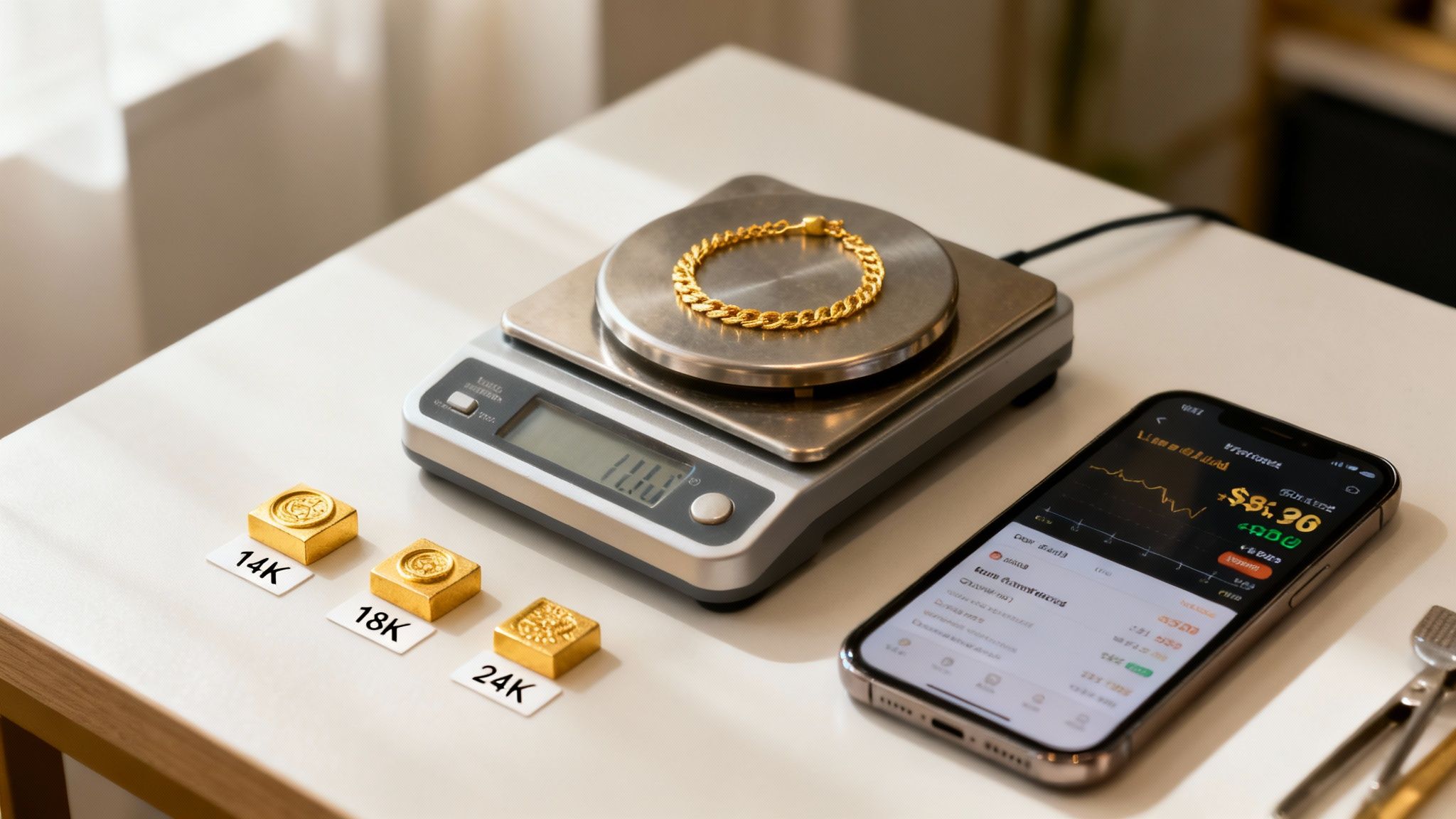
Before a single link is forged or a clasp is attached, every gold necklace starts with its raw material value. Think of it as the base cost of the ingredients in a recipe—it’s the foundation of the price long before any artistry, branding, or markup comes into play.
Getting a handle on these core components is the key to understanding what a gold necklace is truly worth. The three pillars of this value are purity (karat), weight, and the daily market price of gold. Let’s break them down.
The Karat System Explained
The term "karat" might sound technical, but it’s just a simple measure of gold purity.
Imagine 24K gold as 100% pure gold—it’s the metal in its most authentic form. The color is intensely rich and vibrant, but it's also incredibly soft and easily scratched. Because it’s too delicate for most jewelry, it’s usually mixed with other metals like copper, silver, or zinc to create a stronger, more durable alloy.
This is where the other karat values come in.
18K Gold: This alloy is 75% pure gold (18 out of 24 parts) mixed with 25% other metals. It offers a beautiful, rich color with much better durability for everyday wear.
14K Gold: A hugely popular choice, 14K gold is 58.5% pure gold. It hits that sweet spot between a gorgeous golden hue and the strength needed to handle daily life without worry.
Lower karats, like 10K, offer even more durability at a more accessible price. For a deeper dive, check out our complete comparison guide on 10K vs 14K gold. The higher the karat, the more pure gold it contains, and the higher its base cost will be.
Why Weight Is a Primary Cost Driver
This one is simple: the more gold a necklace has, the more it’s going to cost. A thick, heavy Cuban link chain has a lot more raw material in it than a delicate, whisper-thin cable chain of the exact same karat.
Jewelers measure gold in grams, so the weight is a direct multiplier in the price equation. When you're comparing two necklaces, always pay attention to their weight. A piece that looks big but feels surprisingly light might be hollow, which means less gold, a lower intrinsic value, and often, less durability.
The weight and karat together tell you the "fine gold content" of a necklace. For example, a 20-gram 14K (58.5% gold) necklace contains 11.7 grams of pure gold. A 15-gram 18K (75% gold) necklace has 11.25 grams. That pure gold amount is what really matters for its base value.
The Role of the Gold Spot Price
The final piece of the puzzle is the spot price of gold. Think of it like the stock market for precious metals. It's the live market price for one troy ounce of pure, 24K gold, and it shifts constantly based on global economics, investor demand, and currency fluctuations.
Jewelers use this spot price as the starting point for calculating the raw material cost of their pieces. When the global spot price goes up, the cost to make a gold necklace goes up, and that increase is passed on to the buyer. It's why the exact same necklace can have a different price tag from one month to the next.
These three factors—karat, weight, and the spot price—come together to form the baseline value of your necklace. This is the cost of the metal itself, before any labor, design, or retail markup is added. Once you master these concepts, you have the power to truly understand the worth of any piece you’re considering.
How Craftsmanship and Branding Add to the Cost
Once you know the value of the gold itself, the real artistry begins. The journey from a simple lump of metal to a treasured necklace involves layers of skill, creativity, and reputation—and these are the factors that really drive up the price.
It’s why two necklaces with the exact same gold weight and purity can have wildly different price tags. The difference is all in how the piece was made, who designed it, and the story it tells. Let's break down these crucial elements that build value far beyond the metal.
The Value of the Artisan's Hand
Imagine two gold chains. One is cranked out by a machine in minutes, perfectly uniform and identical to thousands of others. The other is meticulously handcrafted by a master jeweler over several days, with each link shaped, soldered, and polished by hand. Their gold content might be the same, but their costs will be worlds apart.
This price gap comes down to craftsmanship, which includes:
Time and Skill: A handcrafted piece represents hours, or even days, of a skilled artisan's labor. You're paying for expertise that took years to develop.
Design Complexity: An intricate design with unique links or detailed patterns requires a much higher level of artistry and precision than a simple, mass-produced chain.
Durability and Finish: Hand-finishing often results in a more durable and beautifully polished product. That extra attention to detail, like making sure every link is perfectly soldered, adds longevity and value.
A machine-made necklace is a commodity; a handcrafted one is a piece of art. The premium you pay for craftsmanship is an investment in the human skill that brought it to life. This is especially true for hollow gold chains, where the quality of construction is everything. You can learn more in our buyer's guide on what hollow gold is.
A simple, machine-made 14K gold rope chain might have a retail markup of 50-100% over its gold value. But an intricate, handmade 14K gold Byzantine chain from a skilled artisan could easily command a markup of 200-300% or more, just for the labor and complexity involved.
The Power of the Brand Name
So, why does a necklace from a legendary luxury house cost exponentially more than a similar-looking piece from an unknown jeweler? The short answer: brand equity. When you buy from a renowned brand like Tiffany & Co. or Cartier, you aren't just buying jewelry; you're buying into a legacy.
This brand premium is built on a few key pillars:
Reputation for Quality: Big-name brands have a long history of using top-tier materials and exceptional craftsmanship. That reputation acts as a guarantee of excellence.
Design Legacy: Luxury brands are known for their iconic, often copyrighted designs. You're paying for a piece of that unique design history.
Perceived Value and Status: Let's be honest—owning a piece from a famous brand carries a certain prestige. This perceived value is a powerful driver of price, connecting the owner to a story of luxury and exclusivity.
Think of it this way: a plain white t-shirt and a designer t-shirt might be made from similar cotton, but the designer's logo can multiply its price tenfold. The same principle applies here, where the brand's story is an intangible yet highly valuable asset.
How Gemstones Elevate the Cost
Adding gemstones like diamonds, emeralds, or sapphires introduces another huge variable to the cost. The final price of a gem-studded necklace isn't just the gold value plus the stone value; it’s a much more complex equation.
The cost impact of gemstones boils down to:
The 4 Cs (for Diamonds): Carat (weight), Cut (sparkle), Color (whiteness), and Clarity (lack of flaws) are the universal standards for a diamond's value.
Gemstone Quality: For other stones, factors like color saturation, rarity, and origin are critical. A vibrant Burmese ruby will always cost far more than a more common Thai ruby of the same size.
Setting Complexity: The labor needed to set the stones securely and beautifully is a major cost. A simple bezel setting is far less expensive to produce than an intricate pavé setting, which involves setting dozens of tiny stones by hand.
Ultimately, craftsmanship, branding, and gemstones are what transform gold from a raw commodity into a true luxury good. Understanding these factors helps you see why prices vary so dramatically and lets you make a smarter choice based on what you value most—whether it's pure material, artistic skill, or the prestige of a celebrated name.
How to Calculate the Real Gold Value of Any Necklace
Knowing what goes into a necklace's price is one thing, but being able to calculate its raw gold value yourself? That’s a powerful skill. It puts you in control, letting you instantly gauge the baseline worth of any piece before a single dollar of markup is even added.
Think of it as knowing the cost of the flour before you buy the artisan bread. It's the starting point from which every other cost—labor, design, branding, and profit—is layered on top. With a simple formula, you can look past the price tag and become a much savvier buyer.
The Simple Formula for Intrinsic Gold Value
To figure out the raw metal value, often called its intrinsic value, you just need three key pieces of information. The jeweler can usually provide these, or you can find them online in seconds.
Here’s the core formula:
(Current Gold Price per Gram) x (Purity Percentage) x (Weight in Grams) = Intrinsic Gold Value
Let's walk through each part so you can see just how easy it is to apply in the real world.
A Practical Step-by-Step Example
Imagine you're eyeing a 14K gold necklace that weighs 10 grams. A quick search tells you the current spot price for pure gold is hovering around $75 per gram.
Here’s how you’d crunch the numbers:
Current Gold Price per Gram: $75 (This is your baseline for pure, 24K gold).
Purity Percentage: Because the necklace is 14K, its actual gold content is 58.5%. For the formula, you’ll use the decimal form: 0.585.
Weight in Grams: The necklace weighs 10 grams.
Now, let's plug it all in:
$75 (Price/Gram) x 0.585 (Purity) x 10 (Weight) = $438.75
So, the actual market value of the gold in that necklace is $438.75. This is your baseline—the fundamental cost of the raw material before anyone has touched it.
Why the Retail Price Is So Much Higher
If the gold itself is only worth $438.75, why is the necklace priced at $900? This is where retail markup comes into play, and it’s not just pure profit. For a more detailed breakdown, our guide on what gold chains really cost offers some great insights.
The markup covers every step that transforms a lump of metal into a beautiful piece of jewelry.
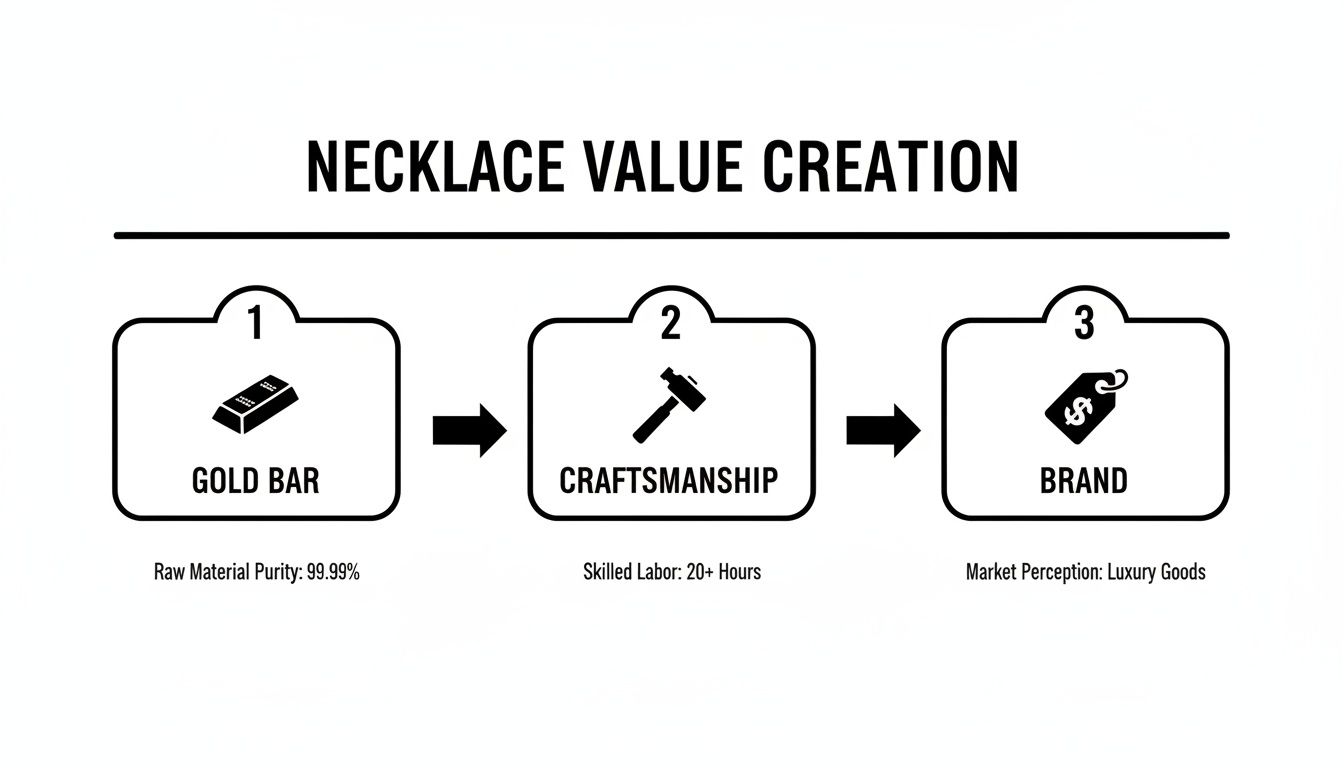
As you can see, the journey from a simple gold bar to a luxury necklace involves skilled craftsmanship and branding, both of which add significant value.
Here’s what that markup really pays for:
Craftsmanship & Labor: The skilled jewelers who designed, cast, polished, and perfected the piece.
Overhead Costs: Things like the store’s rent, employee salaries, marketing, and utilities.
Brand Value: The premium you pay for a trusted designer or a well-known jewelry house.
Profit Margin: The amount the business needs to make to stay afloat and create new designs.
To help you get a feel for this, here's a quick reference for gold purity and typical markups.
Gold Karat Purity Conversion and Markup Guide
Karat Value | Pure Gold Content (%) | Common Retail Markup Range (over gold value) |
|---|---|---|
24K | 99.9% | 1.2x - 1.8x (Usually for bullion, less for jewelry) |
22K | 91.7% | 1.5x - 2.5x |
18K | 75% | 1.8x - 3.0x |
14K | 58.5% | 2.0x - 4.0x |
10K | 41.7% | 2.5x - 5.0x |
Generally, a standard retail price is often 2 to 4 times the raw gold value. For high-end luxury brands, that multiplier can be much, much higher. Knowing how to find the base value gives you a powerful tool to decide if the final price truly reflects the artistry and quality you’re paying for.
Ever noticed how the exact same gold necklace can have a surprisingly different price tag depending on where you're shopping? A piece in a Parisian boutique might feel a lot heavier on your wallet than a similar one in New York, even after you’ve done the currency conversion. This isn't just a random retail quirk; it's the result of local taxes, duties, and even cultural tastes.
While the global spot price of gold gives everyone the same starting point, it's just one piece of the international pricing puzzle. The moment raw gold crosses a border to become jewelry, a whole host of regional factors kick in, shaping what you ultimately pay.
The Impact of Taxes and Import Duties
The biggest reason for those price gaps? Taxes. Think of them as mandatory markups added by governments, and they can dramatically inflate the cost of a gold necklace before it even hits the display case.
Value Added Tax (VAT) in Europe: Most European countries have a Value Added Tax (VAT), a consumption tax that can feel pretty steep on luxury goods. With rates often ranging from 19% to 27%, VAT adds a huge chunk to the final price tag.
Goods and Services Tax (GST) Elsewhere: Countries like Australia use a similar system called the Goods and Services Tax (GST). It’s a broad-based tax that adds a flat percentage to the cost, directly increasing what you pay at the counter.
Sales Tax in the United States: The U.S. has a much more fragmented system. Sales tax is set by state and local governments, which means prices can vary wildly from one city to the next. A necklace bought in Oregon (which has no statewide sales tax) will be cheaper off the shelf than the same piece in a city where the combined tax rate is close to 10%.
On top of all that, import duties add another layer of cost. These are tariffs a country charges on imported goods to protect its own industries. So, a necklace crafted in Italy and sold in the U.S. will have those duties baked into its price, making it more expensive than a piece made domestically.
Cultural Preferences and Karat Popularity
But it’s not just about taxes. It's also about what people want. Different cultures have deep-rooted preferences for gold purity, and that demand shapes local markets and pricing.
In Western markets like the United States and Europe, durability is a big deal. We want jewelry we can wear every day without worrying too much about it. This makes 14K and 18K gold the most popular choices, as they offer a great balance between the beauty of gold and the strength needed for an active lifestyle.
Now, contrast that with markets in India, Southeast Asia, and the Middle East. There, gold is often seen as a critical investment and a powerful symbol of wealth. Purity is everything. It's why 22K and even 24K gold are the standard for jewelry, creating a completely different pricing environment for these softer, purer pieces.
The global jewelry market is a fascinating reflection of local values. While a Western buyer might prioritize a brand and design in 14K gold, a buyer in another part of the world might focus almost exclusively on the weight and purity of 22K gold, seeing it as a tangible asset.
This is why you'll see such a range in retail prices. For example, a 7-gram 14K necklace has a raw metal value of around $569, but after markups and taxes, the final price can land anywhere from $900 to $1,500. As gold price analysts will tell you, those premiums cover craftsmanship, branding, and government fees, all of which vary wildly from one country to another. To get a better feel for these dynamics, you can explore the factors that have influenced U.S. gold prices over the past five years.
Answering Your Gold Necklace Cost Questions
Now that we've broken down what goes into the price of a gold necklace, let's get into the questions that come up right before you buy. Think of this as the final check-in to clear up any lingering doubts, whether you're browsing online or standing at the jeweler's counter.
Is Buying a Gold Necklace Online Cheaper Than in a Store?
It often is, but you’re trading savings for certainty. Online jewelers don’t have the overhead of a fancy storefront or a large sales team, so they can pass those savings on to you. It's also incredibly easy to compare dozens of options and prices in just a few minutes.
The catch? You can’t hold the piece. Judging the true weight, the richness of the gold’s color, and the feel of the craftsmanship is tough to do through a screen. You also run a higher risk of ending up with a less-than-reputable seller if you haven't done your homework.
Buying from a brick-and-mortar store gives you that hands-on experience. You can inspect the necklace, verify the hallmarks, and build a relationship with a jeweler you trust. Yes, you might pay a bit of a premium, but you're paying for assurance, expert guidance, and service. A good strategy is to use online prices as a benchmark, then visit a few reputable local jewelers to make a final, confident choice.
Why Can a 14K Necklace Cost More Than an 18K One?
This is a great question, and it gets to the heart of what you’re really paying for. While 18K gold (75% pure) is purer and more valuable than 14K gold (58.5% pure), the final price tag is about the whole package, not just the raw material.
So, what’s going on? The 14K piece might be much heavier, meaning it physically contains more gold, even at a lower purity. More often than not, though, the price difference comes down to craftsmanship, a complex design, or the power of a brand name.
An intricate, handmade 14K necklace from a world-renowned designer will almost always command a higher price than a simple, mass-produced 18K chain. In these cases, you're investing in artistry and brand prestige, which can easily outweigh the difference in gold value.
How Does a Hollow Chain Affect the Cost and Durability?
Hollow gold chains are designed to give you a bold, chunky look without the hefty price tag of a solid piece. Because they use a lot less gold, they're lighter and far more affordable. If you love a substantial style but are working with a tighter budget, they can seem like a great option.
The major trade-off, however, is durability. Hollow chains are much more likely to dent, kink, and break under pressure. Once damaged, they are notoriously difficult—sometimes impossible—to repair without leaving a visible mark. They have the look but aren't built for the wear and tear of everyday life.
A solid gold chain is a bigger investment upfront because of its weight, but it’s built to last a lifetime. It can handle daily wear, holds its value far better, and is a true heirloom piece.
Does Gold Color Change the Price?
Generally, no. For two necklaces of the same weight, karat, and design, the color—whether it’s yellow, white, or rose—shouldn’t have a meaningful impact on the price.
Yellow gold is the metal's natural hue when alloyed. White gold is mixed with white metals like palladium and typically plated with rhodium for extra brightness, while rose gold gets its warm blush from a bit of added copper.
While palladium is more expensive than copper, most jewelers absorb these small differences and price the colors identically. It simplifies things and lets you choose based on your personal style, not the price tag. If you do see a price gap between colors for a similar necklace, it’s likely due to a specific design element or a retailer’s own pricing strategy, not the gold itself.
At Panther De Luxe Shop, we believe that understanding your jewelry is the first step to loving it. Explore our curated collections of masterfully crafted gold necklaces, designed for timeless style and lasting value. Find your perfect piece today at pantherdeluxe.com.
Comments